

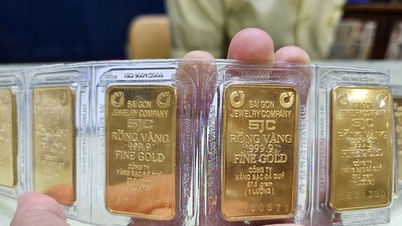
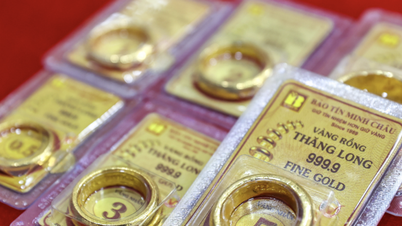
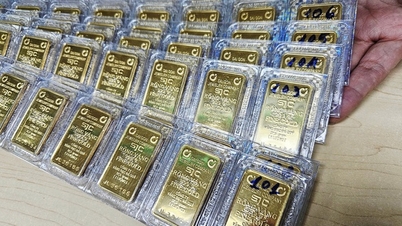
On December 22nd, the gold market set a new record as the price of SJC gold bars reached 157.5 million VND/ounce for selling and 155.5 million VND/ounce for buying, an increase of nearly 1 million VND compared to the previous session. 99.99% pure gold rings also remained at their historical peak of 154.1 million VND/ounce for selling.
Adding influencing factors
This phenomenal surge was fueled by a continuous increase in world gold prices of over $80 to $4,420 per ounce, before cooling down to $4,410 per ounce at 7 PM on December 22nd (Vietnam time). Since the beginning of the year, world gold prices have increased by 68%, while SJC gold bars have risen by as much as 85%, making domestic prices 15-17 million VND/ounce higher than world prices. The continuous breaking of previous highs to establish new price levels in such a short period has surprised both experts and investors.

Buying and selling gold at Mi Hong gold shop (Ho Chi Minh City). Photo: HOANG TRIEU
Speaking to a reporter from Nguoi Lao Dong newspaper, Mr. Huynh Trung Khanh - Vice Chairman of the Vietnam Gold Business Association (VGTA), and senior advisor to the World Gold Council in Singapore and Vietnam - said he was quite surprised that world gold prices continued to reach new highs.
According to Mr. Khanh, factors often considered the main drivers of gold's rise, such as geopolitical tensions, the interest rate policy of the US Federal Reserve (FED), or the buying demand from investment funds and central banks, have been partially reflected in the price level recently. However, the market still witnessed a strong surge exceeding expectations.
"Some forecasts from major international financial institutions such as Goldman Sachs and JP Morgan suggest that the price of gold could reach $4,900-$5,000 per ounce next year. These forecasts have triggered bullish speculation, causing investors to increase their purchases in the expectation that prices will continue to rise. However, on the other hand, the risk of a 'bubble' also needs to be considered, given that the price of gold has increased very sharply in a short period," Mr. Huynh Trung Khanh commented.
Sharing the same view, financial expert Phan Dung Khanh analyzed that in the past two years, the sharp increase in gold prices is mainly due to a series of global uncertainties. In addition, the net gold buying trend of many central banks has also provided important support for prices.
According to data from the World Gold Council (WGC), central banks have recently been buying significantly more gold than in previous periods, indicating that gold continues to be seen as a strategic asset amidst global economic and financial volatility.
Notably, a new factor has emerged impacting the gold market in recent months: the demand for gold from organizations operating in the cryptocurrency and digital asset sectors. "Previously, these businesses focused almost exclusively on blockchain, cryptocurrencies, and technology platforms, with little involvement in gold. However, recently, they have unexpectedly become very large-scale gold buyers. Without comparing them to central banks, this could be considered the strongest group of private investors buying gold currently," Mr. Khanh analyzed.
Things that need to be done immediately.
Given current developments, many forecasts suggest that gold prices may continue to rise, although the rate of increase may slow down in 2026. This directly impacts the domestic gold market, especially the price of SJC gold bars and gold rings.
According to experts, a key factor that could help cool down domestic gold prices is the addition of imported gold, thereby narrowing the gap with world prices. However, to date, no commercial bank or gold business has been licensed to import gold, even though the licensing deadline under Decree 232/2025, December 15th, has passed.
Mr. Huynh Trung Khanh believes that a commercial bank's involvement in importing gold to produce gold bars and build its own brand cannot be accomplished in a short period of time. Banks need to invest systematically in infrastructure, factories, human resources, and management systems, a process that requires time.
"The government is pushing the State Bank to build a gold exchange, and the regulatory agency is implementing it quite urgently. If the gold exchange can operate in the first quarter of 2026, the market will be supplemented with supply from imports and the mobilization of gold from the public. At that time, the difference between domestic and international gold prices could narrow significantly compared to the current level of 15-20 million VND/ounce. The extent of this narrowing will depend on import quotas and the exchange rate management policy of the State Bank," Mr. Khanh said.
Experts also believe that with the establishment of a gold exchange and official gold imports, the increased supply will significantly impact market sentiment. People may no longer hold gold in anticipation of price increases as they do now, but will sell more, contributing to a more stable price level.
According to Dr. Nguyen Tri Hieu, besides Decree 232/2025/ND-CP changing the way the gold market is managed, the market is awaiting the State Bank of Vietnam to issue a new circular regulating the gold position of credit institutions, replacing Circular 38/2012/TT-NHNN. This includes a proposal to raise the end-of-day gold position of credit institutions authorized to produce, import, and export gold bars and raw gold to 5% of their equity capital.
"Limiting gold holdings to 5% of equity capital, equivalent to about 20 tons of gold, will provide the market with a significant additional supply, thereby narrowing the price gap between domestic and international markets, while still ensuring the safety of the banking system. It is crucial that banks accurately and transparently report their end-of-day gold positions to the State Bank of Vietnam, as this is a prerequisite for effective gold market management," emphasized Dr. Nguyen Tri Hieu.
According to many experts, given the current market size, adding just 10,000-20,000 ounces of gold could have the effect of lowering domestic gold prices and narrowing the gap with world prices, while not putting too much pressure on foreign exchange reserves or the USD/VND exchange rate.
Urgent warning
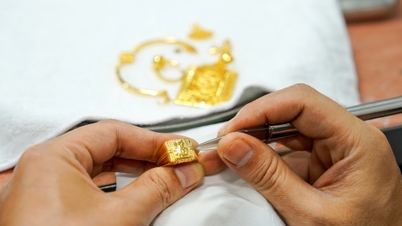
Amidst continuously record-high gold prices, the domestic gold market has seen a resurgence of jewelry being adulterated with impurities. A gold shop owner in Ho Chi Minh City reported recently purchasing a necklace weighing over 1 tael (approximately 37.5 grams) from a customer. Further examination revealed that the necklace contained over 2 taels of impurities, leaving only about 8 taels of pure gold.
Speaking to the Nguoi Lao Dong newspaper, Ms. Han Thi Binh, owner of Kim Phat I gold shop (Go Vap ward, Ho Chi Minh City), said that the phenomenon of gold jewelry produced abroad being mixed with tungsten is not new, but it has appeared quite frequently recently. Because tungsten has a density similar to gold, it is very difficult to detect using conventional testing methods. "People need to be extremely cautious and avoid buying gold products of unknown origin, especially gold brought in from abroad, because the risk of poor quality is very high," Ms. Binh warned.
Source: https://nld.com.vn/ngong-ngay-duoc-cap-phep-nhap-khau-vang-196251222221722265.htm



























































































Comment (0)