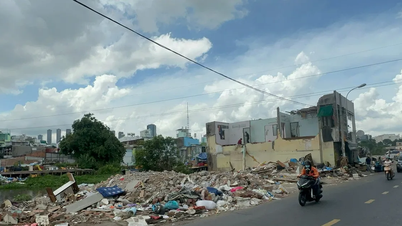
Debris is scattered everywhere.
In early June, the area around Nhan Hoa, Chinh Kinh, and Thuong Dinh streets (Thanh Xuan ward) was a chaotic construction site for the Ring Road 2.5 project. Numerous houses and sturdy structures were being urgently demolished to clear the site for the contractor. The deafening roar of concrete drills and excavators tore through old walls, demolishing 3-4 story buildings. Along with this hustle and bustle came millions of tons of broken bricks, stones, concrete, rusted steel, sand, gravel, and construction materials piled high, in some places encroaching onto the road, ready for trucks to transport away.
Pointing to a pile of rubble 3-4 meters high near his house, Mr. Nguyen Xuan Thanh (62 years old, residing on Nhan Hoa Street) sighed: “We strongly support the city's road construction plan and the demolition of houses to make way for the project, but unfortunately, after the houses are demolished, the waste just piles up day after day. When it's sunny, dust flies everywhere; when it rains, mud and dirt accumulate, and water from the drains overflows onto the road, affecting the daily lives of the surrounding residents.”
Not only the construction area of the Ring Road 2.5 project, but many other areas in Hanoi such as Nghi Tam, Tam Trinh, Thuong Dinh, Yen Nghia… are also in a state of disarray with huge "mountains" of waste from land clearance for road expansion, bridge construction, or infrastructure projects. Hanoi is accelerating land clearance to ensure the progress of key infrastructure projects, but the collection, transportation, and processing of waste after demolition are revealing inadequacies.
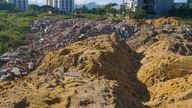


Illegal dumping of construction waste has surged.
According to the Hanoi Department of Agriculture and Environment, the city currently generates approximately 10,000 tons of construction waste per day. This volume increases dramatically during peak periods when the city focuses on implementing major transportation projects, including bridge projects across the Red River, ring roads, and the expansion of National Highway 1, National Highway 6, and the road connecting Thang Long Boulevard with the Hanoi-Hoa Binh Expressway.
However, Hanoi's construction waste treatment system is very modest compared to the amount of waste generated. The entire city can only process about 1,670 tons per day at four receiving points. Specifically, the landfill in Nguyen Khe commune, covering 4.8 hectares, has a capacity of 360 tons per day. Three transfer and recycling points using crushing technology include: the Phap Van - Cau Gie site (Yen So ward) with a capacity of 480 tons per day, the VT12 site (Phuc Loi ward) with a capacity of 480 tons per day, and the site in Thu Lam commune with a capacity of approximately 350 tons per day. After being brought here, construction waste is crushed, mainly to create aggregate for leveling, which is then used in ongoing infrastructure projects. This is a very reasonable circular economy model, but in reality, it is currently "overwhelmed" due to the supply far exceeding the processing capacity.
Representatives from Global Production Services Joint Stock Company – the unit managing two construction waste transfer and recycling facilities in Yen So and Phuc Loi wards – stated that in 2025, the unit received over 5,000 tons of solid waste per day, double the amount from the previous year. However, in the early months of 2026, as projects accelerated land clearance, the amount of construction waste dumped exceeded 10,000 tons per day, while the facility only has two shredding machines with a maximum capacity of 80 tons per hour. Previously, workers averaged two shifts per day, processing about 480 tons. When pressure increased, the unit had to increase to four shifts working continuously day and night to reach 800-1,000 tons per day, but even that was like "a drop in the ocean."
The enormous amount of waste generated, coupled with limitations in collection and processing, has led to illegal dumping of construction waste. Taking advantage of the cover of darkness, many trucks carrying construction waste, bricks, stones, and concrete secretly dump them in vacant lots, ponds, and canals in the suburbs. Ms. Le Thu Tu (52 years old, An Khanh commune) expressed her frustration: "Occasionally, we see a huge pile of mortar, bricks, and stones appearing along the roadside. They usually dump them illegally at dawn, making it very difficult to catch them red-handed."


Hanoi People's Committee Chairman Vu Dai Thang has just issued Directive No. 08/CT-UBND on strengthening measures to ensure environmental hygiene during the construction of investment projects in the city. The Chairman of the Hanoi People's Committee requires investors and contractors to strictly adhere to the principle of phased construction, cleaning up each section as it is completed; and restoring infrastructure immediately after each item is finished. In particular, construction units must bear full responsibility for environmental hygiene at the construction site; they are required to implement shielding, dust suppression spraying, provide vehicle washing areas, and ensure that vehicles transporting materials and waste are cleaned before leaving the site to minimize the spread of dust and waste into the environment.
Source: https://www.sggp.org.vn/ngop-tho-vi-xa-ban-post856115.html

![[Image] Schools organize meetings and introduce teaching models to students admitted to grade 10.](https://vphoto.vietnam.vn/thumb/1200x675/vietnam/resource/IMAGE/2026/06/25/1782368077271_ndo_br_z7970052192242-1ec8daeb77a6eed1a4e9f58c564ddd3e-jpg.webp)

![[Image] Ho Chi Minh City: Ma Lang area, Chicken-Rice Market about to change its appearance](https://vphoto.vietnam.vn/thumb/1200x675/vietnam/resource/IMAGE/2026/06/25/1782377698627_ndo_br_m1-jpg.webp)
![[Photo] General Secretary and President To Lam receives Palestinian Ambassador Saadi Salama](https://vphoto.vietnam.vn/thumb/1200x675/vietnam/resource/IMAGE/2026/06/25/1782365384740_a1-bnd-9423-8322-jpg.webp)