The birthplace of precious materials
In the Mekong Delta, this season the fields are flooded with water, and farmers are taking advantage of the opportunity to soak the soil, collect silt, and prepare for the new winter-spring rice crop. The small dirt road leading to the rice breeding experimental farm of farmer Hoa Sy Hien in Tan Phu B hamlet, Tan An commune ( An Giang province) has therefore become muddy. Both sides of the road are overgrown with reeds and weeds. Whenever it rains, the fields are flooded, and those who are not careful could fall at any time.
In the middle of the field, Mr. Hien built a simple thatched hut as a place for research, experimentation, and teaching agricultural students about rice breeding. Next to it is a plot of land over 4,000 square meters, which he divided into separate areas for planting salt-tolerant varieties, for growing initial hybrid materials, and for recording results. During seasons when there are no students coming to learn, he continues his experiments, personally measuring salinity, testing water, and recording each stage of rice growth.
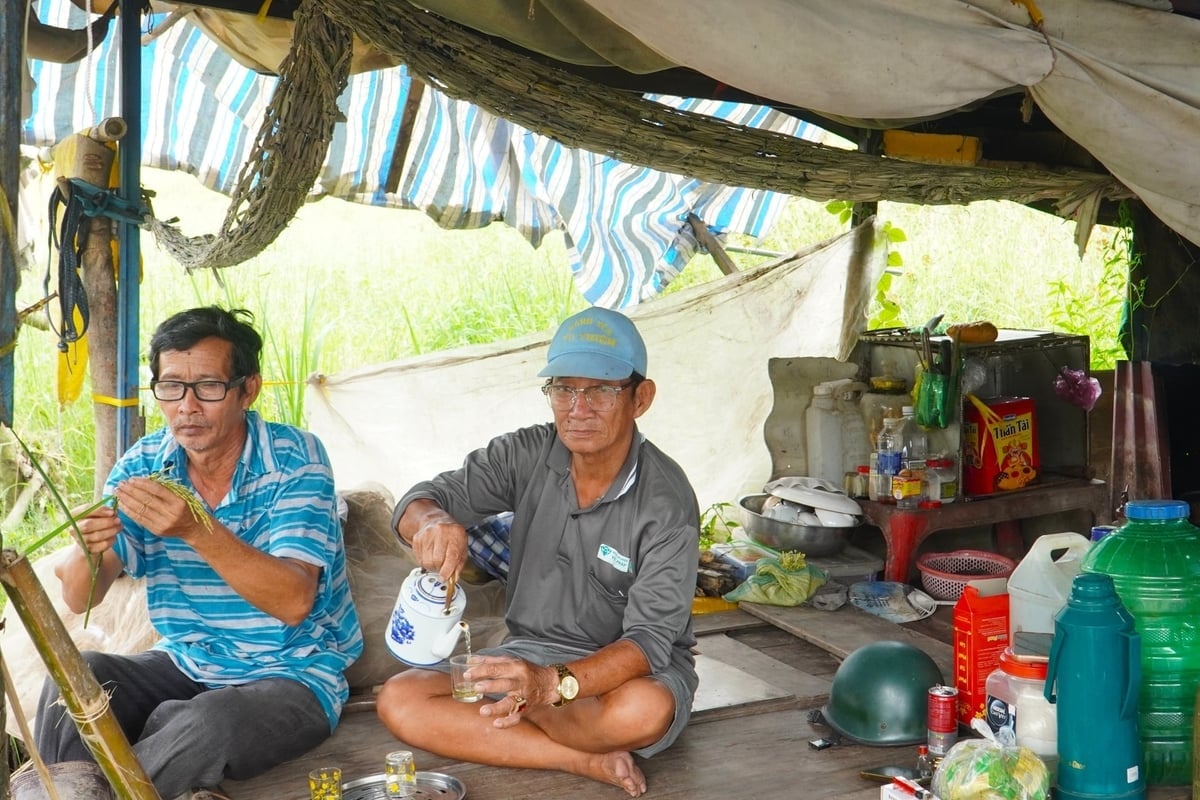
A simple thatched hut in the middle of the field is where farmer Hoa Sy Hien (on the left) and his colleagues diligently select and breed rice varieties every day. Photo: Kim Anh.
Mr. Hoa Sy Hien's entry into the field of plant breeding was quite coincidental. In 1997, he was encouraged by the An Giang Provincial Farmers' Association to participate in short-term training courses on "1 must, 5 reductions," "3 reductions, 3 increases," and learning how to produce certified rice seeds... These initial knowledge ignited a passion for research in this farmer.
In 2004, he continued his studies by participating in a community-based seed breeding skills training course organized by the An Giang Provincial Agricultural Extension Center in collaboration with the Institute for Research and Development of Farming Systems (now the Mekong Institute, part of Can Tho University). From then on, he developed many ideas and began experimenting with rice breeding. This was considered a rather bold decision, as it is a field requiring a high level of expertise and technical skill.
Two years later, Mr. Hoa Sy Hien created the first rice variety and named it TC1 (TC is an abbreviation for Tan Chau - where he lived). This rice variety has the characteristics of strong stems, good resistance to pests and diseases, and stable yields of 600-700 kg/1,000 m2. However, due to its long growing season (about 105 days), the TC1 rice variety was only initially well-received by farmers; later, they chose shorter-growing varieties.
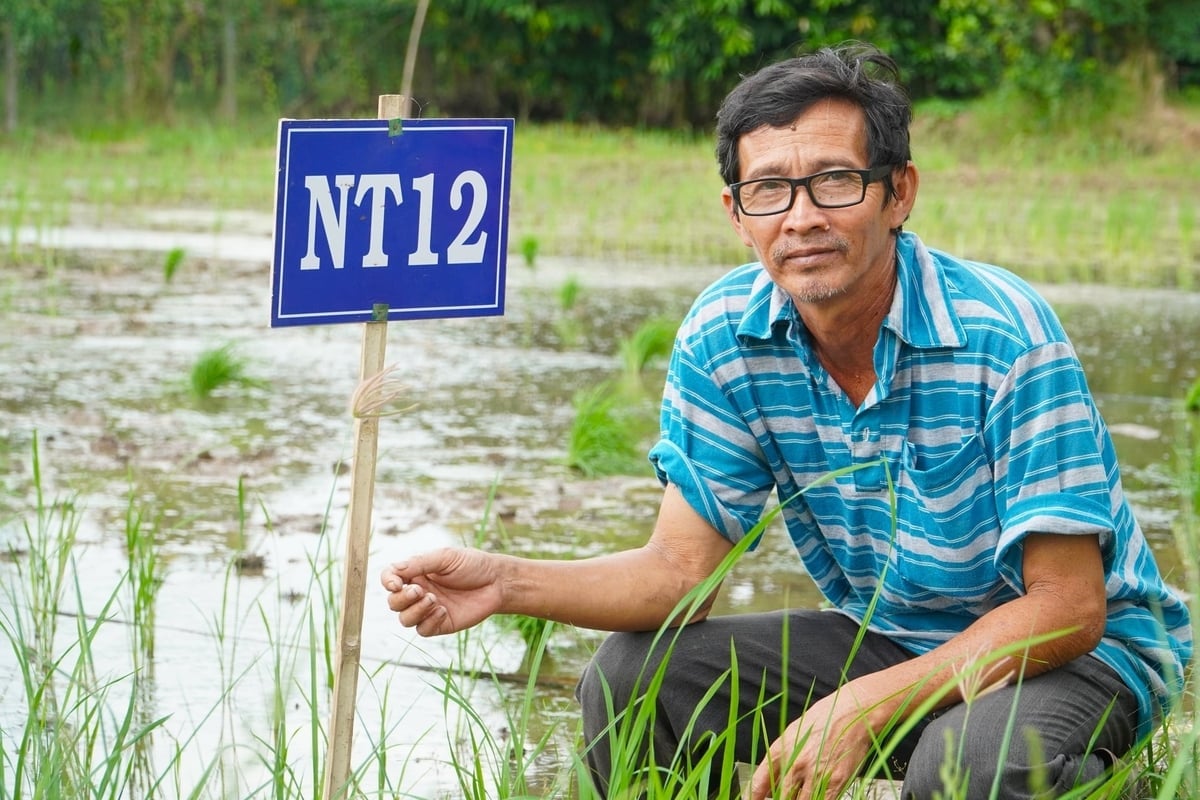
Farmer Hoa Sy Hien - who owns 63 rice varieties, used for production and scientific research. Photo: Kim Anh.
In later years, this farmer continued his research on salt-tolerant rice varieties, witnessing many farmers in Hon Dat district, Kien Giang province (formerly), now Hon Dat commune, An Giang province, "crying bitterly" because their rice crops died due to salinity. To research this rice variety, farmer Hoa Sy Hien personally built experimental models, determined the desired salinity level, and then created a similar saltwater environment to assess the rice plant's salt tolerance.
Mr. Hien recounted: “In Tan An commune, there is freshwater all year round, so where would I find saltwater to experiment with rice cultivation? I asked some acquaintances to get me 4 liters of seawater to test the model. When the seawater ran out, I continued using salt to create the salinity for the water. The model was divided into 3 plots, corresponding to 3 treatments. Treatment 1 had a salinity of about 5 parts per thousand; treatment 2 had a salinity of 10 parts per thousand; and treatment 3 had a salinity of 15 parts per thousand.”
After more than 10 years of perseverance, he successfully developed the TC7 rice variety, which can tolerate salinity levels of 3-5 parts per thousand, making it suitable for coastal areas of the Mekong Delta. In September 2025, TC7 was officially granted a new plant variety protection certificate by the Department of Crop Production and Plant Protection (Ministry of Agriculture and Environment).
Later, Mr. Hoa Sy Hien renamed his rice varieties to "SH" – an abbreviation of his name. Over 20 years in the profession, Mr. Hien successfully developed 63 rice varieties, from TC1-TC30 and SH31-SH63. Many of these have been recognized and commercialized, such as TC29, SH31, SH61, SH63… and have been transferred to farmers by businesses for production.
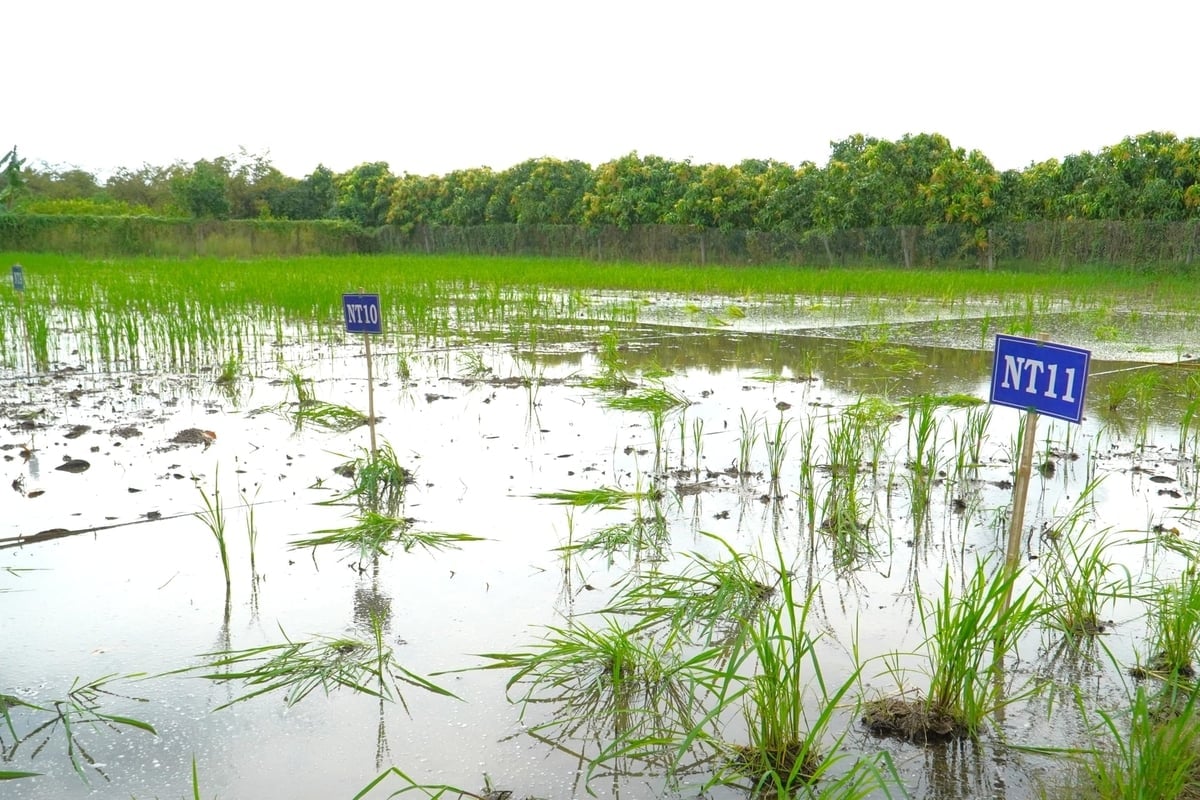
The experimental rice breeding field of farmer Hoa Sy Hien. Photo: Kim Anh.
Currently, the rice gene bank of the School of Agriculture (Can Tho University) is preserving 17 rice varieties developed by Mr. Hoa Sy Hien. This is a recognition of farmer Hoa Sy Hien's contributions to the Vietnamese agriculture and environment sector in general and the Mekong Delta region in particular. At the same time, this will be a valuable source of material for future rice breeding projects.
Silent contributions
Mr. Hoa Sy Hien still vividly remembers the time in 2021 when the Nam Thai Son area (Hon Dat district, Kien Giang province), now Hon Dat commune, An Giang province, experienced a saline intrusion affecting hundreds of hectares of rice crops, resulting in almost total crop loss. At that time, he was invited by the local agricultural department to survey the situation.
Upon arriving, he personally used his hands to remove the topsoil, then tasted the soil beneath to determine the extent of the contamination. “After tasting it, I determined that the soil here was both saline and acidic. The only solution was to create a canal encompassing the entire area, then subdivide it and build another canal to bring freshwater from An Giang through Hon Dat to flush out the acidity and salinity in the soil,” Mr. Hoa recounted.
It was his practical experience and passion for agricultural technology that helped Mr. Hien develop many new ideas and perspectives.
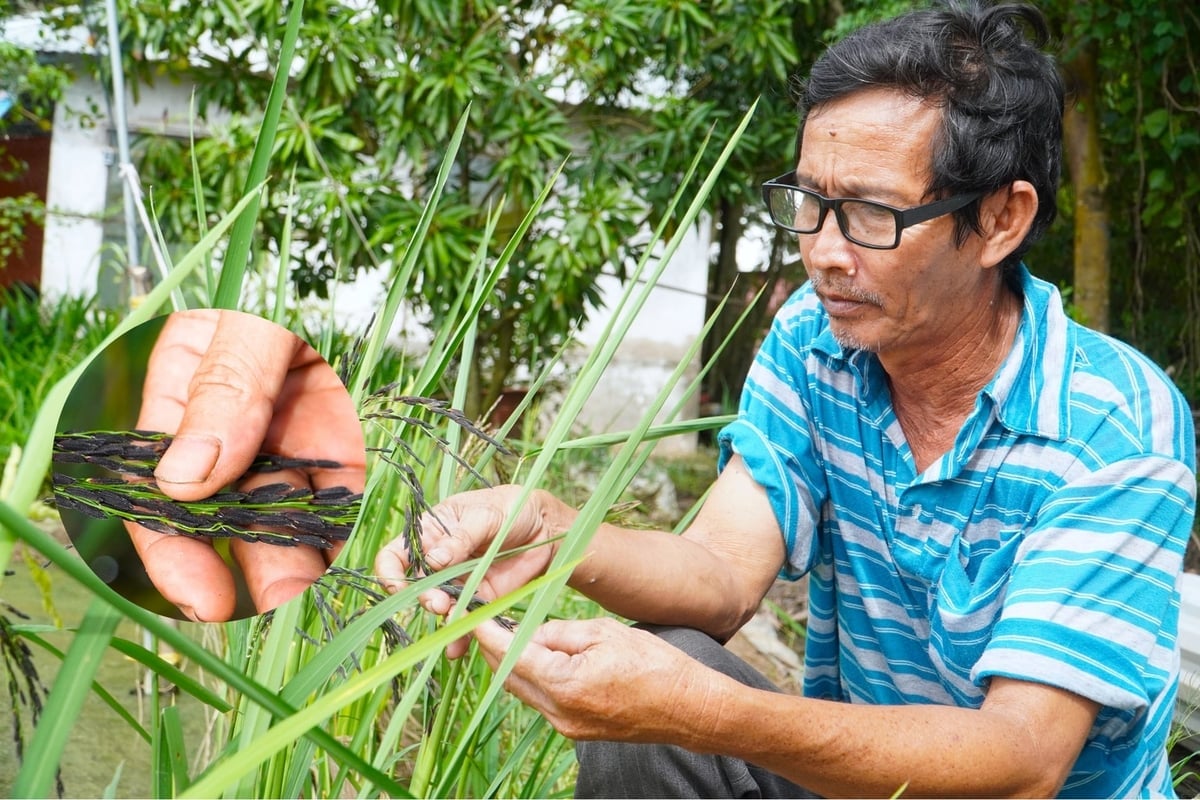
The red brown rice variety was created by Mr. Hoa Sy Hien from various types of wild rice. Photo: Kim Anh.
In 2010, he first experimented with crossbreeding four lines of wild rice around the fields, resulting in a red brown rice variety named TC10. According to him, these wild rice lines have several outstanding characteristics: long, round, red grains… After selection and breeding, the good traits are expressed, so the TC10 variety has long grains, a short growing season, and especially, does not shed. From the results of this research, Mr. Hien drew a rather important conclusion: wild rice is the precursor, the "ancestor," of cultivated rice and possesses valuable characteristics that can be exploited for research and breeding of rice varieties.
In addition to his research work, farmer Hoa Sy Hien also inspires thousands of students from Can Tho University and An Giang University with his passion for agronomy at his small experimental farm.
Students learn about rice cultivation techniques, the various stages of the cropping season from sowing to harvesting, methods for dealing with pests and diseases, and methods for identifying and analyzing soil and water resource samples.
In every teaching, Mr. Hoa Sy Hien reminded: "For rice farming, in addition to tending the rice plants, farmers must also nourish the soil resources. Because the land nourishes the plants, the plants nourish the people, and people must nourish the plants and also the land and water. Only then will agriculture be harmonious and sustainable."
For him, modern agriculture must harmoniously combine chemical, organic, and microbial methods. Organic and microbial methods are nutrients for the soil, while chemical methods are nutrients for the plants. None can be eliminated, as each has its own function.
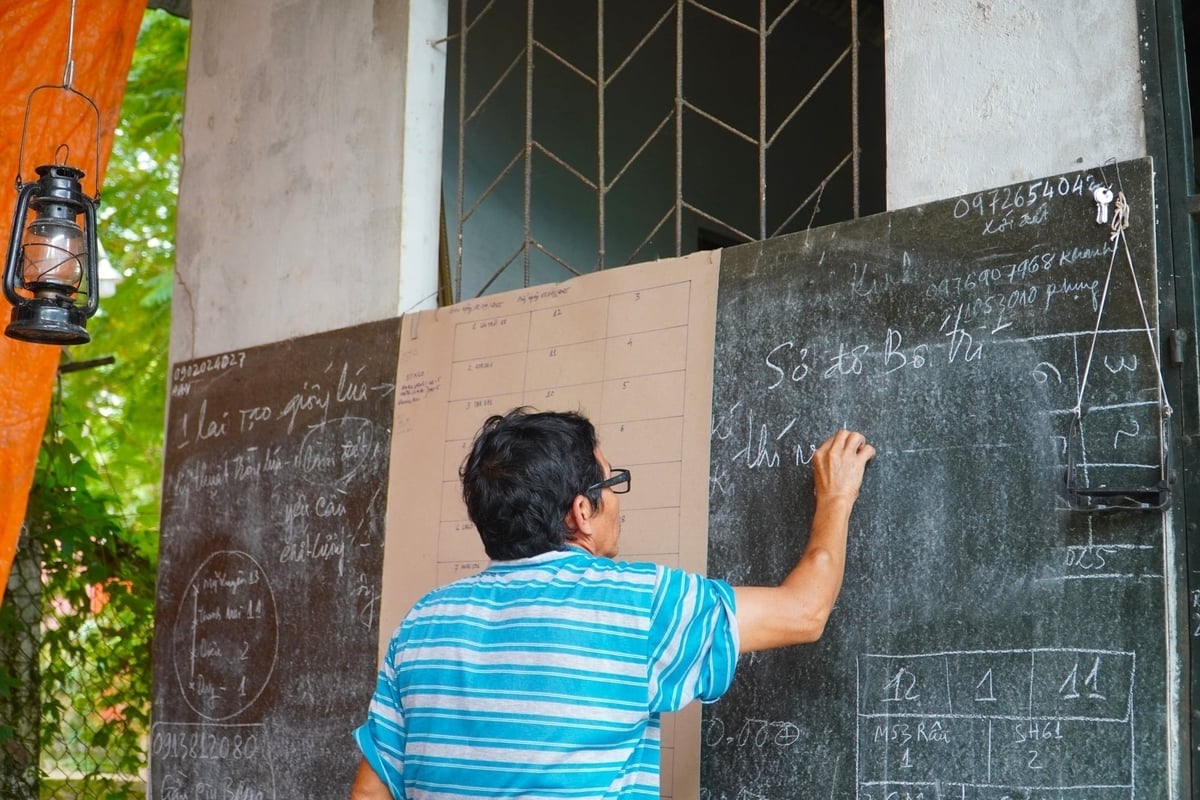
One corner of the experimental farm is used by farmer Hoa Sy Hien to instruct students on agronomy. Photo: Kim Anh.
About a year ago, when his family's rice seed storage conditions were inadequate, Mr. Hoa Sy Hien devised a method of preserving seeds based on the experience of his ancestors: vacuum-sealing them and burying them about 1.5 meters deep in the ground in an anaerobic environment. Every two years, he would dig up the seeds to check their viability.
Although it hasn't created major breakthroughs for Vietnam's agriculture and environment, the "treasure trove" of 63 rice varieties painstakingly created by farmer Hoa Sy Hien has left behind a valuable source of material for future rice breeding efforts.
For Mr. Hien, choosing to breed rice varieties is not just a profession, but a lifelong passion. This shows the spirit of learning, creativity, and unwavering belief of farmers in the Mekong Delta on their agricultural journey.
Source: https://nongnghiepmoitruong.vn/nguoi-am-tham-gop-hang-chuc-giong-lua-cho-dbscl-d783149.html



![[Image] A brilliant symphony and explosive power in the skies of Da Nang.](https://vphoto.vietnam.vn/thumb/1200x675/vietnam/resource/IMAGE/2026/05/31/1780196945787_anh-man-hinh-2026-05-31-luc-10-08-51.png)







![[Video] Sunset at Lap An Lagoon – Where the sun sets over the fishing nets](https://vphoto.vietnam.vn/thumb/340x192/vietnam/resource/IMAGE/2026/05/31/1780192137701_beach-landscape-sea-water-nature-grass-745871-pxhere-com.jpeg)

![The Essence of Viet Bac Villages: [Part 3] The Precious Fragrance of Nghinh Tuong](https://vphoto.vietnam.vn/thumb/402x226/vietnam/resource/IMAGE/2026/05/29/1780020600366_5237-tinh-tuy-ban-lang-viet-bac-bai-3-chuyen-o-nghinh-tuong-050626_700.jpeg)
![The Quintessence of Northern Vietnam's Villages: [Part 2] The Famous Cassava Noodles of Kunming](https://vphoto.vietnam.vn/thumb/402x226/vietnam/resource/IMAGE/2026/05/28/1779937455892_3929-3144-mien-dong-15-nongnghiep-023138.jpeg)
![The Essence of the Village: [Part 1] Wine on the mountain, tea in the clouds - Bang Phuc](https://vphoto.vietnam.vn/thumb/402x226/vietnam/resource/IMAGE/2026/05/27/1779841729178_3821-1jpg-nongnghiep-103814.jpeg)




















































Comment (0)