

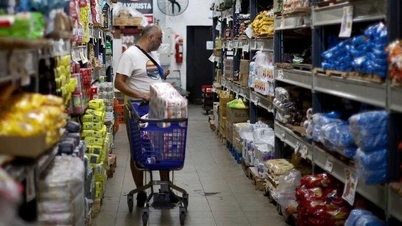
Consumer purchasing power has not improved, so shopping baskets at supermarkets still mainly consist of essential goods and promotional items.
A survey by Vietnam Report in September showed that about 40% of respondents did not feel their financial situation had improved in the final months of the year. This sentiment was also reflected in purchasing power at major retailers, with shopping baskets mainly consisting of essential goods and promotional items.
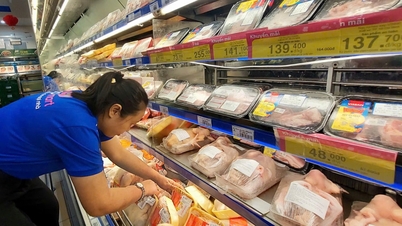
According to a representative from MM Mega Market, consumer demand increased by approximately 5-6% in the first nine months of the year compared to the same period last year. Although the volume of purchases increased by 9%, the value of each shopping basket remained relatively stable. Specifically, the average shopping basket per household remained at around 800,000 VND, primarily containing essential goods.
Similarly, Saigon Co.op also reported increased sales thanks to weekly promotional programs. The average bill at Co.opmart reached 400,000-500,000 VND, unchanged from last year. Instead of buying a wide variety of items as before, customers are now focusing on products with big discounts and gifts.
Consumer purchasing power remains weak, leading to a shrinking demand for loans. Ms. Tran Khanh Hien, Director of Research at MB Securities Company, stated that credit growth by consumer finance companies alone is currently lower than the industry average, whereas during periods of economic stability, it was double that rate.
According to Ms. Dinh Thi Thuy Phuong, Director of the Trade and Services Statistics Department (General Statistics Office), although the growth rate of total retail sales of goods and consumer service revenue in the first nine months of this year (at current prices) increased by 8.8% compared to the same period in 2023, it has not yet reached the level of the pre-Covid period (an increase of over 10%). The increase in the first nine months of this year is also 2.5 percentage points lower than the average for the first nine months of the years in the period (2015-2019). This reflects that domestic consumer demand has recovered but is not yet at a high level.
After excluding the price factor (CPI), real consumer spending growth from the beginning of the year to date has still not been able to break strongly above 5%, according to data from financial services provider AFA Capital. This is a modest figure despite receiving support from more than 12.7 million international visitors in the first nine months, a 43% increase compared to the same period last year.
Investment, exports, and domestic consumption are the three main drivers of economic growth. However, investment and exports are currently having to shoulder the burden of supporting domestic consumption to accelerate economic growth.
Mr. Huynh Hoang Phuong, an independent financial analyst, noted that consumer spending growth was lower than GDP growth in the first nine months of the year (6.18% and 6.4% respectively).
During periods of economic stability, such as 2015-2019, consumption grew at an average rate of 7% per year, higher than the figure for the first nine months of this year. Consumption is a crucial component of GDP, accounting for over 60% in Vietnam and approximately 60-70% in the US. It reflects consumer demand, forms the basis for private investment development, and creates future economic prospects.
According to experts, the reason for low consumer spending is either a lack of confidence in the future of the economy or a negative impact on their jobs and income.
Many large-scale promotional programs have been launched to stimulate shopping and connect supply and demand. However, from the perspective of a distributor, Mr. Ha Ngoc Son, Deputy General Director of Saigon Trading Company (SATRA), believes that prolonging promotional programs will reduce their attractiveness. He suggests that the duration could be shortened to about one month, half a month, or even one week, but it needs to be simultaneous and widely publicized so that consumers are aware of it. Mr. Son believes this will create a synchronized ripple effect.
On e-commerce platforms, sales events are spread out over several months, with a focus on double-day promotions (e.g., August 8th, September 9th...). Therefore, Mr. Nguyen Binh Minh, a member of the Executive Board of the Vietnam E-commerce Association, believes that year-end promotions will only tap into remaining latent demand. Instead of waiting for consumer spending and income to improve, he suggests that solutions should come from retailers themselves.
"The increasing commitment to users will encourage them to spend money even when it's not necessary," Mr. Minh emphasized. One of the solutions being implemented and needing further development in the future is identity verification in e-commerce. Supporting order cancellation even after delivery will also help reduce buyer doubts about goods and limit disputes.
Ultimately, the core issue is that consumer income needs to improve to create a positive spending mindset. According to Dr. Nguyen Quoc Viet, Deputy Director of the Institute for Economic and Policy Research, it is necessary to focus on the sustainable development of the private sector to create jobs and income for the people. This will contribute to making the policy of increasing the basic salary by 30% and the regional minimum wage by 6% from July 1st have a broad and effective impact.
To achieve this, Mr. Viet suggested that the government should not immediately increase taxes and fees in 2025 when fiscal policy shifts from loose to tight. This is because doing so would force businesses to increase input costs or raise selling prices, inadvertently counteracting the current consumer demand stimulation policies.
Source


![[Photo] National Assembly Chairman Tran Thanh Man working with the Standing Committee of the National Assembly's Ethnic Council](https://vphoto.vietnam.vn/thumb/1200x675/vietnam/resource/IMAGE/2026/05/21/1779337435930_ndo_br_1-jpg.webp)


















![[Image] "Journey of Hope" promotes the organ and tissue donation movement in Vietnam.](https://vphoto.vietnam.vn/thumb/1200x675/vietnam/resource/IMAGE/2026/05/20/1779294400833_1-8910-jpg.webp)
































































Comment (0)