

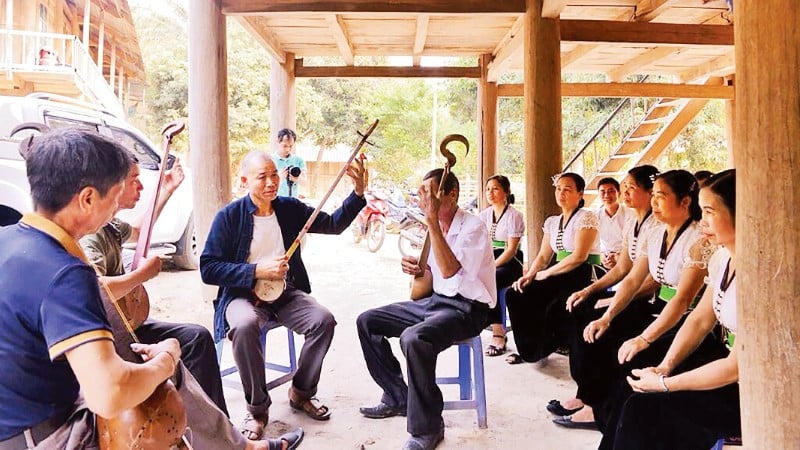
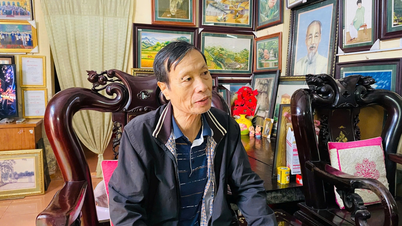
In Nam Ty village, Nam Hang commune ( Lai Chau province), there is a man who has dedicated more than half his life to preserving that "spirit" - artisan Lam Van Dien, a "living treasure of art," a key figure in the conservation and restoration of the local Then heritage.
Arriving in Nam Ty village one early morning, still shrouded in mist, before we could even ask for directions, the sound of the zither guided us to a stilt house on the mountainside. In the tranquil atmosphere of the highland village, that sound was like an underground stream, winding through the village lanes, evoking a feeling that was both familiar and profound. This was the traditional house of the artisan Lam Van Dien.
Mr. Dien was born into a family with a tradition of Then singing and playing the zither. His childhood was marked by an early connection with this folk art form. From a young age, Dien often accompanied his father and elders in the village to perform Then during village ceremonies and festivals. Each time he heard his father play the zither and sing the Then melodies, an indescribable and heartfelt emotion would well up inside him.
It was the years spent traveling with his father to various Thai ethnic minority regions such as Quynh Nhai, Muong Lay, and Dien Bien to assist in performances that instilled in him a lasting passion for traditional Then singing. By the age of 15, he had memorized all the traditional Then songs; at 20, he was trusted and respected by the people, who called him "Master Then," and from then on, Lam Van Dien officially followed in his father's footsteps.
According to artisan Lam Van Dien, Then is not just a performing art, but a form of "spiritual language," a culmination of singing, dancing, musical instruments, and rituals. Each ritual of worshipping heaven, earth, and ancestors is associated with a specific Then song, requiring practitioners to have a deep understanding of customs, beliefs, and performance techniques.
"Learning Then is difficult, and preserving Then is even more difficult, because nowadays young people lack patience, want to learn quickly, but don't delve deeply enough to truly 'absorb' and understand the essence and spiritual meaning of the traditional Then rituals, songs, and dances," Mr. Dien lamented.
Aware of the risk of the heritage fading away, in 2013, he mobilized those who loved traditional culture in the village to form a Then singing and Tinh lute playing troupe. Initially, only a few people participated, all of them family members. Whenever the music of the Tinh lute was played, everyone remembered their village and their community. Since then, in the evenings, his courtyard has become a cultural space, where the sound of the Tinh lute touches people's hearts, and where the activities of the old community are retold through sound and scenes.
The Nậm Ty village's performing arts troupe has participated in numerous competitions and festivals both within and outside the province, winning many awards and creating a widespread impact in the community. To pass on the art of playing the zither and singing Then songs, he gathered the men in the village who loved ancient culture, and they practiced playing the instruments at his house every evening. He himself put a lot of effort into finding wood and dried gourd shells to craft the zither.
Thanks to the resurgence of the Tinh Tau instrument playing movement, his family's traditional Tinh Tau instrument-making craft has "come back to life." Each year, he produces nearly a hundred instruments, supplying clubs and cultural centers in many provinces of Northwest Vietnam. Some people, captivated by the sound of the instrument and the Then songs, seek out Nam Ty to hear him sing, then buy instruments to display and preserve as a spiritual treasure.
From ancient Then songs such as: Inviting Then to Earth; Bidding farewell to Then as they ascend to Heaven, Blessings and prayers for the village's peace and prosperity, Celebrating the New Rice Festival…; to suit modern life, he adapted many new songs on the Tinh Tau musical scale on themes such as: Celebrating the Party, celebrating Spring; Remembering the gratitude to Uncle Ho, bidding farewell to sons going to the army, love songs…
"Despite his busy schedule, whenever he has a little time, he patiently guides each student, teaching them how to play the instrument, correcting each dance move," shared Ms. Lo Thi Trieu, Team Leader of the Nam Ty Village Performing Arts Troupe.
Mr. Lo Van Trinh, Chairman of the Thai Ethnic Folk Culture Club, said: “From the initial 7 members guided by artisan Dien, the club has now grown to 20 members, becoming a core force in the cultural and artistic movement of Nam Ty and representing the Thai ethnic group of Nam Nhun district (formerly), participating in many cultural activities at the provincial and regional levels, winning the A Prize at the National Then Singing and Dan Tinh Playing Festival in 2015 and 2018…”.
Recognized by UNESCO as a Representative Intangible Cultural Heritage of Humanity, Then singing and Tinh lute playing have entered the contemporary cultural space with more opportunities for wider access and dissemination. However, this title also demands great responsibility from the community living alongside the heritage. In this journey, artisan Lam Van Dien is one of those who quietly nurture each Tinh lute note and each Then verse so that the heritage remains present in daily life. In March 2019, he was honored with the title of Outstanding Artisan by the President of Vietnam . This is a well-deserved recognition for more than half a lifetime of dedication to preserving the Then music of the mountains and forests.
Today, amidst the upheavals of modern life, with new cultural trends flowing in daily, he steadfastly preserves the traditional roots, so that this heritage can continue to be passed on to future generations.
Source: https://nhandan.vn/nguoi-giu-then-co-giua-muong-thai-nam-hang-post932540.html


![[Image] First Congress of the Vietnam Science and Technology Trade Union](/_next/image?url=https%3A%2F%2Fvphoto.vietnam.vn%2Fthumb%2F1200x675%2Fvietnam%2Fresource%2FIMAGE%2F2025%2F12%2F24%2F1766552551054_ndo_tr_img-1801-jpg.webp&w=3840&q=75)





























































Comment (0)