

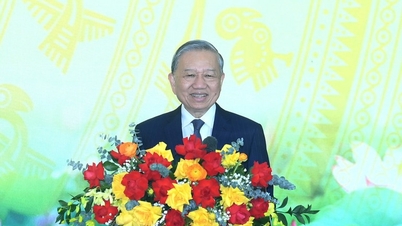
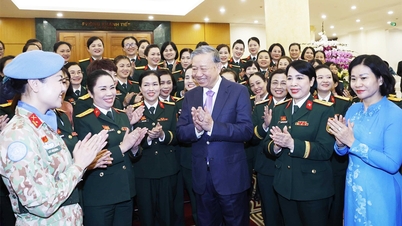
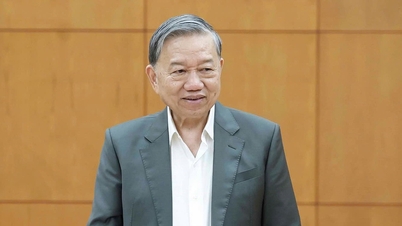
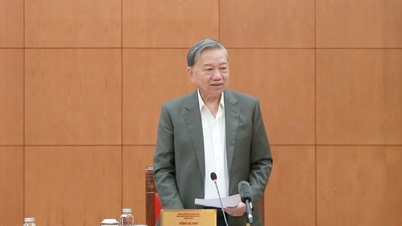
On the morning of November 18th, General Secretary To Lam met with representatives of teachers and education administrators to celebrate Vietnamese Teachers' Day on November 20th.
Speaking at the meeting, the General Secretary stated that one of the four immediate tasks for the education sector is to ensure that the budget allocated to education is at least 20% of the total state budget expenditure, in accordance with the resolution set forth by the Party.
The General Secretary also pointed out that current educational methods have not yet fostered the active participation and creativity of learners, nor have they focused on developing skills and qualities in learners; the effectiveness of investment in education is not commensurate with the principle that education is a top national priority.
Earlier, during discussions on the draft Law on Teachers in the National Assembly , General Secretary To Lam offered insightful opinions on what should be included in the law and what needs to be added: "We must ensure that teachers receive this law with genuine enthusiasm, with genuine honor, and with truly favorable conditions created for them. We must not let the law become more difficult for teachers or lead them to say, 'How can we implement these regulations?'"
Everyone knows that making laws in Vietnam is not easy, but even though it's not easy, it has to be done, and done to the best of our ability, in accordance with the spirit of the law.
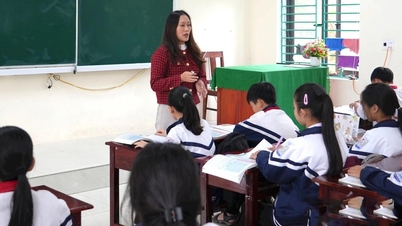
From ancient times, even before education laws were established, our ancestors had a concise saying: "Respect your teachers and uphold moral principles." This means we must respect our teachers and uphold moral principles. Moral principles here refer to the principles of education, encompassing the teacher-student relationship and the parent-child relationship. Humanistic education must include all three components.
Therefore, everyone is delighted that teachers have been and will be provided with favorable conditions regarding salaries, housing, and benefits when teaching in mountainous areas. Teachers cannot be allowed to suffer from numerous shortages; this must be clearly and transparently stated in the Law on Teachers. At the same time, the responsibilities of teachers must be clearly defined. As the General Secretary said, every teacher must be a scientist. To achieve this, they must learn throughout their lives, accumulating more knowledge and experience as they get older, rather than ceasing to teach upon retirement.
To ensure that "teachers act like teachers, and students act like students," and that the superiority of education is demonstrated in the teacher-student relationship, teachers must set an example both in the classroom and in their daily lives. How can we ensure that students never forget the teachers who have taught them, from elementary school onwards? Gratitude arises from this unforgettable experience.
We have previously argued that students are the subjects, and teachers are the transmitters of knowledge. This understanding is incorrect. The teacher must be the subject in education; there is no other way. Students are co-creators with the teacher as the subject. In this way, the teacher-student relationship will be both respectful and intimate. The teacher helps the student, and the student can discuss and exchange ideas with the teacher democratically and respectfully.
As for lifelong learning, it's not just students who need to learn; teachers must too, as Lenin said, "Learn, learn more, learn forever."
Ultimately, the Law on Teachers is one of the most difficult laws to enact, but it must be done in the best, most comprehensive, accurate, and up-to-date way possible.
Source: https://thanhnien.vn/nguoi-thay-la-chu-the-day-va-hoc-suot-doi-1852411190017215.htm




















![[Photo] Prime Minister Pham Minh Chinh presides over the conference announcing the establishment of the International Finance Centre in Vietnam.](/_next/image?url=https%3A%2F%2Fvphoto.vietnam.vn%2Fthumb%2F1200x675%2Fvietnam%2Fresource%2FIMAGE%2F2025%2F12%2F21%2F1766309817714_ndo_br_dsc-3400-jpg.webp&w=3840&q=75)





















































Comment (0)