

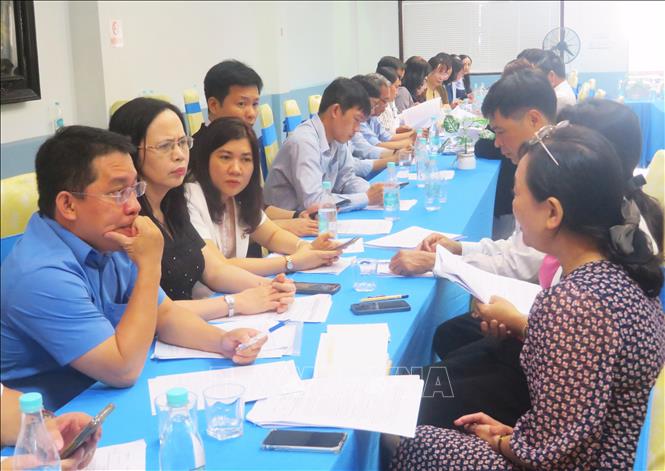
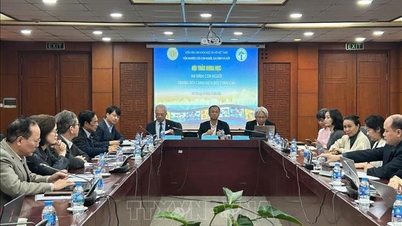
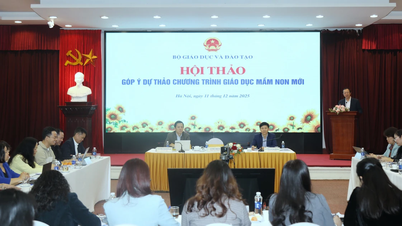
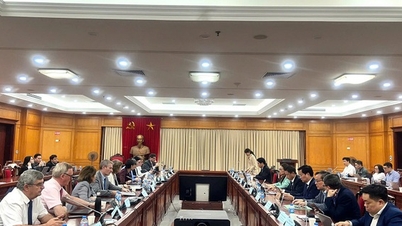
The workshop aimed to gather feedback from educational institutions in the South to refine the policy before submitting it for evaluation, ensuring it aligns with practical realities and enhances the rights of teachers.
Here, universities, colleges, and general education institutions focused on analyzing issues related to mobility allowances, responsibility allowances, special salary coefficients, determining eligibility for allowances, and fairness among different groups of teachers. Representatives from Ho Chi Minh City University of Education and Can Tho University argued that the daily calculation of mobility allowances is not suitable for the reality of schools having multiple campuses at different distances. Specifically, lecturers teaching only 1-2 lessons are calculated on a daily basis, or teaching at campuses of varying geographical distances receive the same allowance, making it difficult for schools to develop internal spending regulations. Suggestions were made for the Ministry to expand the autonomy mechanism to allow schools to convert allowances based on teaching hours or standard hours, ensuring flexibility and accurately reflecting the workload.
Many delegates expressed concerns about the regulation that stipulates "only one of the two is allowed" between reduced teaching hour quotas and responsibility allowances; they worried that this would diminish the benefits of subject heads and deputy heads, or those currently receiving reduced quotas. Other opinions focused on determining which subjects are eligible for the 65% preferential allowance, especially for Arts and National Defense and Security Education. Representatives from several schools argued that it is impossible to separate "theory" and "practice" in teaching Arts, as the current curriculum is integrated, requiring teachers to use musical instruments and practice materials.
The group representing high schools requested clarification on whether Technology and Informatics should be included in the Technology-Arts group in the new general education curriculum to avoid misunderstandings when applying allowances. Some delegates also suggested adding Physical Education as a specific subject instead of just listing " Sports and Physical Education" to better reflect school terminology.
Regarding teachers of National Defense and Security Education, delegates suggested reconsidering the preferential allowance rates, as many seconded military instructors are simultaneously receiving national defense allowances, which could easily lead to significant disparities compared to instructors of other subjects.
Regarding the title of teaching assistant, many opinions suggest adjustments because the new Education Law has defined teaching assistants as no longer being lecturers; at the same time, it is necessary to clarify the concept of "contract" within its scope of application to distinguish between visiting lecturer contracts and regular employment contracts.
Regarding school health officials, delegates also requested clarification on whether school health officials will receive this 30% increase when the Ministry of Health finalizes the amendment to Decree 56, or whether they will retain the current 20% rate under the education system.
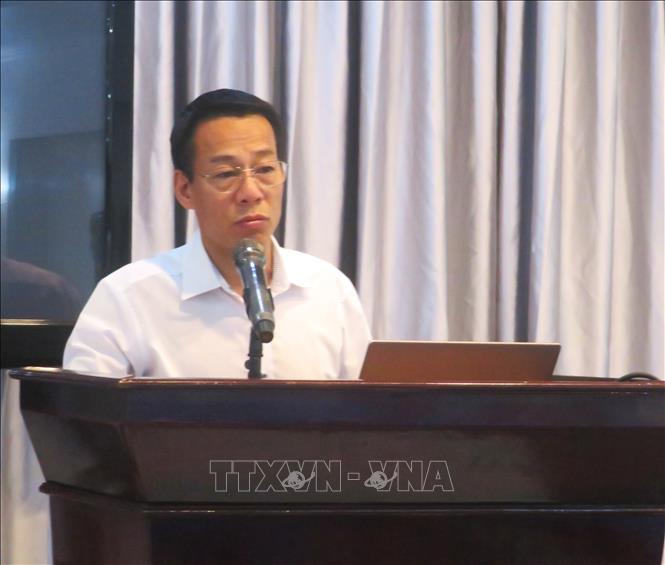
Mr. Phung Nhu Thuy, representative of the Department of Teachers and Educational Management Staff (Ministry of Education and Training), highly appreciated the feedback; stating that many contents accurately reflect the current difficulties faced by educational institutions. The feedback will be compiled, explained, and used to refine the draft before submission for appraisal, ensuring that the new policy, once issued, will be appropriate, feasible, and contribute to motivating teachers to work with peace of mind and continue contributing to the development of the education sector.
Source: https://baotintuc.vn/giao-duc/gop-y-hoan-thien-chinh-sach-tien-luong-phu-cap-cho-nha-giao-20251211183638910.htm


![[Photo] Prime Minister Pham Minh Chinh holds a phone call with the CEO of Russia's Rosatom Corporation.](/_next/image?url=https%3A%2F%2Fvphoto.vietnam.vn%2Fthumb%2F1200x675%2Fvietnam%2Fresource%2FIMAGE%2F2025%2F12%2F11%2F1765464552365_dsc-5295-jpg.webp&w=3840&q=75)

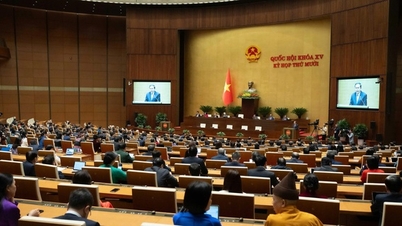
![[Photo] Closing Ceremony of the 10th Session of the 15th National Assembly](/_next/image?url=https%3A%2F%2Fvphoto.vietnam.vn%2Fthumb%2F1200x675%2Fvietnam%2Fresource%2FIMAGE%2F2025%2F12%2F11%2F1765448959967_image-1437-jpg.webp&w=3840&q=75)



































![[OFFICIAL] MISA GROUP ANNOUNCES ITS PIONEERING BRAND POSITIONING IN BUILDING AGENTIC AI FOR BUSINESSES, HOUSEHOLDS, AND THE GOVERNMENT](https://vphoto.vietnam.vn/thumb/402x226/vietnam/resource/IMAGE/2025/12/11/1765444754256_agentic-ai_postfb-scaled.png)




































Comment (0)