

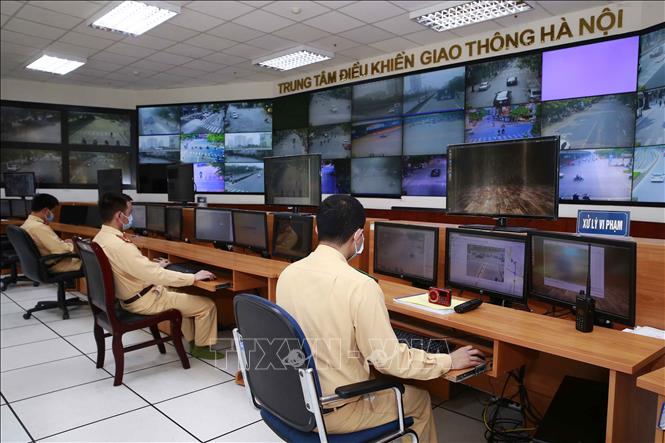
The project aims to build a unified, secure, and efficient IoT application platform to serve the management, operation, and exploitation of the intelligent transportation system managed by the Ministry of Construction ; and to share data with relevant agencies and units.
The target for the 2026-2028 period is to select at least two cities to pilot the implementation of a smart traffic operations center integrating IoT data. 100% of the North-South Expressway (Eastern section) will have a fully implemented electronic toll collection system, and 100% of electronic toll collection data will be integrated into a shared smart traffic data sharing system. 90% of national legal documents, standards, and technical regulations on IoT in transportation will be developed, promulgated, or submitted for promulgation.
During the period 2029-2035, the goal is to have at least 5 cities and 10 provinces deploying and operating smart operation centers integrating IoT traffic data. 100% of IoT traffic data will be standardized and ready for interconnection and sharing between the Ministry of Construction, the Ministry of Public Security , and local authorities. At least 50% of major transportation routes (expressways, ring roads) will have IoT sensor infrastructure installed to serve the management, monitoring, and maintenance of road infrastructure.
To achieve the above objectives, the Plan outlines specific tasks for ministries, departments, localities, and relevant agencies as follows:
Regarding research, proposals, and the refinement of the legal framework for applying IoT in the field of smart transportation, the Project requires the Ministry of Construction to coordinate with the Ministry of Public Security, the Ministry of Science and Technology, the Ministry of Finance, and the Ministry of Justice to complete the system of legal documents. This includes developing a Decree on controlled testing of IoT applications in smart transportation to provide detailed guidance on Clause 3, Article 21 of the Law on Science, Technology and Innovation. Simultaneously, it involves reviewing and supplementing content on digital transformation and IoT applications in legal documents. It also requires research and proposals for mechanisms (financial and technical) to upgrade, transform, or build new IoT infrastructure, ensuring interoperability and data synchronization.
The Ministry of Construction, in coordination with the Ministry of Public Security, the Ministry of Science and Technology, and the Ministry of Industry and Trade, will finalize the technical standards system. They will develop a national set of technical standards for IoT in the field of smart transportation, ensuring consistency, compatibility, and conformity with international standards.
Regarding the development of IoT infrastructure in smart transportation, the plan for the period 2026-2030 requires the Ministry of Science and Technology to coordinate with telecommunications and information technology enterprises to upgrade telecommunications and connectivity infrastructure. It also calls for the development of high-speed, wide-bandwidth, low-latency data transmission infrastructure using 5G technology and optical transmission networks to meet the demand for continuous connectivity; and simultaneously, to enhance the capacity of dedicated communication networks for smart transportation, ensuring stable connections between devices, control centers, and data platforms. Urban areas, expressways, and bus stations will be prioritized for the deployment of synchronous IoT connectivity infrastructure that is scalable and capable of handling high loads.
The Ministry of Construction is leading the implementation of IoT applications in smart transportation management and operation: road, bridge, and tunnel infrastructure; weather and environmental conditions along the route, etc.
Local People's Committees, in coordination with the Ministry of Construction, the Ministry of Science and Technology, and the Ministry of Public Security, will develop mechanisms and upgrade local smart operation centers to integrate IoT applications and connect with the Smart Transportation System Management Center. This will ensure that IoT data collected in transportation is integrated and consistent with regulations on transportation sector database management and general regulations on smart city data to guarantee data security and safety.
Establish a coordination mechanism among ministries, departments, and localities to clearly identify the organizations and individuals responsible for managing, operating, maintaining, and ensuring data security.
The Ministry of Science and Technology is building an integrated platform to connect data with the intelligent transportation system already invested in the Eastern North-South Expressway.
The Ministry of Public Security is building a data center for managing, monitoring, processing violations, and controlling traffic.
Regarding the deployment of IoT in the field of smart transportation, the Project requires the Ministry of Construction to take the lead and coordinate with the Ministry of Science and Technology, the Ministry of Public Security, technology enterprises, universities, research institutes, and local People's Committees to implement IoT applications in the management of transportation infrastructure; toll collection, weight control and traffic safety; multimodal transport management; serving citizens and businesses; and experiencing green transportation and autonomous vehicles. Local People's Committees will apply IoT in traffic management and operation.
The Ministry of Construction is leading the development of a framework of quantitative and qualitative indicators for evaluating the application of IoT in smart transportation (based on four groups of criteria: economic, social, environmental, and technological), serving as a basis for measuring, monitoring, and evaluating the effectiveness of the Project's implementation in each stage.
Resource mobilization: prioritize social mobilization and diversify resource allocation, combining state budget with private capital, ODA funds, and international cooperation to invest in smart transportation IoT infrastructure.
Encourage domestic technology companies to participate in the development of IoT devices, platforms, and services, gradually mastering the technology and reducing dependence on imports.
There are incentive and support mechanisms for research and development (R&D) for businesses, research institutes, and universities in the fields of IoT, AI, big data, and cybersecurity.
Source: https://baotintuc.vn/thoi-su/ung-dung-internet-van-vat-trong-linh-vuc-giao-thong-thong-minh-20251211204337998.htm


![[Photo] Closing Ceremony of the 10th Session of the 15th National Assembly](/_next/image?url=https%3A%2F%2Fvphoto.vietnam.vn%2Fthumb%2F1200x675%2Fvietnam%2Fresource%2FIMAGE%2F2025%2F12%2F11%2F1765448959967_image-1437-jpg.webp&w=3840&q=75)


![[Photo] Prime Minister Pham Minh Chinh holds a phone call with the CEO of Russia's Rosatom Corporation.](/_next/image?url=https%3A%2F%2Fvphoto.vietnam.vn%2Fthumb%2F1200x675%2Fvietnam%2Fresource%2FIMAGE%2F2025%2F12%2F11%2F1765464552365_dsc-5295-jpg.webp&w=3840&q=75)


































![[OFFICIAL] MISA GROUP ANNOUNCES ITS PIONEERING BRAND POSITIONING IN BUILDING AGENTIC AI FOR BUSINESSES, HOUSEHOLDS, AND THE GOVERNMENT](https://vphoto.vietnam.vn/thumb/402x226/vietnam/resource/IMAGE/2025/12/11/1765444754256_agentic-ai_postfb-scaled.png)























![[Photo gallery] Long Thanh Airport 'lights up' ready to welcome its first flight](https://vphoto.vietnam.vn/thumb/402x226/vietnam/resource/IMAGE/2025/12/11/1765467251707_bia_20251211222704.jpeg)
















Comment (0)