

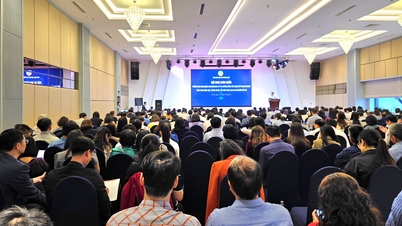
This was the assessment of experts on the story of Hue city at the scientific conference "Hue City in the Flow of History" organized by the Hue City Historical Science Association on the morning of December 10th.
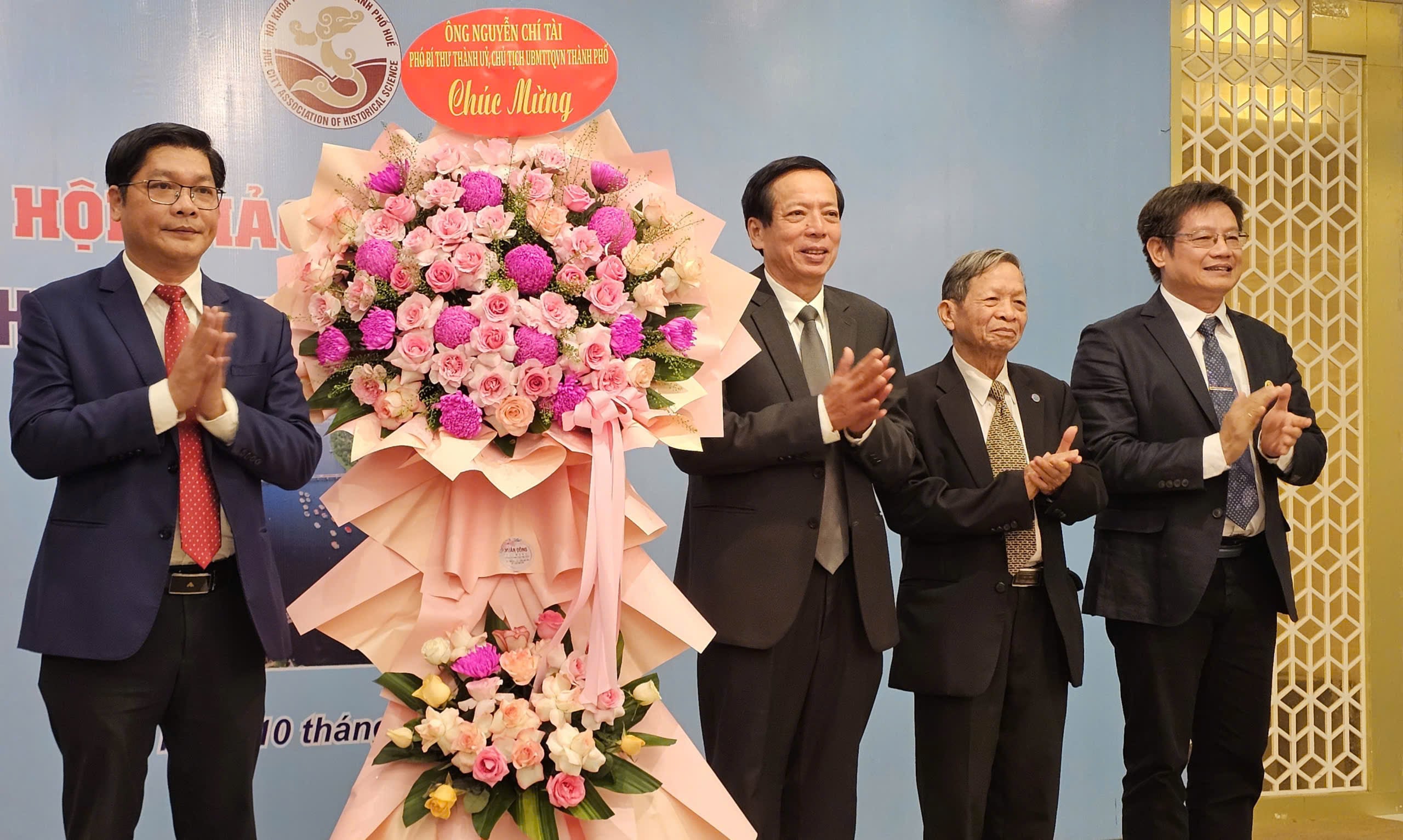 |
| Deputy Secretary of the Hue City Party Committee and Chairman of the Vietnam Fatherland Front Committee of Hue City, Nguyen Chi Tai (left), presents flowers to the organizing committee of the workshop. |
Former Politburo member and former Head of the Central Committee's Ideology and Culture Department, Nguyen Khoa Diem; Deputy Secretary of the Hue City Party Committee and Chairman of the Vietnam Fatherland Front Committee of Hue City, Nguyen Chi Tai; along with representatives from various departments, agencies, experts, and researchers attended the event.
"Without the Perfume River, there would be no Hue."
When discussing the development of Hue city, experts emphasize the role of the Perfume River throughout its history. Dr. Nguyen Dinh - Institute of Environmental Technology, Disaster Mitigation and Climate Change - observes: "It can be said that without the Perfume River, there would be no Hue; and conversely, without Hue, the Perfume River could not have achieved its legendary status as it does today."
Dividing the city in two, this poetic river serves as the urban facade of Hue, becoming the most important organic part of this heritage city. Along with other natural landmarks in its basin, the Perfume River is the decisive factor in the flourishing of Hue.
Furthermore, the rich heritage system, blended with the beauty of the Perfume River, makes Hue considered "a masterpiece of urban architectural poetry," forming the very soul of Hue.
According to this expert, thanks to the Perfume River, relying on the Perfume River, and blending with the Perfume River, the ancient city of Phu Xuan, now Hue City, has integrated precious material and spiritual values to create a unique cultural tradition. Therefore, protecting, preserving, enhancing, and promoting the value of the Perfume River for the sustainable development of Hue City is also an issue that needs to be addressed.
Specifically, it is necessary to continue beautifying the landscape on both banks of the Perfume River, and construction projects must adhere to the principle of not encroaching on or affecting the flow and flood drainage corridor of the river. “Prioritize ecological solutions that harmonize with the natural landscape, minimizing the concreting of riverbanks to maintain water infiltration capacity and a healthy hydrological regime for the river. Urgently issue regulations on the flood drainage corridor of the Perfume River and its tributaries, strictly prohibiting encroachment. Develop, build, and manage a green Hue city, especially new urban areas, with specific regulations and targets regarding drainage space…”, Dr. Dinh stated.
The challenge between urban development and conservation.
From a traditional imperial city, Hue has gradually transformed into a modern metropolis while still preserving its distinctive Eastern architectural and landscape characteristics. The adjustments to its administrative boundaries in 1899, 1929, 1945, 1975, 1990, and from 2021 to 2025 all reflect the need to expand living space, improve governance capacity, and adapt to new development requirements.
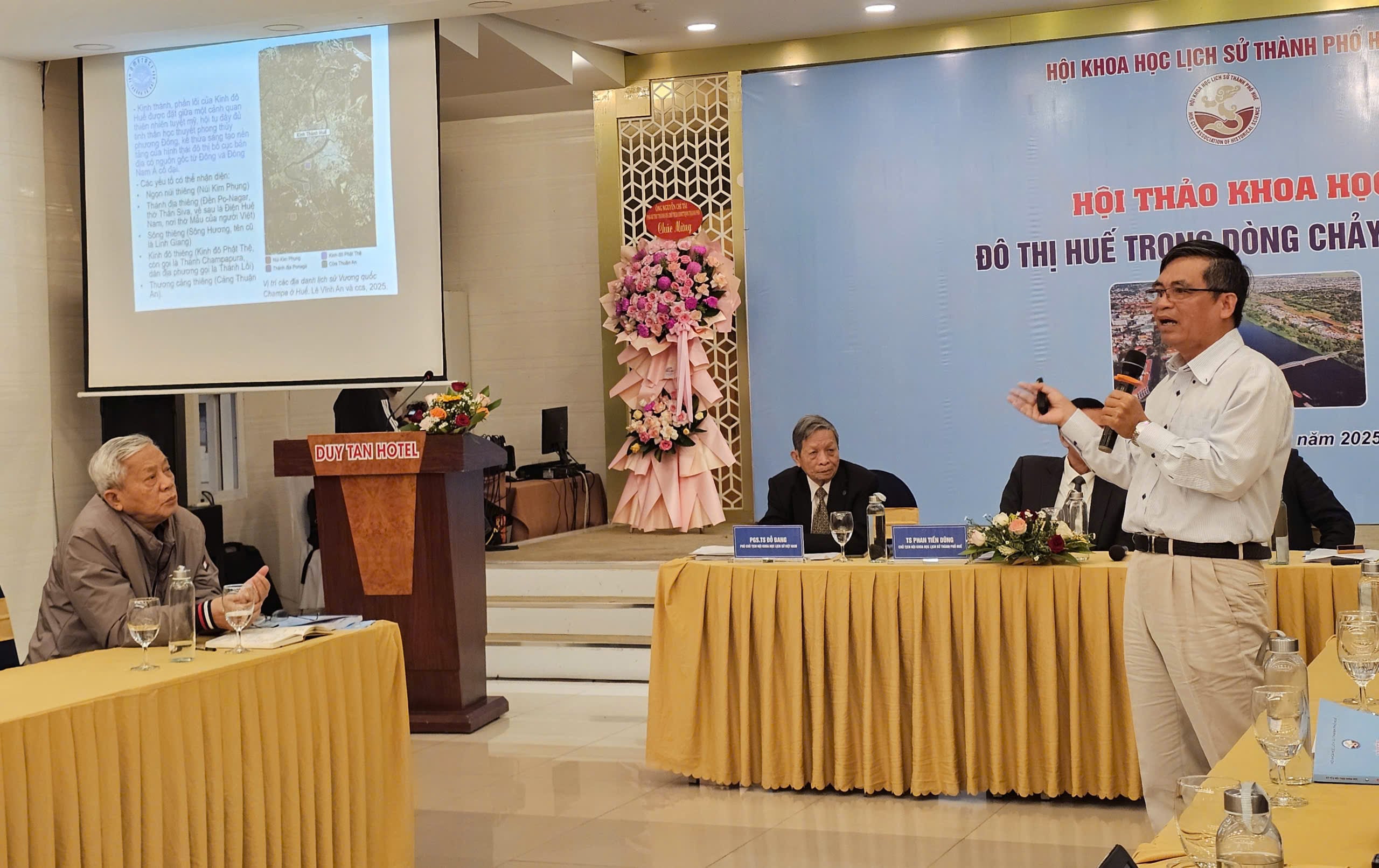 |
| Dr. Nguyen Dinh - Institute of Environmental Technology, Disaster Mitigation and Climate Change, presented his views at the workshop. |
One of the historical highlights when discussing the city of Hue is the official elevation to city status under the central government on January 1, 2025. Associate Professor Dr. Nguyen Van Manh (Hue City Historical Science Association) believes that this event has profound political, cultural, and social significance, reflecting pride and affirming the sustainable development path of Hue in the process of national integration and modernization.
However, along with that honor, Hue is facing many new challenges in harmonizing urban development with the preservation and promotion of cultural heritage values. How to preserve the essence of the heritage city while still meeting the dynamic development demands of the times is a major question facing the government and the community of Hue today.
According to Mr. Manh, cultural heritage in general, and the heritage city of Hue in particular, belongs to the people. Therefore, when the people agree and work together to preserve and promote cultural heritage, the effectiveness of that work will be very high. Conversely, without the support and consensus of the people, the work of preserving and promoting cultural heritage will face many difficulties.
Discussing the demarcation of heritage sites for preservation and promotion, this expert also suggested dividing them into three zones. “These three zones include the original/unchanged urban heritage zone, the adapted/transformed urban heritage zone, and the modern urban zone. The original urban heritage zone includes the Hue Imperial Citadel complex, the garden house heritage areas, colonial architecture, etc. The adapted heritage zone includes the old town of Cho Dinh, Chi Lang, Gia Hoi, the urban area on the north bank of the Perfume River, etc.,” Mr. Manh explained.
Also at the seminar, many issues related to the city of Hue, such as the role of geopolitical factors in the early formation of urban space in Hue; the relationship between the royal city and the commercial city; the values of Hue in its current development; and proposals for Hue to enhance its position in national development, were discussed and suggestions were offered by experts.
Hue is a city of convergence and inheritance. Speaking at the workshop, Deputy Secretary of the Hue City Party Committee and Chairman of the Vietnam Fatherland Front Committee of Hue City, Nguyen Chi Tai, emphasized that the outstanding characteristic of Hue city is its convergence and inheritance. With diverse architectural styles and urban spaces, ranging from folk architecture, royal palace architecture, colonial architecture to modern architecture, while maintaining harmony between built spaces, natural landscapes, and cultural life, this is the foundation that creates the urban identity of Hue - the core value of this heritage city. In the current context, as Hue aims for sustainable heritage urban development, systematic research into the city's historical process; a comprehensive identification of historical, cultural, and spatial structural values; and clarification of the relationship between preservation and development are of paramount importance both scientifically and practically. Therefore, this conference is an important academic forum to gather research results, exchange scientific viewpoints, and adopt a multidisciplinary approach to the urban issues of Hue. “The presentations and discussions at the conference are expected to contribute valuable scientific arguments to serve the planning, conservation, and development of Hue in the future, in conjunction with the implementation of Resolution No. 54 of the Politburo on the construction and development of Hue City,” shared Deputy Secretary of the City Party Committee Nguyen Chi Tai. |
Source: https://huengaynay.vn/van-hoa-nghe-thuat/thong-tin-van-hoa/hue-truoc-thach-thuc-phat-trien-do-thi-va-bao-ton-di-san-160780.html





















![[Video] The craft of making Dong Ho folk paintings has been inscribed by UNESCO on the List of Crafts in Need of Urgent Safeguarding.](https://vphoto.vietnam.vn/thumb/402x226/vietnam/resource/IMAGE/2025/12/10/1765350246533_tranh-dong-ho-734-jpg.webp)










































Comment (0)