

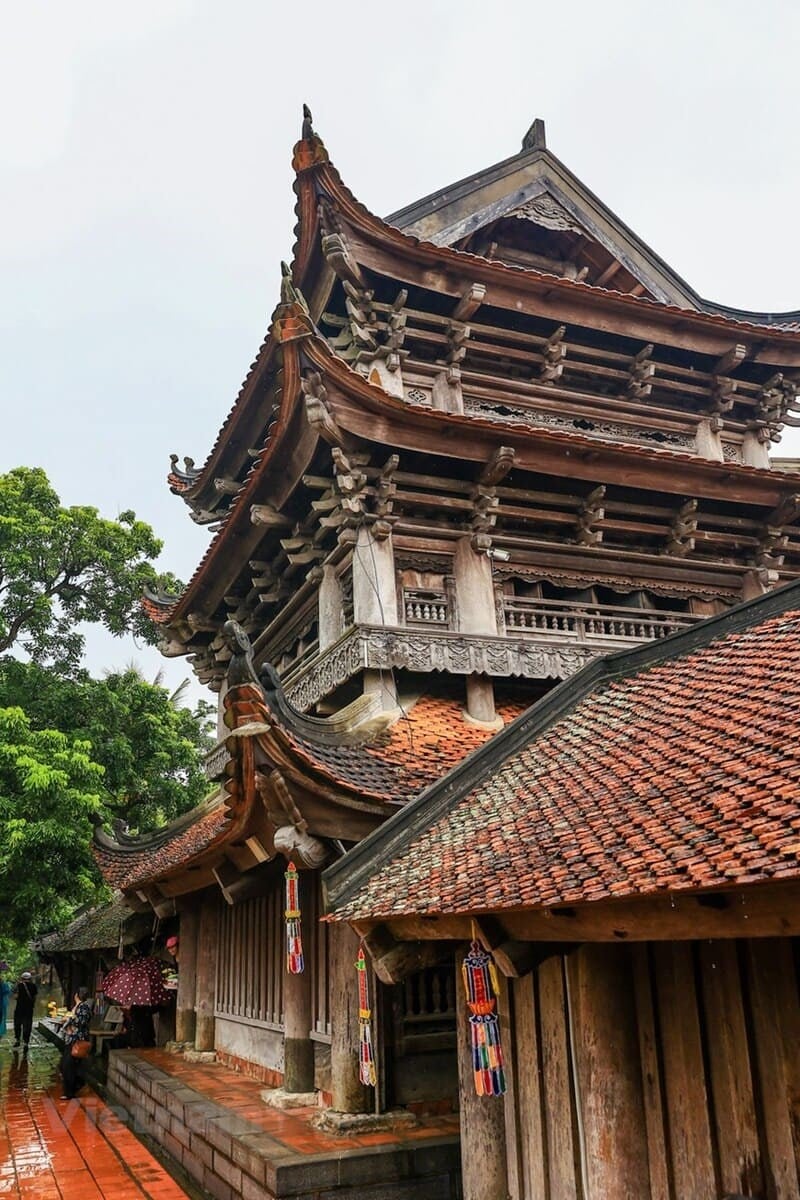
Core Regulatory Values of Vietnamese Buddhism
First, we asked a farmer about 40 or 45 years old why he chanted sutras; he answered happily that his life and his family's were still poor, and every time he chanted sutras and recited Buddha's name, he felt more peaceful and happier.
When we met a renowned scientist who also went to the temple, and he answered the question above, he calmly said that, long ago, Aristotle said that culture is the purification of the soul. He added that real life is too complicated, so going to the temple helps find peace of mind for work and balance in life. We think this is a manifestation of Vietnamese culture.
There are common thoughts and feelings between the poor farmer and the scientist. The farmer says he goes to the temple to find peace, to temporarily forget his life of poverty and hardship. The scientist goes to the temple to find spiritual purification, to temporarily forget the worries and complexities of real life; both aim to live happier and more productive lives.
Thus, there is a similarity in the feelings of two people in different living circumstances, jobs, and social positions, sharing a common goal, which is also an extremely important and essential content of Buddhist teachings expressed in the Dhammapada: "Cease all unwholesome actions; Develop wholesome actions; Purify the mind; These are the teachings of all Buddhas..."
Purification of the mind is the most characteristic philosophy and practice requirement of Buddhism in general and of Buddhism when it entered Vietnam in particular. Buddhism in Vietnam has been "Vietnamized" over thousands of years of history, the most successful and highest achievement being the Truc Lam Zen sect founded by the retired Emperor Tran Nhan Tong.
The essence and depth of cultural value of spiritual purification is the constant perseverance in self-cultivation to strive for perfection, the constant self-control and self-regulation to purify oneself , because "it is we who purify ourselves and it is we who pollute ourselves."
Buddhist philosophy in Vietnamese life
Thus, from ancient times, Buddhist teachings have addressed a concept perfectly aligned with the new scientific term: self-regulation. Atthasàlini , page 63, and The Expositor , Part I, page 91, record this admonition: “When the mind cannot be controlled , one cannot restrain actions, speech, and thoughts. Controlling the mind means restraining body, speech, and mind” (quoted from Narada Maha Thera: The Buddha and Buddhism , Religious Publishing House, Hanoi , 2003, p. 343).
Undoubtedly, self-restraint and restraint are essentially forms of regulation. One of the most fundamental principles of Buddhism is that it is human-centered. The goal of Buddhism – according to its way of thinking and philosophy – is to enable individuals to transcend themselves, to "fight against themselves" (because within each person there is always a mixture of good and bad, virtue and vice, and because this mixture is always "dormant" within them) so that they can strive for perfection, to become more "human."
Here, we connect with a very important philosophy of Buddhism. Becoming more "human" is not about striving for abstract perfection, but about knowing "contentment." Knowing when enough is enough, not chasing after boundless desires of "greed, anger, and delusion." The role of self-regulation is extremely important to Buddhism. This is the foundation that creates the beautiful characteristics of Vietnamese Buddhist culture, and therefore, Buddhist culture has become an organic part of Vietnamese culture, from the past to the present.
On the other hand, Buddhist culture does not stop at the theoretical and philosophical level but goes deep into the lives, thoughts and behaviors of many people and it is a practical, "worldly" culture. This governs the regulatory role of Buddhist culture with its practical value.
In that sense, the important content of Buddhism is the value of practical culture, not stopping at begging and praying, but requiring "continuous and persistent effort... self-control, self-purification, and enlightenment" (quoted from Narada Maha Thera: The Buddha and Buddhism , op. cit. , p. 8). Pure faith cannot purify the body and mind. In the Sutta Pitaka, verse 145, the Buddha admonished: "Only I commit sins, only I defile myself / Only I avoid sins, only I cleanse myself / Purity or defilement comes from within myself / No one can make another person pure."
Buddhist culture has focused on affirming the power of self-regulation ; in other words, the function of self-regulation (self-control, self-purification) has become the most prominent characteristic in Buddhist culture and in Buddhist teachings (the word "Buddhist teachings" - Ohamma - from its root means to support or to restrain . "Supporting" means preventing those who act according to the rules from falling into states of suffering).
The foundation of regulation in Buddhist culture
Thus, self-regulation is essentially a continuous, persistent, silent, and enduring struggle between three well-known categories in Buddhism: greed (lobha), hatred (dosa), and delusion (moha), and non-greed (alobha), non-hatred (adosa), and non-delusion (amoha), which Buddhism summarizes as two categories: "unwholesome actions" and "wholesome actions." This is regulation in the realm of moral culture – a content that plays a dominant role in Buddhism (the Five Precepts, the Four Noble Truths, the Ten Virtues, and the Eightfold Path). So, how can we practice self-regulation to achieve these moral and ethical standards?
Let us listen to the Buddha's answer to Rahula: “If there is something you wish to do, Rahula, think this way: Will this harm me or others, or will this harm both me and others? Then it is a bad action, one that will bring suffering. You must strive to avoid doing it. If there is something you wish to do, Rahula, think this way: Will this not harm me, will not harm anyone else, or will this not harm both me and others? Then it is a good action, one that will bring happiness. You must do this action and repeat it many times.” This is the true value of the concept of function and the practice of regulation in Buddhist culture.
It is precisely because of these positive and deeply humane factors that Vietnamese Buddhist culture has long been a companion to the nation. Selecting these beautiful and unique traditional cultural values to contribute to the building and development of modern Vietnamese culture is a crucial and urgent requirement and task in the context of globalization and international integration today.
(To be continued)
Source: https://baovanhoa.vn/van-hoa/phat-giao-viet-nam-va-vai-role-dieu-tiet-cua-phat-phap-187100.html

![[Photo] The captivating scenery of the fragrant maple forest in Quang Tri](/_next/image?url=https%3A%2F%2Fvphoto.vietnam.vn%2Fthumb%2F1200x675%2Fvietnam%2Fresource%2FIMAGE%2F2025%2F12%2F10%2F1765353233198_lan09046-jpg.webp&w=3840&q=75)

![[Photo] Explore the US Navy's USS Robert Smalls warship](/_next/image?url=https%3A%2F%2Fvphoto.vietnam.vn%2Fthumb%2F1200x675%2Fvietnam%2Fresource%2FIMAGE%2F2025%2F12%2F10%2F1765341533272_11212121-8303-jpg.webp&w=3840&q=75)





















![[Video] The craft of making Dong Ho folk paintings has been inscribed by UNESCO on the List of Crafts in Need of Urgent Safeguarding.](https://vphoto.vietnam.vn/thumb/402x226/vietnam/resource/IMAGE/2025/12/10/1765350246533_tranh-dong-ho-734-jpg.webp)




























































Comment (0)