

 |
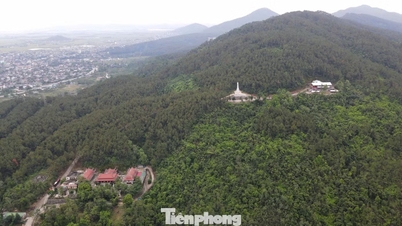
| The peaceful beauty of Tan Do village as seen from above. |
"I sell my soul, not a piece of wood."
Tan Do welcomed us with its characteristic coolness and the earthy scent of plants and the lingering smell of wood smoke from the yin-yang tiled roofs. This small hamlet has long been considered a "living museum" of the Nung people. According to the elders, the Nung people settled here in the 1930s, bringing with them their way of life, customs, and even the passionate sli and then melodies from their homeland in Lang Son to this new land.
Despite enduring many ups and downs, and even though modern life has permeated every corner with new conveniences, Tan Do still retains its pristine beauty. Over 95% of the population are Nung ethnic people, and most importantly, they have preserved almost entirely their traditional stilt houses.
Mr. Kien's stilt house sits modestly in the village, built in 1975 with sturdy pillars. Born in 1962, the year of the Tiger, perhaps that's why his personality is both strong and decisive, yet also possesses the subtlety and quietness of an experienced man.
 |
| A moment of triumph for the farmer-artist alongside his artwork depicting an eagle spreading its wings. |
Sitting at a simple wooden table and chairs, pouring a cup of hot tea for his guest, Mr. Kien slowly recounted his life story. He originally came from a carpentry background, a profession he said he "had practiced since his youth, during the subsidy era." Back then, his skillful hands had built countless rice threshing machines and constructed numerous stilt houses for the people in the region. But the title "carpenter" seemed "too tight a garment" for his creative aspirations.
A turning point in Mr. Kien's life came during a trip to Dong Ky craft village ( Bac Ninh province). In the heart of the most exquisite wood carving village in Northern Vietnam, the young Nung Tan Do was completely captivated. He hadn't received any formal training or had a teacher to guide him. "I just watched others work, and while watching, I imagined what I could make," Mr. Kien recalled. Back home, he bought wood, acquired machinery, and taught himself carving. From lifeless pieces of wood, through his hands and rich imagination, works of art were born.
Unlike other craftsmen who work simply for a living, Mr. Kien approaches woodworking with the mindset of a connoisseur, appreciating beauty. This could be an intricately carved pendulum clock, a majestic eagle soaring, a poetic image of a shepherd riding a buffalo and playing a flute, or a mischievous mouse climbing a papaya or pumpkin...
Mr. Kien believes that wood carving is not about mechanical copying, but about the sublimation of thought. "Sometimes when people buy from me, they say: 'I'm buying your idea and your soul, not just a piece of wood,'" Mr. Kien shared. That statement is his artistic manifesto.
 |
| Skilled hands meticulously craft each detail, transforming rough pieces of wood into works of art. |
His meticulousness was evident in the smallest details. He showed me a statue of a turtle (Quy) and explained in detail: "This turtle shell, the scales must be stacked on top of each other like roof tiles, the upper scales pressing down on the lower ones so that the water can flow. That's the law of nature; doing it wrong will ruin it, it will be illogical." Or, when sculpting the 12 zodiac animals, he said the most difficult were the tiger and the dragon: "The tiger is the king of the jungle; its majesty and spirit are very difficult to portray. If you don't sculpt skillfully, if you don't capture the tiger's power, people will look at it and think it's a cat or a leopard, and it's worthless," he chuckled.
Although he claims to follow his intuition, Mr. Kien is extremely respectful of feng shui principles and traditional culture. He says that there are things he can be creative with, for example, using leftover pieces of wood to carve flowers and branches to make things more lively. But there are things that are governed by age-old conventions, such as the four mythical creatures "Dragon - Kylin - Turtle - Phoenix," and absolutely no other animals should be added arbitrarily, lest it detract from the solemnity and spiritual significance.
Those moments when you "forget to eat, forget to sleep."
When artists are immersed in their creative world, they often forget about reality, and Mr. Kien is no exception. He recounts that whenever he starts a new work, he spends hours just... observing the piece of wood. He has to calculate where the head and tail are, which direction the wood grain runs, and how the wood patterns curl to choose the appropriate carving technique. Sometimes, when he's so focused on his thoughts, he might not answer questions from others, or even ignore his wife and children calling him for dinner – he admits. Those are the moments when he is communicating with the wood.
 |
| Mr. Trieu Van Kien enthusiastically introduced the turtle statue (Quy), a work he cherishes for its logic and natural patterns in each layer of its scales. |
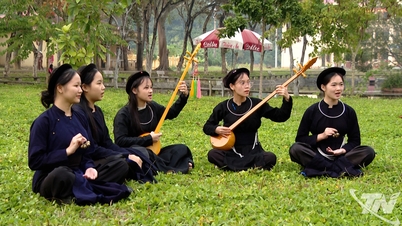
Besides being skilled in sculpting, Mr. Kien is also deeply committed to his ethnic culture. He independently researched and handcrafted Tinh lutes, the "soul" musical instrument of the Tay and Nung people. He understands the structure and musical laws of the instrument to create the most accurate sounds.
Late in the afternoon, the sun gradually sets over the tea hills, and the evening smoke begins to swirl around the stilt houses. Bidding farewell to Mr. Trieu Van Kien, I carried with me the impression of a simple Nung man, yet one who harbored a burning love for beauty. Tan Do is changing every day with the project to preserve the traditional Nung ethnic village and develop community tourism. People like Mr. Kien are the "red bricks" building a solid cultural foundation for this land.
I believe that anyone who holds Mr. Kien's works in their hands will feel the warmth from his skillful hands and the open, genuine "soul" of this village artisan. And, as he said, they are not buying a piece of wood; they are taking home a story, a piece of the soul of Tan Do.
Source: https://baothainguyen.vn/van-hoa/202601/nguoi-thoi-hon-cho-go-fcb3fdd/
![[Image] "Journey of Hope" promotes the organ and tissue donation movement in Vietnam.](https://vphoto.vietnam.vn/thumb/1200x675/vietnam/resource/IMAGE/2026/05/20/1779294400833_1-8910-jpg.webp)

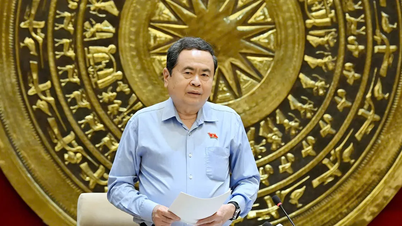
![[Photo] National Assembly Chairman Tran Thanh Man working with the Standing Committee of the National Assembly's Ethnic Council](https://vphoto.vietnam.vn/thumb/1200x675/vietnam/resource/IMAGE/2026/05/21/1779337435930_ndo_br_1-jpg.webp)

































































Comment (0)