

To ensure smooth economic activity and attract investment, large, stable, and continuous power supplies are necessary.
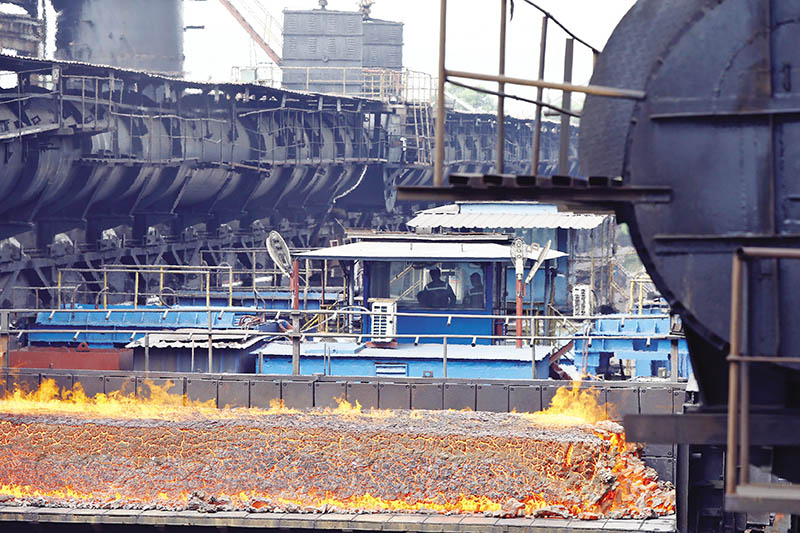 |
| Steel production at Hoa Phat Group. Photo: Duc Thanh |
Electricity is the fundamental foundation.
At a meeting between the Prime Minister and foreign investors a few days ago, the provision of continuous and stable electricity was mentioned by many foreign business associations as one of the key conditions for maintaining production and attracting investment.
Joseph Uddo, President of the American Chamber of Commerce (AmCham) in Hanoi, warned that many of Vietnam's goals will be difficult to achieve without a stable and affordable electricity supply.
The power outages in northern Japan in mid-2023 were also recalled by Japanese businesses, as they made it impossible to plan production and forecast delivery dates. This significantly impacted the Just-in-Time model – the core of the supply chain. Some Japanese companies are even considering and reviewing their global production systems.
Sharing his experience in South Korea, Mr. Hong Sun, President of the Korean Business Association in Vietnam, said that when the Korean Ministry of Trade and Industry developed its industrial development plan, they prioritized electricity development. Without electricity, there is no industry. Steel production, semiconductor manufacturing, displays, batteries… all require electricity, so South Korea needs to ensure a massive power supply.
Statistics published from various sources show that in 2022, South Korea consumed 567 billion kWh of electricity. Thus, with a population of 51.7 million, South Korea has an average electricity consumption of 11,000 kWh per person per year.
During the same period, Vietnam consumed 242 billion kWh. If calculated per capita, that's only 2,420 kWh per year.
Nevertheless, in the past, Vietnam's ability to ensure a stable, continuous, and safe electricity supply has been one of the prerequisites for attracting a large number of investors, including South Korean businesses.
Specifically, by the end of 2013, total investment from South Korea into Vietnam had only reached approximately $23 billion. However, in the following 10 years, by the end of 2023, total South Korean investment in Vietnam had risen to $85 billion. Most South Korean investors in Vietnam during this period have been operating in the industrial manufacturing sector, with major names such as Samsung, LG, Hyundai, and Hyosung.
Currently, according to Mr. Hong Sun, for Korean businesses wishing to invest in Vietnam, especially high-tech companies such as semiconductor companies, Vietnam's electricity shortage is one of the main factors causing them to hesitate in making investment decisions.
This fact once again highlights the urgent need for electricity to be one step ahead in economic development.
A large power source is still waiting.
To ensure the system's operation, it will require power sources with stable and continuous operating hours, such as large hydropower plants, offshore wind farms, coal-fired power plants, gas-fired power plants, or nuclear power plants.
Given Vietnam's current situation and emission commitments, only offshore wind power and gas-fired power, including both domestically produced gas and imported LNG, can now fulfill this task.
 To ensure the system's operation, it will require power sources with stable and continuous operating hours, such as large hydropower plants, offshore wind farms, coal-fired power plants, gas-fired power plants, or nuclear power plants.
However, according to recent calculations by the Ministry of Industry and Trade, it will take 7-10 years to complete the LNG power plant project.
Specifically, it takes 2-3 years to complete and approve the feasibility study and necessary legal documents for an LNG power plant project. Then, it takes another 2-4 years to negotiate the power purchase agreement (PPA) and arrange financing, depending on the investor's capacity, experience, and financial resources. The construction and commissioning time for a plant with a capacity of approximately 1,500 MW is 3.5 years.
However, in reality, even if a project developer has been selected as the investor, if they cannot sign a Power Purchase Agreement (PPA) with Vietnam Electricity Group (EVN), the loan funds for the power project (even if negotiated) cannot be officially disbursed.
Currently, apart from the Nhon Trach 3&4 LNG Power Plant Project, which is over 80% complete but has yet to sign an official PPA, other imported LNG power plant projects, despite having selected investors, have uncertain completion dates.
Even domestic gas-fired power projects like Block B and Blue Whale, while clearly showing potential for efficiency and budget contributions, have not progressed rapidly in the past 10 years. Although the Ministry of Industry and Trade has proposed that relevant ministries develop a financial mechanism for EVN and the Vietnam National Oil and Gas Group (PVN) to implement gas-fired power projects in a coordinated manner, without putting pressure on electricity prices or burdening EVN, it remains uncertain when this will be achieved.
In offshore wind power projects, the situation is even more challenging, as the legal procedures and feasibility of these projects remain unclear. Furthermore, an offshore wind power project typically takes about 7 years to implement.
Furthermore, in order to implement the transmission network development plan as expected in the Power Development Plan VIII, socialized capital is highly anticipated. However, although the amended Electricity Law, effective from March 1, 2022, with its main emphasis on socialized investment in transmission, has not had any decrees or implementing guidelines issued in the past two years. In addition, no private companies have registered to undertake transmission projects like during the previous solar power boom.
Faced with the reality that too many projects are behind schedule or entangled in a "jungle" of procedures, leaving projects in existence but with no clear start or completion date in the last 7-8 years, Mr. Thai Phung Ne, former Minister of Energy, once stated, "We must bring the spirit of Son La and Lai Chau into the implementation of power projects."
Therefore, more than ever, the Government needs to clearly demonstrate its role as the "conductor" in formulating urgent and appropriate countermeasures to diversify investment forms and attract various sources of capital to develop key sectors, including electricity infrastructure, with the goal of ensuring sufficient electricity supply for production and daily life, meeting the requirements of socio-economic development. If there is delay and a lack of decisive action, the price to pay will be unpredictable shocks, not only in economic development but also affecting society as a whole.
Source
![[Photo] General Secretary and President To Lam presides over a working session with the Central Policy and Strategy Committee on the development of the materials industry.](https://vphoto.vietnam.vn/thumb/1200x675/vietnam/resource/IMAGE/2026/05/21/1779359935432_a3-bnd-3129-1412-jpg.webp)





























































Comment (0)