

The Ho Dynasty, with its bold and groundbreaking reforms, lasted only seven years but has sparked much debate in its evaluation and interpretation. The Ho Dynasty was established amidst severe social conflicts, a declining government, rampant corruption, treacherous officials, a weak nation, and a deficient military, while the last Tran emperors were incompetent, thus facing numerous difficulties.
According to historian Le Van Lan, in such a context, Ho Quy Ly's replacement of the Tran dynasty was an inevitable historical event. "The Tran dynasty had lost its role in governing and developing the country due to stagnation in its management thinking and organizational difficulties. Therefore, replacing the Tran dynasty to pave the way for history to continue its progress was Ho Quy Ly's responsibility, alongside his ambition to become a leader, a great leader, a military commander, and an emperor."
The Ho Dynasty lasted only seven years, yet from his time as a high-ranking official in the Tran Dynasty, Ho Quy Ly implemented numerous reforms across various fields. During his approximately 35 years in power under both the Tran and Ho dynasties, he carried out a series of reforms in many areas, altering old policies and proposing new ones. These measures aimed to resolve the socio-economic crisis in Dai Viet, eliminate the separatist elements of the Tran aristocracy, and establish a strong, centralized autocratic monarchy. His reforms were relatively comprehensive and systematic, encompassing many areas from politics and defense to economics, society, culture, and education.
As a talented and ambitious man, even while serving under the Tran dynasty, Ho Quy Ly introduced paper money into circulation for the first time in Vietnam in 1396, replacing the metal coins that had been in use before. This innovation by the Ho dynasty can be considered a great step forward, demonstrating foresight and vision.
Ho Quy Ly was also the first king in Vietnam to widely popularize the use of Nom script, elevating it to an important position. This is seen as an expression of his will to uphold the national spirit. Regarding examinations, although the Ho dynasty only lasted 7 years, it organized two examinations, with nearly 200 people passing. Some talented individuals who passed the examinations during the Ho dynasty later served the Early Le dynasty: Nguyen Trai, Ly Tu Tan, Vu Mong Nguyen, Hoang Hien, and Nguyen Thanh.
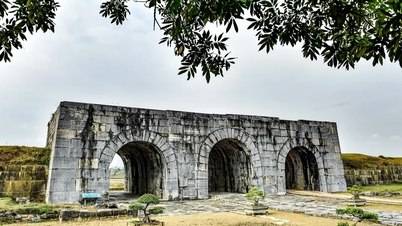
In terms of military affairs , the Ho Dynasty reformed and strengthened the army, eliminating weak personnel, adding strong ones, and increasing the number of troops and local military forces. At the same time, they paid attention to improving military technology. Ho Nguyen Truong, the eldest son of Ho Quy Ly, created new weapons: large cannons and the Co Lau warships for seafaring. Notably, the Ho Dynasty built a new, sturdy stone capital at An Ton, known as Tay Do, often called the Ho Dynasty Citadel.
"The Ho Dynasty Citadel is a globally significant structure, a military fortress that demonstrates the ingenious integration of architecture with the cultural and natural landscape. The construction of the arched vaults is a highly advanced technique of the Ho Dynasty Citadel. Due to the weight of the stones pressing against each other, they do not shift, and are unaffected by strong winds or storms, except in the case of an extremely large earthquake. In the past, the longest stone measured about 6 meters and weighed about 26-27 tons," shared Mr. Truong Hoai Nam, Deputy Director of the Thanh Hoa Center for Historical Research and Cultural Heritage Preservation.
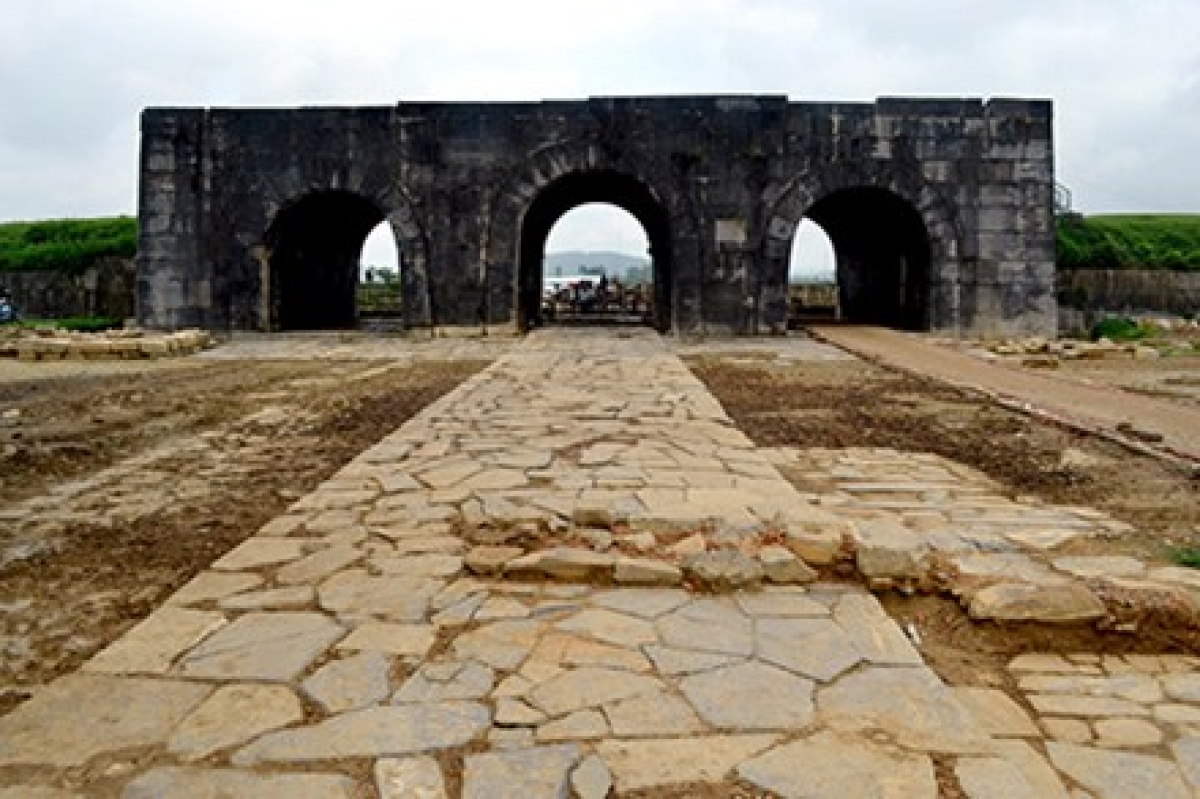
Tay Do Citadel, also known as Ho Dynasty Citadel, is a famous ancient stone architectural structure.
Furthermore, the Ho Dynasty implemented many social reforms, such as land and slave restrictions, the issuance of paper money, the restructuring of the tax system, and the reform of education and examinations. They paid particular attention to reorganizing the army, establishing weapons forging workshops, building ships, constructing fortifications, and strengthening strategic locations for national defense. However, when the Ming Dynasty invaded Vietnam in 1406, despite the Ho Dynasty's efforts to build high walls and deep moats and produce many weapons to resist the enemy, the dynasty still collapsed.
Mr. Do Quang Trong, Deputy Director of the Department of Culture, Sports and Tourism of Thanh Hoa province, believes that although the reforms of the Ho Dynasty did not historically bring truly lasting results for the country—evidenced by the fact that they did not truly help the Ho Dynasty maintain the country against foreign invasion—they are still very commendable and have many positive and progressive aspects. "These policies, along with the Confucian monarchical state model adopted by Ho Quy Ly, later laid the groundwork for the early Le Dynasty. This can be seen as the beginning of the development of our country in the future."
The Ho Dynasty, specifically Ho Quy Ly, is recognized as a great reformer with many progressive ideas in Vietnamese history. However, due to many hasty steps that widened the gap between the court and the people, a major crisis of trust arose in society. This loss of popular support ultimately led to the Ho Dynasty's defeat when the country was invaded by the Ming army.
Source: https://vov2.vov.vn/van-hoa-giai-tri/nha-ho-va-nhung-cai-cach-trong-lich-su-dan-toc-50096.vov2

![[Image] National Assembly discusses the implementation of the socio-economic development plan.](https://vphoto.vietnam.vn/thumb/1200x675/vietnam/resource/IMAGE/2026/04/20/1776696707422_ndo_br_img-20260420-185419-jpg.webp)

![[Photo] General Secretary and President To Lam meets with National Assembly delegates from ethnic minorities.](https://vphoto.vietnam.vn/thumb/1200x675/vietnam/resource/IMAGE/2026/04/20/1776696701056_a1-bnd-8331-3342-jpg.webp)








































































Comment (0)