

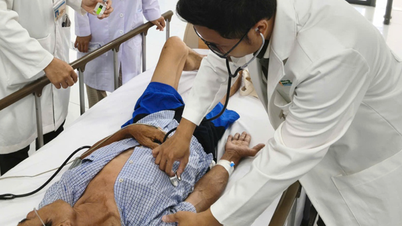
According to Dr. Nguyen Huy Hoang, a member of the Vietnam Society of Underwater and Hyperbaric Oxygen Medicine, the time from waking up until getting out of bed is considered the "critical period" for stroke.
Studies worldwide show that approximately 25% - 30% of strokes occur in the first hour after waking up, primarily between 6 and 9 a.m.
Causes of stroke in the early morning:
Blood pressure spikes, making blood vessels more vulnerable to damage.
Morning is the time when the body makes a sudden transition from rest to activity. Upon waking, the heart rate increases, blood vessels constrict, and blood pressure spikes, triggering simultaneous changes in the nervous system, endocrine system, and blood clotting mechanisms.

The blood vessels in the brain therefore become more sensitive and vulnerable.
One notable factor is the phenomenon of increased blood pressure in the morning. Normally, blood pressure decreases by about 10% - 20% at night, then rises again upon waking.
However, in some people, especially those with long-standing hypertension, diabetes, or atherosclerosis, this increase is too drastic. This "excessive morning hypertension" can cause blood vessels in the brain to rupture or lead to sudden blockages.
Blood clotting and morning hormones increase the risk of stroke.
At the same time, from 6 to 9 a.m., the blood clotting system in the body also functions in an unfavorable way.
Platelets become more prone to clumping, fibrinogen and clotting factor levels are elevated, while the fibrinolytic mechanism is inhibited. This makes it easier for small blood clots to form but difficult to remove, increasing the risk of stroke.
In addition, cortisol, a hormone that helps the body stay alert and respond to stress, peaks around 7-8 a.m.
High cortisol levels make blood vessels more sensitive to vasoconstrictors, making atherosclerotic plaques less stable and thus more prone to vascular events, especially during morning hours.
Morning habits that can trigger strokes
According to Doctor Hoang, some seemingly harmless morning habits can become "triggers" that can cause strokes, especially in the elderly or those with underlying cardiovascular conditions.
Jumping out of bed suddenly: The habit of jumping out of bed immediately after waking up causes a sudden change in blood pressure, and the brain doesn't have time to adapt to the change in circulation, increasing the risk of stroke.
Going out into the cold immediately after waking up: In winter, stepping into a cold environment immediately can cause blood vessels to constrict sharply, blood pressure to spike, and easily lead to ruptured blood vessels in the brain.
Exercising too early and too intensely: Some people have a habit of doing high-intensity exercise right after waking up. When the body hasn't had time to adapt, strenuous activity can put a lot of pressure on the heart and blood vessels.

Avoid drinking water after waking up: After several hours of sleep, the body may be slightly dehydrated, causing the blood to become thicker and increasing the risk of blood clots.
Early warning signs of stroke are important to recognize.
Strokes often occur suddenly, but there are still early warning signs. People need to remember the FAST rule for quick recognition:
Face: Facial asymmetry, uneven smile. Arm: Weakness or numbness in one arm or leg. Speech: Difficulty speaking, slurred speech, unclear speech. Time: Emergency services need to be called immediately.
In addition, patients may also experience symptoms such as: sudden, severe headache, dizziness, loss of balance, blurred or lost vision in one eye, and numbness or weakness on one side of the body.
If these symptoms appear, the patient should be taken to a medical facility as soon as possible, because "time is brain," and the sooner treatment begins, the higher the chances of recovery.
Ways to reduce the risk of stroke in the morning.
To reduce the risk of stroke during peak hours, experts recommend:
Don't jump out of bed immediately upon waking; lie down for a few more minutes, gently move your arms and legs before sitting up; drink about 200 ml of warm water after waking up to aid circulation; keep your body warm, especially in cold weather; avoid sudden exposure to cold weather; maintain good control of blood pressure, blood sugar, and blood lipids.
Making just a few small changes to your morning habits can help your body transition gradually from sleep to activity, limiting blood pressure fluctuations and reducing the risk of cerebrovascular events.
Source: https://baolaocai.vn/nhan-dien-thoi-diem-de-kich-phat-dot-quy-post896124.html





![[Photo] Prime Minister Pham Minh Chinh presides over meetings of the Government Standing Committee to discuss several important issues.](https://vphoto.vietnam.vn/thumb/1200x675/vietnam/resource/IMAGE/2026/03/16/1773674631996_ndo_br_img-5789-jpg.webp)


























![[Photo] Prime Minister Pham Minh Chinh holds a phone call with Angolan President João Manuel Gonçalves Lourenço](https://vphoto.vietnam.vn/thumb/1200x675/vietnam/resource/IMAGE/2026/03/16/1773674632171_ndo_br_dsc-4772-jpg.webp)




































































Comment (0)