

The most decisive factor is Saudi Arabia, and the impetus driving Saudi Arabia to implement significant strategic adjustments to its future political , security, stability, and regional cooperation is the reduced US interest and increased direct involvement of China and Russia in cooperation with countries in the region.
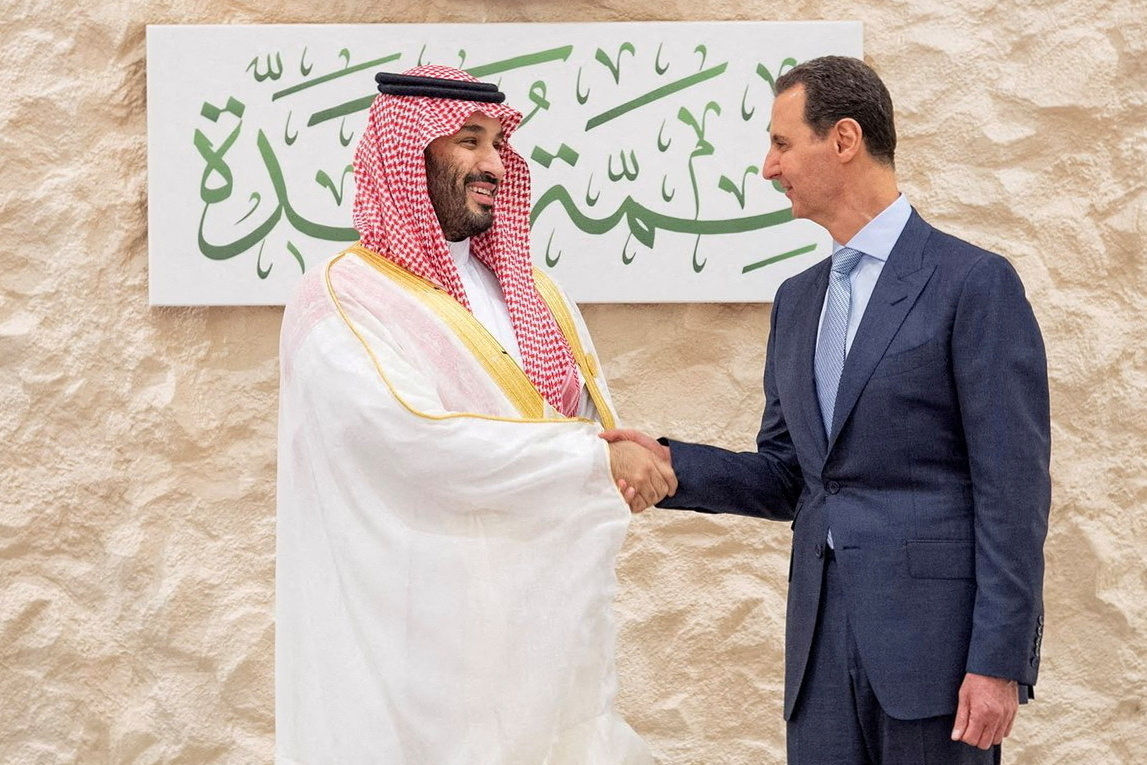
Saudi Arabian Crown Prince Mohammed bin Salman (left) shakes hands with Syrian President Bashar al-Assad before the Arab League summit on May 19.
Here again, national interests come into play. Saudi Arabia realizes it must adjust its strategy before it's too late. Without normalizing diplomatic relations with Iran, the war in Yemen cannot end anytime soon. Meanwhile, another conflict has erupted in Sudan – where Saudi Arabia wants to play a mediating role and end the civil war, not directly engage in conflict. Reconciliation with Syria would prevent Saudi Arabia from pushing Syria further toward Iran, Turkey, and Russia, while several other countries in the region are already gradually normalizing relations with Syria.
Saudi Arabia, having initiated the initiative, must also take the lead in ending the diplomatic conflict with Qatar – which is being joined by Egypt and several members of the Gulf Cooperation Council. Saudi Arabia has publicly shown that it will no longer blindly support the US as it has for so long, while simultaneously being very friendly and trying to win over China.
By establishing a decisive role, Saudi Arabia gradually became the true center of power in this vast region.
Source link


![[Image] National Assembly discusses the implementation of the socio-economic development plan.](https://vphoto.vietnam.vn/thumb/1200x675/vietnam/resource/IMAGE/2026/04/20/1776696707422_ndo_br_img-20260420-185419-jpg.webp)
![[Photo] General Secretary and President To Lam meets with National Assembly delegates from ethnic minorities.](https://vphoto.vietnam.vn/thumb/1200x675/vietnam/resource/IMAGE/2026/04/20/1776696701056_a1-bnd-8331-3342-jpg.webp)


















































































Comment (0)