

While 14-17% of the global population is left-footed, this percentage rises to 23-32% in international football teams, and even reaches 41% among defenders in the Dutch youth teams.
The advantage of being left-footed in top-level football lies primarily in its tactical value. When building a team, recruiters not only consider a player's physical fitness, movement ability, and cognitive skills, but also their left foot, as this characteristic has significant strategic value on the field.
 |
| A shot by Norwegian striker Erling Haaland during the match against Iraq at the 2026 World Cup. Photo: AP |
A Dutch study showed that being left-footed increases the chances of being selected for national youth teams, although this does not guarantee that the player will progress to professional level. At the selection stage, left-footed players are rare, but once they enter the professional football system, the proportion of left-footed players increases significantly, and therefore competition for related positions becomes more intense.
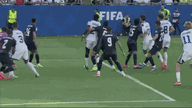


This means that scouts are well aware of the tactical value of being left-footed in football. Teams benefit when players are positioned in the area of the pitch that suits their left foot and playing preference. Players who play in such positions, such as the great Australian left-footed player Harry Kewell, can execute skillful one-touch passes or shots very quickly and effectively (one-touch passing or shooting instead of dribbling).
Left-footed players don't need to change their stance to receive or pass the ball with their left foot, as they are already in the correct position. Generally, being left-footed is more suitable for positions on the left wing in the team's attack, because when dribbling forward, the player doesn't need to move the ball to the right (i.e., towards the inside of the field), thus limiting the opponent's ability to approach and tackle the ball. Similarly, being right-footed is an advantage when playing on the right wing.
 |
| Argentina superstar Lionel Messi dribbles the ball during the Group J match of the 2026 World Cup between Argentina and Austria. Photo: AP |
Left-footed superstars like Messi can also take advantage of this natural advantage when deployed on the right wing as a "reverse winger" by performing diagonal dribbles. Combined with their skillful ball control with their right foot (their non-dominant foot), they can easily deceive the opposing defense, then dribble inwards with their left foot. This allows them to broaden their stance and vision, creating good passing angles for teammates or shooting opportunities.
Facing left-footed players on the pitch is also a difficult task. This is because players are constantly trying to identify the movements of their opponents, both conscious and unconscious, to help them understand what their opponent will do next. Whether it's a slight shrug or a subtle body movement, the way a player moves on the field can signal their intentions or the overall structure of the team's formation. However, when these patterns are disrupted by the less familiar movements of left-footed players, opposing players may need extra time to process the information, make a decision, and then act.



Although top players are highly experienced in dealing with both left-footed and right-footed opponents, these crucial moments, measured in milliseconds, can still decide the fate of an entire World Cup match.
Source: https://www.qdnd.vn/the-thao/worldcup-2026/nhan-world-cup-noi-ve-keo-trai-1046730
![[Image] A look back at the capital's preparations for the century-long master plan.](https://vphoto.vietnam.vn/thumb/1200x675/vietnam/resource/IMAGE/2026/06/29/1782750453122_quy-hoach-100-nam-minh-duy-1-2118-jpg.webp)

![[Photo] General Secretary and President To Lam works with the Party Committee of the Government on the work of preventing and combating storms, floods, extreme natural disasters and climate change.](https://vphoto.vietnam.vn/thumb/1200x675/vietnam/resource/IMAGE/2026/06/29/1782729441945_a1-bnd-0385-9454-jpg.webp)

![[Photo] National Assembly Chairman Tran Thanh Man attends the Conference to announce the Master Plan for Hanoi Capital City with a 100-year vision.](https://vphoto.vietnam.vn/thumb/1200x675/vietnam/resource/IMAGE/2026/06/29/1782709639728_ndo_br_1-jpg.webp)









































































![[Infographic] Notable new regulations for civil servants effective from July 1, 2026](https://vphoto.vietnam.vn/thumb/402x226/vietnam/resource/IMAGE/2026/06/30/1782779868692_infographic-nhung-quy-dinh-moi-dang-chu-y-doi-voi-vien-chuc-co-hieu-luc-tu-ngay-1-7-202620260629111721.webp)