

A plentiful supply of pork will help stabilize prices.
Pork price Pork prices are currently at 66,000 - 74,000 VND/kg depending on the region. This represents a decrease of 10,000 - 15,000 VND/kg compared to the peak at the beginning of the year. However, this is still a profitable price for farmers. It is predicted that live pig prices will stabilize in the near future thanks to the large supply from large-scale livestock businesses and farms, helping to gradually stabilize pork prices for consumers.
At the Tan Binh commune livestock farm in Thai Binh city, Thai Binh province, an average of 3,000 to 4,000 pigs are shipped to the market each day. Larger farms typically ship between 800 and 1,000 pigs per day.
At its peak, the price of live pigs for sale reached 75,000 - 79,000 VND/kg. However, currently, the price of live pigs has dropped rapidly and sharply, by 10,000 - 15,000 VND/kg. Many forecasts suggest that the price of live pigs will stabilize in the near future due to a more abundant supply.
Mr. Pham Ba Vang, owner of a livestock farm in Tan Binh commune, Thai Binh city, Thai Binh province, said: "Currently, the situation in the South has stabilized considerably. The amount of pigs being transported to the South is no longer significant. In the North, supply and demand will be balanced. In my opinion, the price of live pigs will soon return to a stable level."
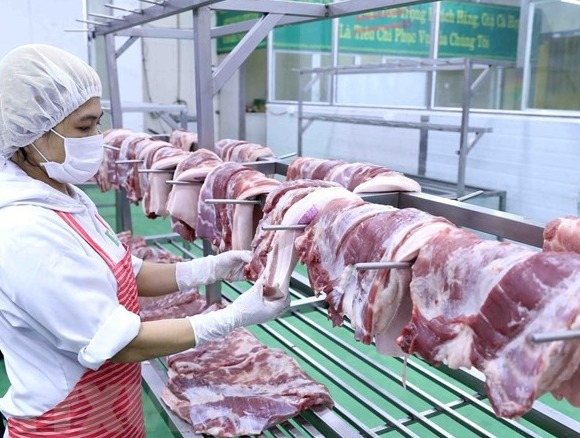
Business activity at the Ha Nam Livestock and Poultry Wholesale Market is no longer as vibrant as before. While two weeks ago around 2,000 pigs were brought to the market daily, this number has dropped to just over 1,000. Many traders have closed the market due to stable supply from other localities.
According to the Department of Animal Husbandry and Veterinary Medicine, Ministry of Agriculture and Environment , the total pig population nationwide is currently estimated at over 30 million head, yielding an estimated 5.5 million tons of pork, a 5% increase compared to last year. This abundant supply provides a basis for the decrease and stabilization of live pig prices and pork prices in markets.
Pork imports increased by 38%.
According to the Department of Animal Husbandry and Veterinary Medicine, the increase to 32 million pigs at the end of last year was the highest in the past five years. Along with this, pork consumption in Vietnam has also shown a gradual increase in recent years. Last year, pork consumption in Vietnam was estimated at 37 kg per person per year. Vietnam ranks fourth in the world for pork consumption.
In addition to the more than 50 million pigs slaughtered annually, businesses also import pork to meet domestic consumption needs.
Quick statistics show that, as of March 25th, Vietnam imported 32,900 tons of pork and 30,500 tons of edible pork by-products, a 38% increase compared to the same period last year.
The largest suppliers of meat and meat products to Vietnam are India, Russia, the United States, Brazil, Canada, Poland, and the Netherlands. The average import price of pork is around US$2,700 per ton, equivalent to approximately over VND 65,000 per kilogram.
Does meat importation affect domestic pork prices?
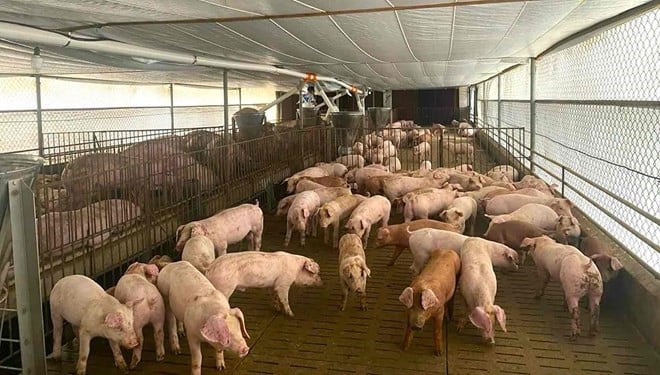
Given the increase in pork imports, many believe this is the reason for the recent rapid and sharp drop in domestic pork prices. However, in response to this information, the Department of Animal Husbandry and Veterinary Medicine, Ministry of Agriculture and Environment, as well as several livestock units, affirm that imported meat accounts for only a very small percentage of the total domestic meat supply, and therefore does not affect domestic pork prices.
Mr. Pham Kim Dang, Deputy Director of the Department of Animal Husbandry and Veterinary Medicine, Ministry of Agriculture and Environment, affirmed: "Regarding imports, we have always imported pork, and this is in accordance with our policy of participating in the international market and agreements with other countries; we still have to allow imports if there is a need. I believe that the amount of imports does not affect pork prices; currently, pork prices are influenced by the abundant domestic supply. When there are signals of rising market prices, livestock farmers, especially large enterprises, must change their farming methods."
"I believe that pork imports don't significantly affect domestic pork prices because the amount imported isn't excessive compared to domestic demand. However, if we don't properly control the import sources, especially smuggling across the border, it will lead to potential disease outbreaks, threatening the domestic livestock industry," assessed Mr. Pham Ba Vang, owner of a livestock farm in Tan Binh commune, Thai Binh city, Thai Binh province.
Some experts believe that increased meat imports put pressure on the industry's development from the perspective of livestock farmers. However, from a market perspective, this is also beneficial for consumers. This is a market principle that enhances the competitiveness of Vietnam's livestock industry.
To ensure a fair competitive environment and the quality of imported meat, it is crucial to strengthen control and supervision by relevant authorities regarding the types and quality of imported meat.
Source: https://baoquangninh.vn/nhap-khau-thit-khong-anh-huong-gia-lon-trong-nuoc-3353494.html
![[Photo] Prime Minister Pham Minh Chinh presides over a meeting on private sector economic development.](/_next/image?url=https%3A%2F%2Fvphoto.vietnam.vn%2Fthumb%2F1200x675%2Fvietnam%2Fresource%2FIMAGE%2F2025%2F12%2F20%2F1766237501876_thiet-ke-chua-co-ten-40-png.webp&w=3840&q=75)


![[Photo] Prime Minister Pham Minh Chinh presides over the conference announcing the establishment of the International Finance Centre in Vietnam.](/_next/image?url=https%3A%2F%2Fvphoto.vietnam.vn%2Fthumb%2F1200x675%2Fvietnam%2Fresource%2FIMAGE%2F2025%2F12%2F21%2F1766309817714_ndo_br_dsc-3400-jpg.webp&w=3840&q=75)


















































































Comment (0)