

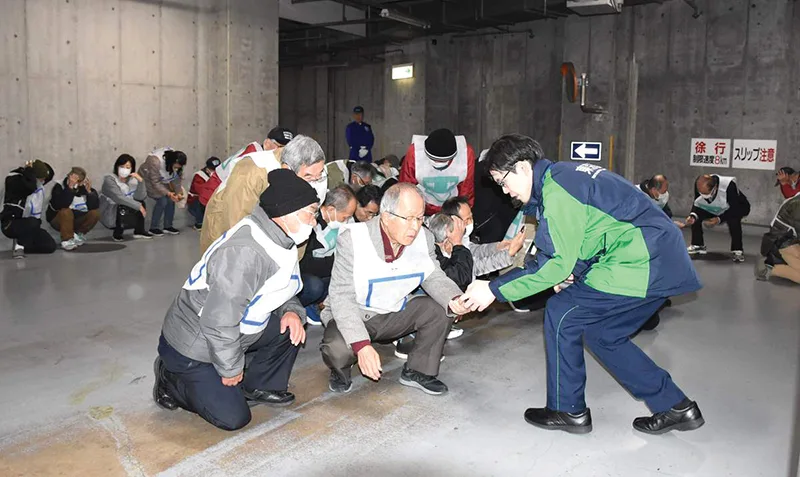
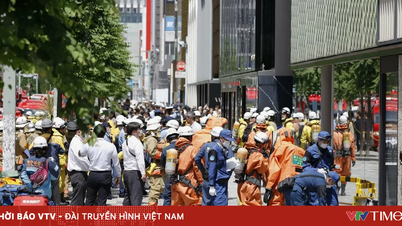
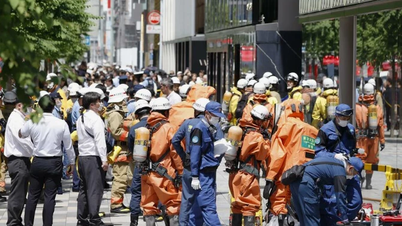
An evacuation drill in a Tokyo underground parking garage earlier this year. Photo: Yomiuri Shimbun
Shortages everywhere.
A public facility in Kumamoto City has been designated as an emergency evacuation center. This is because a nearby Japan Ground Self-Defense Force (GSDF) base deployed long-range missiles in late March. With the capability to reach coastal areas of China, this base could become a target in the event of a crisis.
The facility in question could serve as an evacuation center in the event of an earthquake or storm, but it lacks any underground structures.
Kumamoto has 12 underground facilities, enough to serve about 5% of the population. Developing additional facilities from this point onward will not be easy and will require coordination with the central government .
In Shizuoka Prefecture, long-range missiles were also deployed at a GSDF base in Oyama town in late March. The prefecture's 116 underground shelters are mostly concentrated in urban areas.
In Kashiwazaki City, Niigata Prefecture, where the Kashiwazaki-Kariwa nuclear power plant is located, 15 underground pedestrian tunnels have been identified as shelters. However, local residents remain concerned about their ability to withstand an emergency.
In Shimane Prefecture, where the Chugoku Electric Power Company operates a nuclear power plant, the situation is no better. The entire prefecture has only three underground shelters, while the prefectural nuclear safety office admits to "not knowing of any privately owned underground facilities."
The village of Tokai in Ibaraki Prefecture is home to a nuclear power plant operated by Japan Atomic Power Company. More than 900,000 people live within a 30km radius of the plant – the highest number of people living near any nuclear power plant nationwide – yet the prefecture has only 13 underground shelters.
Last March, the Japanese government approved a plan to ensure shelter in case of ballistic missile attacks. The Northeast Asian nation aims to have 100% of its population in all regions have shelter by 2030.
The total capacity of shelters currently exceeds 150% of the population, but the coverage rate of highly secure underground shelters is just over 5%. Countries like Switzerland and South Korea recognize only underground facilities as shelters, and their coverage rates are both above 100%.
Construction costs are high.
According to the Japan Nuclear Shelter Association, an underground shelter capable of holding seven people costs between 80 million and 100 million yen (US$630,000) to build. A prototype built by the organization in 2023 cost approximately 60 million yen, but escalating material prices since then have driven costs up sharply.
For larger-scale facilities, the costs are even higher. Starting in fiscal year 2026, the Tokyo Metropolitan Government will renovate an emergency supplies storage facility at Azabu-juban station on the Toei subway system into a 1,400m² underground shelter. Approximately 4.2 billion yen has been allocated for this project. However, the ground in many areas of Japan is quite soft, so additional costs may arise.
On the Sakishima Islands in Okinawa Prefecture, development of designated evacuation facilities is scheduled to begin in fiscal year 2026, amid concerns about a potential crisis involving Taiwan. These sites are designed to respond to scenarios such as missile attacks or amphibious landings, with financial support from the central government.
Conversely, there is currently no mechanism to support the construction of emergency shelters nationwide, including underground bunkers, so local authorities often have to bear the majority of the costs themselves.
According to Japan's Civil Protection Law, prefectures and cities designated by the government are responsible for selecting emergency evacuation facilities. These facilities must be accessible to the public within 1-2 hours in situations such as missile attacks.
HANH NGUYEN (According to Nikkei Asia, Japan Forward)
Source: https://baocantho.com.vn/nhat-thieu-ham-tru-an-cho-nguoi-dan-a205331.html









































































Comment (0)