21 types of income that are tax-exempt.
According to the Personal Income Tax Law of 2025, 21 types of income are exempt from tax. This policy aims to ensure social security, support the people, and encourage production development, investment, innovation, and environmental protection. Many regulations remain unchanged from before. For example, income related to real estate between close relatives is still tax-exempt, including income from the transfer, inheritance, or gift of real estate between spouses; biological parents and children; adoptive parents and adopted children; father-in-law and mother-in-law and daughter-in-law; father-in-law and mother-in-law and son-in-law; and income from the transfer of housing, land use rights, and assets attached to land owned by individuals in Vietnam who only own one house and land. Income from savings deposits, interest on government bonds, interest from life insurance contracts, and remittances are also exempt from personal income tax.

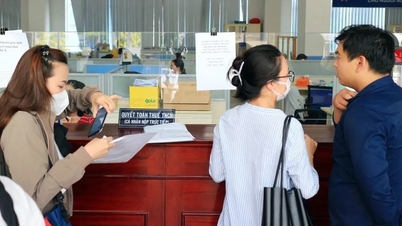
Several new regulations regarding personal income tax will take effect from July 1st.
Photo: Ngoc Duong
At the same time, there are some new regulations regarding tax-exempt income that taxpayers need to pay attention to in order to enjoy the benefits. These include income from dividends of members of agricultural cooperatives and cooperative unions; individual farmers who have signed contracts with businesses participating in "Large-Scale Farming" projects, production forestry, and aquaculture; interest from green bonds; interest from local government bonds; wages for night work, overtime, and wages paid for days not taken as leave as prescribed by law; income of individual investors, founders of innovative startup businesses, etc.
Simultaneously, the law applies a 5-year exemption from personal income tax on income from salaries and wages of individuals who are high-quality digital technology professionals engaged in research and development of high-tech or strategic technologies as stipulated by the law on high technology. Similarly, it exempts from tax the transfer of open-ended fund certificates established under the law on securities that have been held for 2 years or more from the date of purchase; and reduces the tax by 50% on dividends received by individual investors from securities investment funds and real estate investment funds.


Notably, the 2025 Personal Income Tax Law also raises the tax threshold from VND 10 million to VND 20 million for income taxable on a transaction-by-transaction basis. This includes income from lottery winnings, royalties, franchise fees, inheritances or gifts, and other income (including the transfer of Vietnamese national domain names ".vn", the transfer of greenhouse gas emission reduction results, carbon credits; the transfer of auctioned vehicle license plates, and the transfer of digital assets). This means that the amount of tax individuals have to pay will be less than before for the aforementioned types of income.
Another significant change is that the 2025 Personal Income Tax Law has adjusted the progressive personal income tax rate for income from salaries and wages from 7 brackets down to 5, increasing the personal allowance for taxpayers and dependents (the allowance for taxpayers has been raised to VND 15.5 million/month (equivalent to VND 186 million/year); the allowance for each dependent has been raised to VND 6.2 million/month). Similarly, the personal income tax threshold for individual businesses and household businesses has been raised to VND 1 billion/year. These regulations on salary and wage income for individuals and household businesses have been applied since the beginning of 2026. The law also adds a provision that expenses for healthcare and education of taxpayers and their dependents can be deducted from income before tax calculation at a rate stipulated by the Government. Thus, many personal income taxpayers will benefit from tax reductions this year.
Expedite the issuance of implementation guidelines.
Lawyer Tran Xoa, Director of Minh Dang Quang Law Firm, commented that the addition of many tax exemption and reduction policies is very good for taxpayers. For example, raising the tax threshold from 10 million VND to 20 million VND for certain incomes such as lottery winnings and gifts is appropriate in practice. More significantly, there are tax exemption and reduction policies for certain sectors, including those related to science and technology.
This is the first time a personal income tax exemption policy has been specifically implemented for industrial and digital technology professionals. This regulation clearly demonstrates the government's orientation towards attracting and retaining high-quality human resources for strategic technology sectors, creating advantages for businesses in the science and technology field. It also reflects the government's policy of developing science and technology and innovation to drive economic growth. Similarly, allowing deductions for medical and educational expenses for taxpayers and their dependents is also a new step forward in the Personal Income Tax Law. This helps taxpayers feel secure in fulfilling their tax obligations after covering essential expenses for themselves and their families.
However, the decree guiding the implementation of the 2025 Personal Income Tax Law has not yet been officially issued. Therefore, businesses still face difficulties in applying it. Similarly, the law mandates the Government to specify detailed regulations on other tax thresholds, such as deductible expenses for healthcare and education of taxpayers and their dependents, but these have not yet been issued. This could inadvertently disadvantage taxpayers.
"Assuming medical expenses are deductible, regulations regarding invoices and receipts must be followed. If the guiding decree has not yet been issued, taxpayers will not know how much they are entitled to deduct and therefore will not know whether they need to obtain invoices for safekeeping. For example, if a taxpayer's parents have been ill and discharged from the hospital, even after detailed regulations are issued, they cannot return to the hospital to obtain invoices and receipts. In that case, the taxpayer will not be able to deduct these expenses as stipulated, meaning the amount of tax they have to pay will be higher. Therefore, providing detailed guidance and regulations on certain income items that are exempt from or subject to tax reduction, or the threshold for deductible expenses in personal income tax, is an urgent issue that needs to be issued by the Government as soon as possible so that citizens and businesses can confidently comply," lawyer Tran Xoa proposed.



Adding more income items subject to personal income tax.
Conversely, the 2025 Personal Income Tax Law also adds more taxable income items. These include income from agency, brokerage, and business cooperation activities with organizations; income from e-commerce and digital platform-based businesses; fees and monetary or non-monetary benefits in any form (for income from salaries and wages); income from the transfer of Vietnamese national domain names ".vn"; income from the transfer of greenhouse gas emission reduction results and carbon credits; income from the transfer of vehicle license plates won through auctions as prescribed by law; income from the transfer of digital assets; income from the transfer of gold bars, etc.
Source: https://thanhnien.vn/nhieu-thu-nhap-duoc-mien-giam-thue-18526070221072896.htm