

Price fluctuations are a general rule of the market. Price increases or decreases for any group of goods are normal occurrences. But for agricultural products, especially fruit, there seems to be a pattern that has existed and continues to exist. When a particular fruit fetches a high price, it almost always triggers a massive surge in its cultivation. Durian is a recent example.
Actually, before durian, there was a story involving dragon fruit. There was a time when you could hear people planting dragon fruit everywhere you went. During that period, along with many other provinces and cities, the area planted with dragon fruit in Tien Giang increased very rapidly, despite warnings from relevant authorities. The export value generated by dragon fruit during this period was also very high, consistently ranking among the top. However, after only a few years, dragon fruit was overtaken by durian in the export sector.
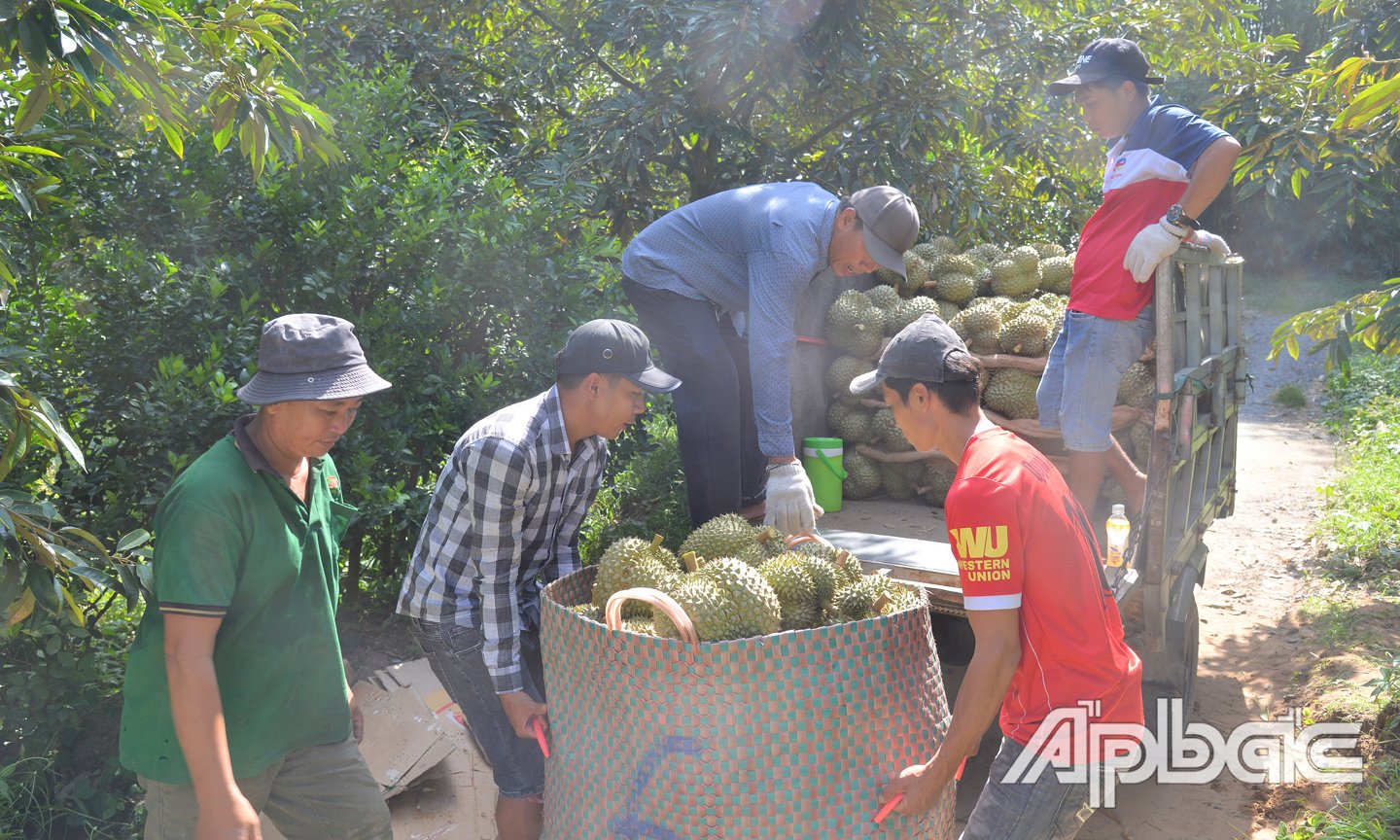 |
| Harvesting durian. |
Evidence shows that while Vietnam's durian export value in 2020 was very low at $116 million, it then increased slightly to over $177 million, reaching nearly $421 million in 2022 and hitting $3.2 billion in 2024. However, in contrast, the value of durian exports nationwide in the first four months of 2025 only reached $130 million, while in the same period of 2024 it reached $500 million. Looking at the current situation, it seems that the current story of durian is repeating the "scenario" of dragon fruit a few years ago.
In fact, "scenarios" regarding agricultural product prices are no longer rare. The examples of several agricultural products demonstrate that the "trend-driven" nature of agricultural production still persists. This reality poses a difficult challenge for the agricultural sector nationwide, and Tien Giang province in particular. Looking at the practical situation, one of the key perspectives of Tien Giang's agricultural sector in implementing agricultural restructuring in the coming period is to shift the mindset from agricultural production to agricultural economic development, meeting market demands; applying high technology and organic farming; using less inorganic fertilizers and water in production; producing along value chains and building brands; and focusing on developing processing industries and supporting industries linked to agricultural economic development.
This is seen as a step in line with the general trend of agriculture nationwide and adapting to modern consumer demands. However, realizing this goal will require time and effective steps. Above all, individual farmers need to transform their production mindset to adapt, limiting the tendency for trends to flourish for a few years and then fade away, leaving behind significant negative consequences.
TT
Source: https://baoapbac.vn/kinh-te/202505/nhin-tu-sau-rieng-1043050/

![[Photo] General Secretary To Lam receives President of the European Council Antonio Costa](/_next/image?url=https%3A%2F%2Fvphoto.vietnam.vn%2Fthumb%2F1200x675%2Fvietnam%2Fresource%2FIMAGE%2F2026%2F01%2F29%2F1769697816651_a1-bnd-5216-9741-jpg.webp&w=3840&q=75)


![OCOP during Tet season: [Part 3] Ultra-thin rice paper takes off.](/_next/image?url=https%3A%2F%2Fvphoto.vietnam.vn%2Fthumb%2F402x226%2Fvietnam%2Fresource%2FIMAGE%2F2026%2F01%2F28%2F1769562783429_004-194121_651-081010.jpeg&w=3840&q=75)


![OCOP during Tet season: [Part 2] Hoa Thanh incense village glows red.](/_next/image?url=https%3A%2F%2Fvphoto.vietnam.vn%2Fthumb%2F402x226%2Fvietnam%2Fresource%2FIMAGE%2F2026%2F01%2F27%2F1769480573807_505139049_683408031333867_2820052735775418136_n-180643_808-092229.jpeg&w=3840&q=75)
![OCOP during Tet season: [Part 1] Ba Den custard apples in their 'golden season'](/_next/image?url=https%3A%2F%2Fvphoto.vietnam.vn%2Fthumb%2F402x226%2Fvietnam%2Fresource%2FIMAGE%2F2026%2F01%2F26%2F1769417540049_03-174213_554-154843.jpeg&w=3840&q=75)



Comment (0)