

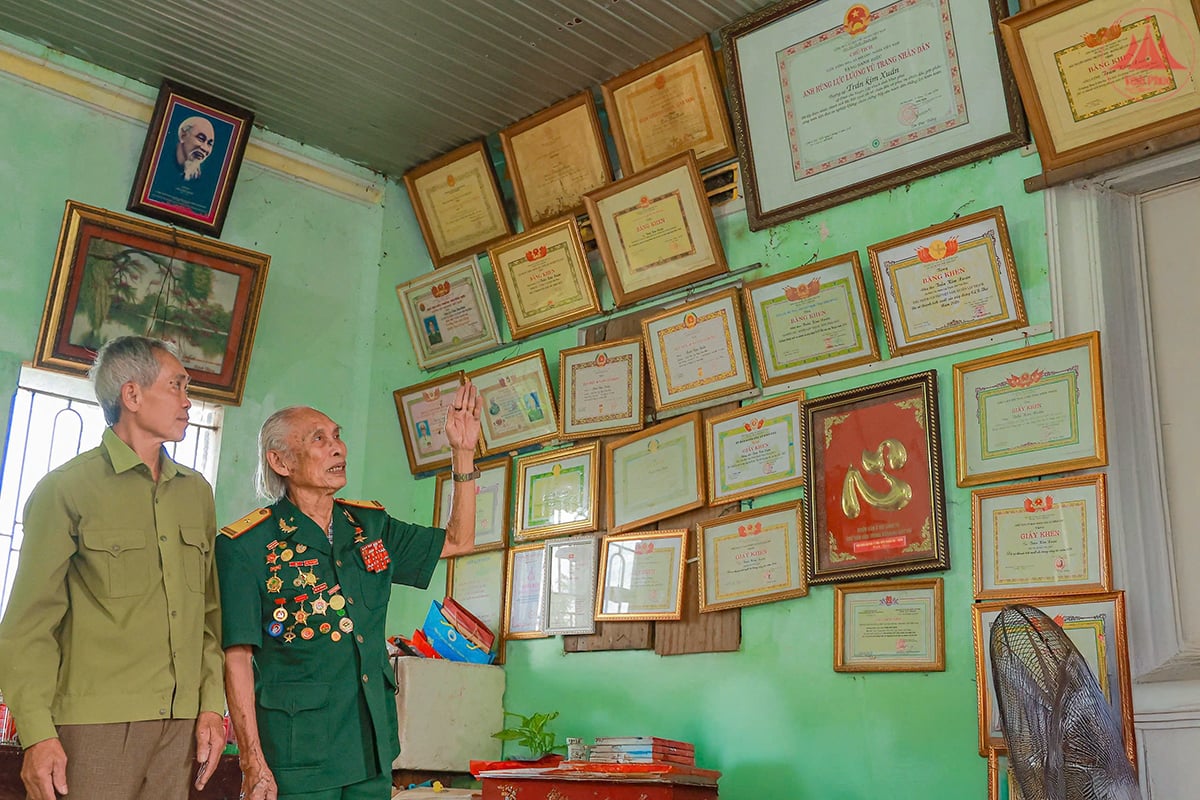
Hero of the People's Armed Forces Tran Kim Xuan proudly displays his Certificates of Merit, Commendations, and war relics. Photo: Tra Huong
Ensuring safety on the roads.
During the war against the US for national liberation, Hero of the People's Armed Forces Tran Kim Xuan - a son of Dinh Chu commune (Lap Thach district) - was the Company Commander of the bomb and mine disposal team of the Engineering Command. He successfully commanded his company to defuse more than 83,000 bombs and mines; of which, he personally handled nearly 1,500, contributing to ensuring the safety of vital routes from North to South.
Mr. Xuan said: “The work of defusing bombs and mines always demands a high level of intelligence, spirit, perseverance, and caution. To successfully carry out the assigned task, I and the entire team have strived to research ways to handle and successfully defuse many types of bombs and mines. I have created many new methods to minimize risks and improve the efficiency of bomb and mine disposal, such as digging trenches, connecting electrical wires, creating ignition points to detonate bombs remotely; using rattan and bamboo ropes to camouflage and defuse entangled bombs… but the greatest success is defusing magnetic bombs.”
In 1968, the US imperialists used MODEN2 magnetic bombs to attack and block supply routes from North to South Vietnam used by our troops. Due to their complex operating principles and immense destructive power, neutralizing MODEN2 magnetic bombs was extremely dangerous and difficult.
When directly approaching the magnetic bomb, Mr. Xuan had to recall the information he had heard beforehand and try to think of a way to safely defuse it. Finally, he decided to use a manual method, employing a wooden shovel, wooden mallet, a screwdriver made of brass, and a wrench made of aluminum to avoid creating a magnetic field that could activate the bomb. Then, using a brass punch, he removed the detonator's control device in a counter-clockwise direction. This method neutralized the bomb's trigger, preventing the creation of a magnetic field, making the bomb removal easier and safer.
Shortly afterwards, the Engineering Command disseminated this method throughout the army, helping to neutralize thousands of MODEN2 magnetic bombs, making a significant contribution to the victory of our army and people in the resistance war against the US. The life of Hero of the People's Armed Forces Tran Kim Xuan is a vivid symbol of the intelligence and courage of Uncle Ho's soldiers.
The unwavering loyalty of a communist soldier
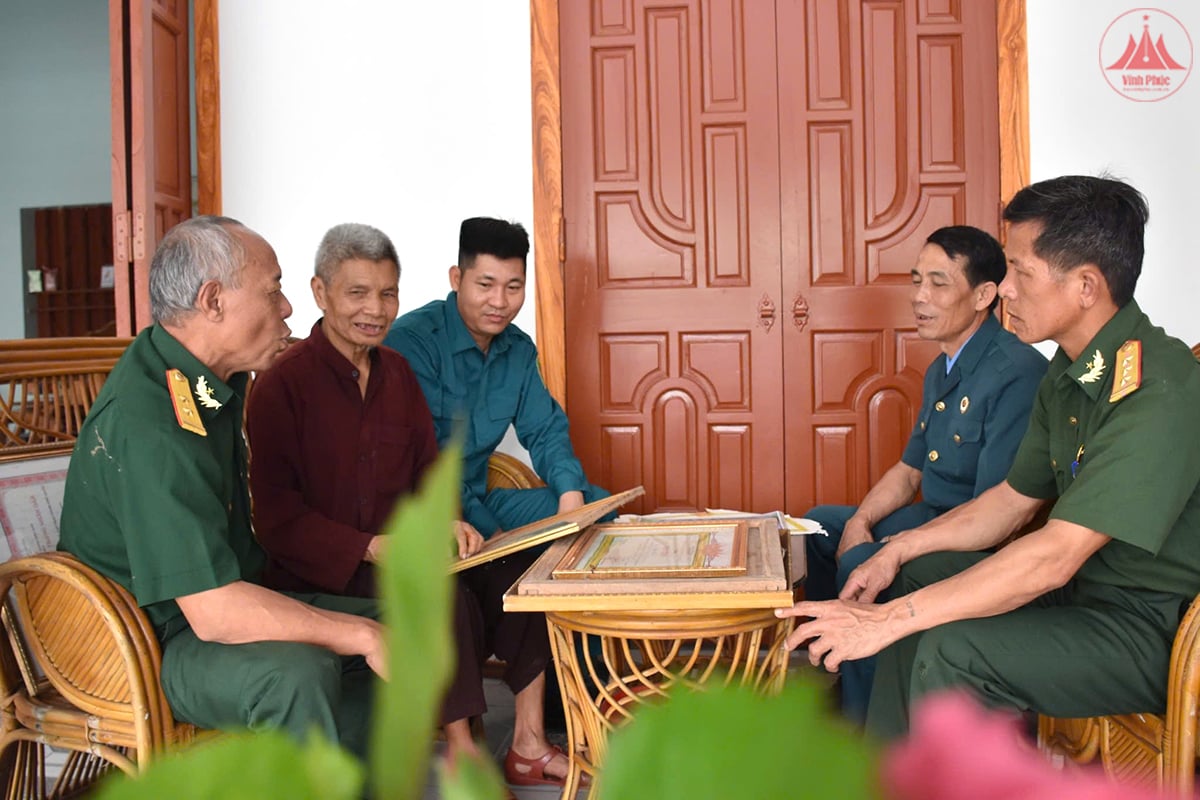
Former Phu Quoc prisoner Nguyen Thai Hoc (in brown shirt) recounts his years of captivity and torture by the enemy. Photo: Tra Huong
Mentioning veteran Nguyen Thai Hoc from Yen Duong commune (Tam Dao district), one cannot help but admire the steely spirit and unwavering loyalty of this revolutionary soldier who was exiled to Phu Quoc prison – once known as "hell on earth".
Mr. Hoc joined the resistance against the Americans when he was 22 years old. In 1970, he was captured by the enemy and subsequently imprisoned in Phu Quoc prison. There, he endured brutal forms of torture such as nailing his hands and feet, breaking his teeth, and being exposed to the sun in a barbed wire "tiger cage" for months on end.
But the most horrific and haunting was the method of nailing through body parts, until the wounds became gangrenous, corroding his body and causing him to die and come back to life many times. Despite this, his love for his homeland and revolutionary ideals were the sources of strength that kept Mr. Hoc steadfastly loyal to his country.
In 1973, when the Paris Agreement was signed, he was one of the first communist fighters to be released. Greeting him on the banks of the Thach Han River ( Quang Tri province ), many of his comrades were heartbroken to see that the once strong young man, weighing over 60kg, was now just skin and bones, weighing less than 24kg, his legs atrophied from torture, unable to stand…
Fifty years have passed since the war ended, but the painful historical scars remain etched on the body of the communist soldier Nguyen Thai Hoc. These include the throbbing pain of shrapnel lodged in his head whenever the weather changes, the toothless smile caused by many teeth broken by the enemy, and the shriveled flesh from the tortures of being nailed to the cross…
Ms. Nguyen Ngoc My, Principal of Yen Duong Secondary School, shared: “Whenever veteran Nguyen Thai Hoc comes to school to talk about revolutionary traditions, both teachers and students are moved by the story told by a historical witness about a glorious period of the nation. The many wounds on Mr. Hoc's body help us feel the unwavering loyalty, courage, and willingness to sacrifice for the independence and freedom of a soldier of Uncle Ho.”
Historical link
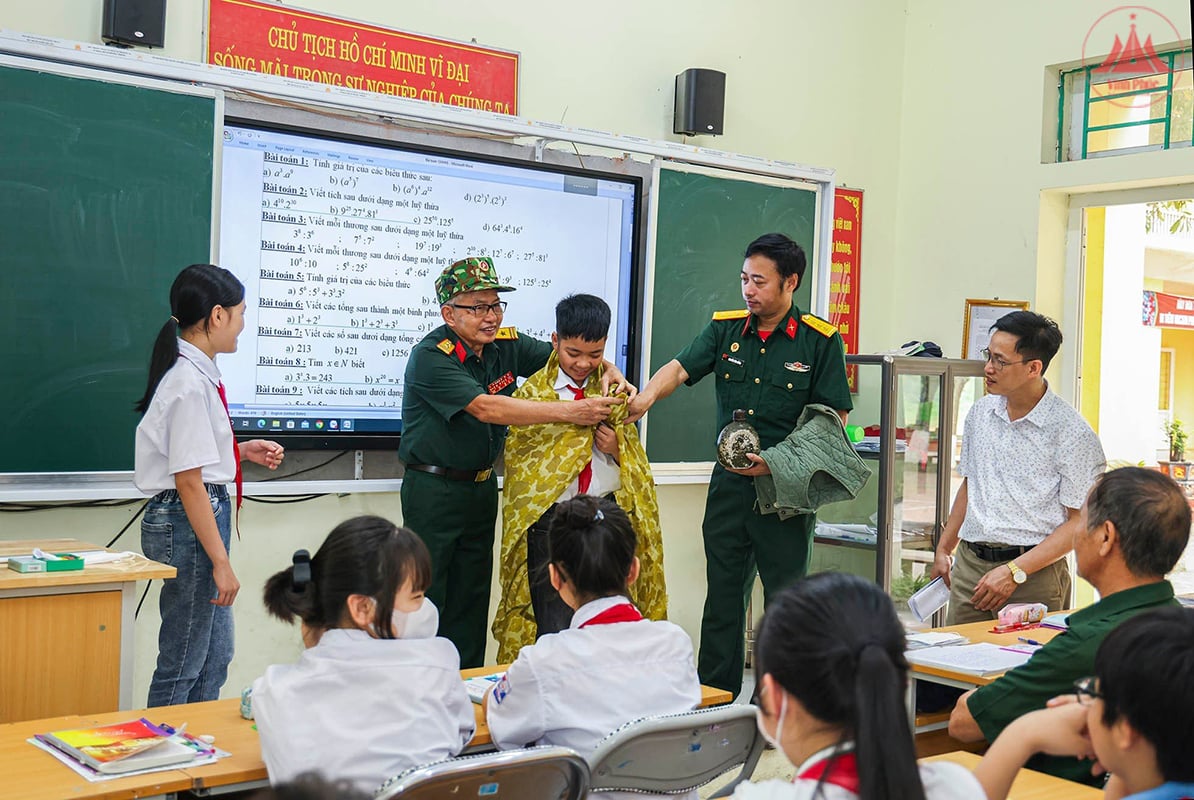
Veteran Nguyen Xuan Chen talks about revolutionary traditions to students at Tam Hong Secondary School. Photo: Tra Huong.
Born and raised amidst the flames of war, heeding the sacred call of the Fatherland, in 1967, Mr. Nguyen Xuan Chen, a son of Tam Hong town (Yen Lac district), volunteered to march south, bravely fighting against the Americans as a Saigon commando. He and his comrades directly participated in many famous battles, such as the Tet Offensive of 1968 and the Spring Offensive of 1975.
After the liberation of South Vietnam, he worked at the Military Administration Committee of Saigon. In 1979, when the border war broke out in the North, despite studying at the Political Academy, he put aside his studies to defend the country's border. After the war ended, he continued his studies and work until 1990, when he retired and became involved in local community activities.
As a historical witness, veteran Nguyen Xuan Chen regularly meets and talks with students from schools in the town about the history of the nation's and homeland's struggle, contributing to "passing on the revolutionary spirit" to the younger generation.
Veteran Nguyen Xuan Chen shared: “Many decades have passed, but I still vividly remember the years of the resistance war, the hardships and sacrifices, and the fiery era of our nation. I actively participate in history talks at conferences and schools because I want to recount my and my comrades' real-life experiences to help the younger generation understand a part of the painful but heroic period of our nation's history and appreciate the value of independence and freedom. From there, I hope to awaken pride and cultivate love for our homeland, and the aspiration to contribute in future generations…”
Time may erase many things, but the memories of soldiers – witnesses to history – remain deeply etched in the nation's history. These memories are nostalgia, a way of life, a flame that ignites the faith and aspirations of an entire generation. As the country achieves peace and development, the stories of revolutionary soldiers become precious historical documents, constantly reminding us of the value of independence and our responsibility to preserve and build our nation.
Minh Huong
Source: http://baovinhphuc.com.vn/tin-tuc/Id/126574/Nhung-chung-nhan-lich-su

















































Comment (0)