

The days leading up to Tet in the Central Highlands were cold, but not so cold as to cause tea leaves to curl up like in the North. Highway 19, running from the coast of Binh Dinh to the Cambodian border, is nearly 200km long. Before the Tet of 1972, we organized many battles along this route. We were on the west side, while the enemy was on the east. Near Tet, the Saigon puppet army still controlled as far as Duc Co ( Gia Lai ) bordering the border. The last buses from the coast to Thanh An Holy Church also arrived around Tet. We and the enemy fought fiercely to seize territory at the time of flag raising. With only two days left until the first day of Tet, many comrades had already died, to the point that there were leftover Tet gifts brought to the battlefield. Those who survived didn't want to eat the candy or smoke the cigarette that belonged to those who had died.
 |
| The author (far right) and his platoon members on Highway 7, March 1975. Photo provided by the subject. |
Near Tet (Vietnamese New Year), the forests of the Central Highlands were shrouded in white mist. In the morning, looking from our outpost on Chu Rong Rang mountain towards the enemy, we saw them raising yellow flags and helicopters flapping their wings as they landed at Tam outpost. Our scouts, using binoculars, reported that some high-ranking officer had come down to comfort and boost the morale of the South Vietnamese soldiers. Standing on the high mountain range and looking down at Highway 19, we saw the road as narrow as a ruler, its black surface resembling a dark line. Smoke from cooking fires drifted like mist from the villages with their white tin roofs. The scouts said they even saw girls in traditional ao dai dresses walking around the villages. The soldiers exclaimed to each other, "That's lovely!"
On the first day after the signing of the Paris Agreement, everyone thought peace was finally here. The soldiers dreamed of returning home to their parents, wives, and children; everyone was in a daze. The cook carried rice and water up to the outpost for the soldiers to celebrate Tet (Lunar New Year). Each squad received two cans of meat. Each platoon received a 50g packet of tobacco, as big as a pack of dried rations. It was great! Plus, each person received four Dien Bien cigarettes and two candies. In the outpost's bunker, there were bamboo tubes pickling green chilies with salt, giving off a fragrant aroma. There were also some sweet potato vines with green leaves that someone had found somewhere, ready to be peeled and cooked with the canned meat for a soup to celebrate the first meal of the new year.
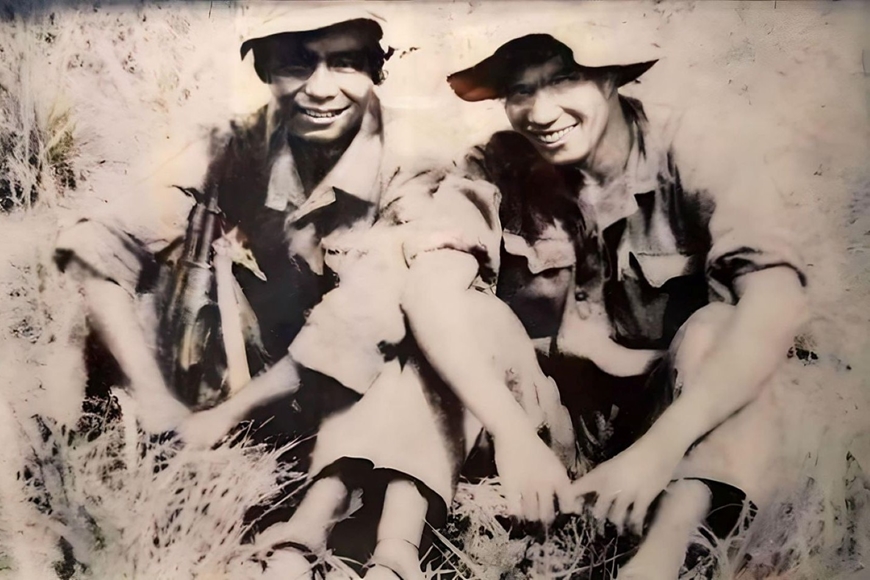 |
| The author (left) and soldier Dinh Ngoc Sy in Cu Chi during the Ho Chi Minh Campaign, April 1975. Photo provided by the subject. |
On the afternoon of the thirtieth day of the Lunar New Year, sporadic gunfire erupted from the enemy. The company officer said, "The enemy's just firing for fun during the New Year; we don't have any spare ammunition to reveal our position. Just ignore them, but we must remain vigilant in case they come up and 'bite' us. That would be terrible." At that moment, I thought, why don't the commanders speak like in the newspaper articles and short stories? None of them were putting on a show of being a comrade; they just called him Luân, Hoan, or Sỹ. Sometimes, during the gunfire, they even swore. They cursed at the cowardly men who bowed their heads and didn't dare look up to fire. They swore a lot. After the fighting, they would chuckle...
I vividly remember the details of smoking on the first night of Tet that year. At that time, I was a squad leader in Platoon 1, Company 1, Battalion 8, Regiment 64, Division 320. Khuat Duy Hoan was in Company 7 with me. Hoan still had some rolled tobacco he'd brought from the North, hidden away like gold. We'd each roll a small cigarette, no bigger than a cassava leaf stem, and smoke together in solidarity... On the first night of the year after the signing of the Paris Agreement, the cold dew fell on the eyelids of the soldiers at the border outpost.
On the second day of Tet (Lunar New Year), Hoan went on a "mission" (to "improve" the soldiers' meals). This kind of "mission" only existed in the Central Highlands battlefield. The platoon trusted Hoan a lot, because Hoan was brave and would surely find something to eat. Hoan returned after three hours. He had wrapped himself completely in sweet potato vines, making him look like a gnarled, green tree trunk. Hoan untangled each strand of vine into a pile. The pile of vines was lush and green. The bunkers divided the vines among themselves, each bunker taking a little bit...
The Tet holiday of 1975 – the last Tet holiday of the war – was in the Buon Ho area (Dak Lak). At that time, we were stationed along Highway 14 bordering the district capital. As Tet approached, I was assigned the task of leading a pig, a gift from the division to the battalions for the Tet celebration. On the way past the 24th Medical Company, I led the pig to visit my friend Dinh Ngoc Sy, a former medical student who was now a nurse there. That very day, Sy was admitted to the Party. We hugged and wished each other a Happy New Year for a while before I led the pig back. On the night of the thirtieth of Tet, the company gathered under a dense, dark canopy of forest trees surrounding the small radio set of the Political Commissar.
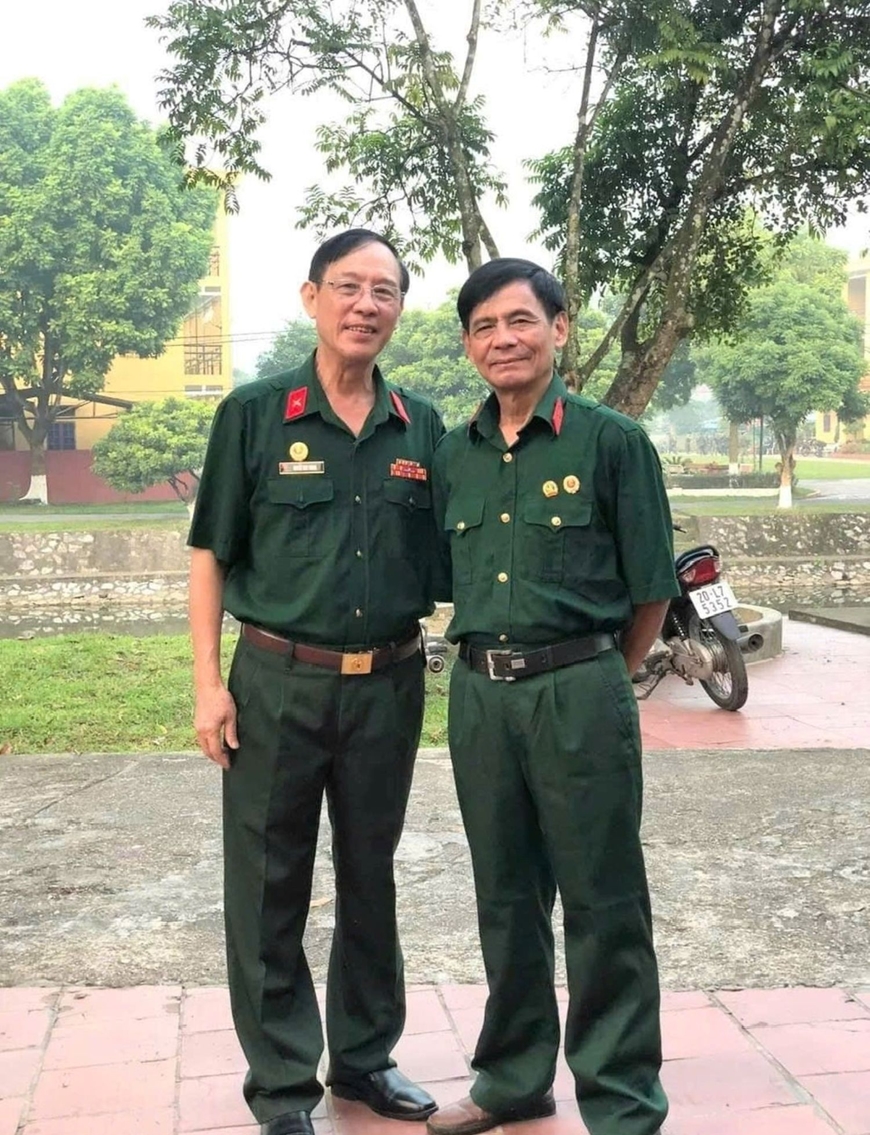 |
| The author (on the right) and his teammate Khuat Duy Hoan. Photo provided by the subject. |
That year, the superiors reinforced our troops for a major campaign, so we had enough soldiers. The new recruits were excited about their first battle and the opportunity to participate in a major operation. The older soldiers were quieter, looking at the newly recruited soldiers—all handsome and well-behaved—and thinking to themselves how many more would be gone in a month or two. Oh well! Cheer up for good luck in the new year. We played "picking flowers of democracy" and celebrated the New Year in the dim light of a storm lamp hung on a holly tree, symbolizing the "flower of democracy." After celebrating the New Year at the company, we returned to our platoon. The pipe, passed from platoon leader to platoon leader, whirred as it returned. Suddenly, gunfire erupted from Highway 14—exactly 11 p.m., the enemy's shift change. Our side still had an hour until New Year's Eve. This was the last New Year's Eve with two hours of celebration in our country. It was also the last New Year's Eve on the border of our country. Two months later, my unit and I followed the entire campaign to liberate the Central Highlands, then the Ho Chi Minh Campaign, and finally advanced all the way to the Independence Palace.
So, in the year of the Dragon, 1976, I got to celebrate Tet (Lunar New Year) in my hometown. It was my first Tet at home after the war, and I missed my friends who couldn't come back so much. I remembered those Tet celebrations on the border between our side and the enemy, with the chilly mist and the battles fought during Tet. After April 30, 1975, I returned to university and later became a mechanical engineer. My friend, Khuat Duy Hoan, pursued a military career, rising to the rank of Colonel, Deputy Commander of the 3rd Army Corps before retiring. And Dinh Ngoc Sy is now an Associate Professor, Doctor, and former Director of the Central Tuberculosis and Lung Disease Hospital (now the Central Lung Hospital). Every Tet, the three of us would sit together and recount the Tet celebrations we had experienced in the border regions.
Source: https://www.qdnd.vn/bao-quan-doi-nhan-dan-xuan-binh-ngo-2026/nhung-lan-don-tet-o-vung-giap-ranh-1025450




































































Comment (0)