

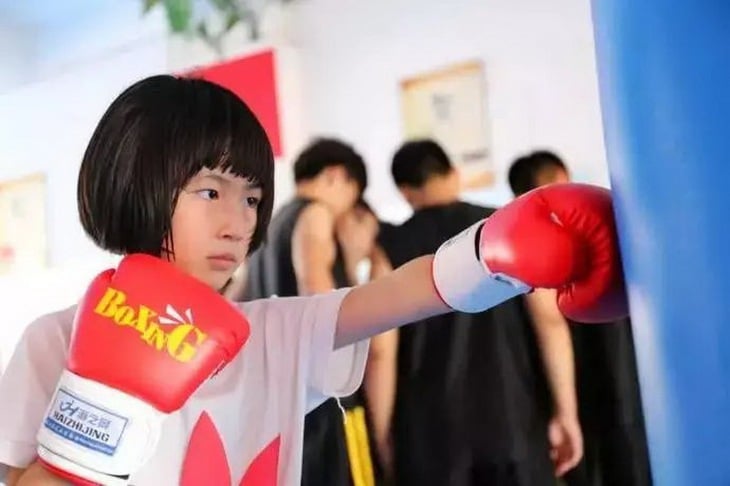
Children should not be allowed to practice boxing too early - Photo: BT
If you only encourage your child to play sports for physical development and health benefits, here are some sports to avoid.
Weightlifting, lifting heavy weights
Sports involving heavy weightlifting, especially those aimed at maximizing strength, are not suitable for children under 12 years old.
When lifting heavy objects, axial compressive forces are transmitted directly through the spine and the ends of the long bones, where growth plates are located. This area is very sensitive and vulnerable during the growth years. Once the growth plates are affected, height growth can be interrupted or even stopped.
Dr. Avery Faigenbaum, a pediatric sports medicine specialist at The College of New Jersey (USA), warns: "Heavy weight training in children needs to be approached with extreme caution. When the growth plates are still open, applying excessive axial pressure – such as when lifting heavy weights – can lead to permanent damage. This damage not only affects height but can also misalign the bone's growth axis."
Contact sports involve strong physical contact (boxing, MMA, etc.)
These sports involve frequent, forceful, and sometimes potentially damaging collisions, easily leading to injuries to the head, neck, spine, or knee joints. This is especially true when a child's musculoskeletal system is not yet fully developed, increasing the risk of long-term damage.
Repeated injuries to the joints can cause misalignment of the bones or lead to premature degeneration of the joints.
Dr. Lyle Micheli, director of the Pediatric Sports Medicine Center at Boston Children's Hospital, stated: "Repeated trauma or impact to a child's developing joints can disrupt normal bone development. This can lead to permanent deformities in body shape or skeletal structure."
In general, sports science experts believe that children should only be introduced to these sports when they are 12 years of age or older.
High-intensity bodybuilding and strength training (bodybuilding, advanced crossfit)
While basic strength training exercises with light loads may be suitable for children, high-intensity training aimed at increasing muscle mass, burning fat, or competing carries significant risks.
Repeatedly lifting and pushing heavy objects without proper technique can cause muscle strain, ligament sprains, and injuries to the shoulder, knee, or spinal joints.
The American Academy of Pediatrics, in its 2020 recommendations, states: "High-intensity strength training is not suitable for children under 15 years of age unless carefully supervised by professionals. Children are not miniature adults – their musculoskeletal systems are not yet stable enough to withstand heavy loads. Improper training can damage the fundamental structure of bones, affecting long-term development."
Long-distance running and endurance competitions (marathon, trail running, running over 10km)
While running can be good for cardiovascular health and overall well-being, long-distance running, especially marathons, is not suitable for children or even minors.

Children should only run distances under 3km - Photo: LM
A child's knee, ankle, and hip joints are still developing and are easily overloaded if subjected to continuous activity for extended periods.
Furthermore, high-intensity training without adequate nutrition can lead to Relative Energy Deficiency in Sports (RED-S), causing hormonal imbalances, delayed puberty, and even decreased bone density.
Dr. Kathryn Ackerman, a sports endocrinologist at Harvard Medical School and director of the RED-S Center in Boston, warns: "High-intensity, prolonged endurance training for children should be strictly limited. Prolonged energy deprivation in pre-pubescent children can slow height growth, affect reproductive function, and lead to poor bone density."
Activities involving excessive stretching and bending (gymnastics, intensive ballet)
Over-exerting yourself during bone development can easily lead to permanent ligament stretching, causing joints to become loose, unstable, and at a higher risk of dislocation.
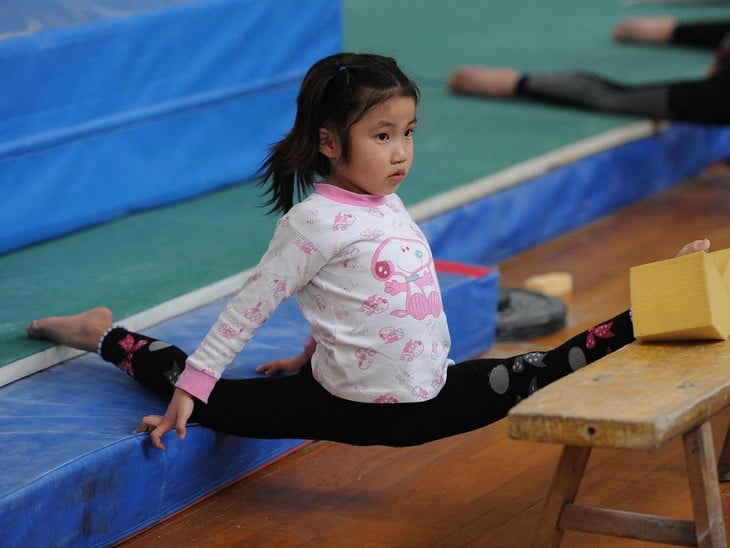
Many gymnasts are unable to reach their full height potential - Photo: BARCROFT
Girls who participate in intensive ballet or gymnastics training from a young age have also been noted to be more prone to endocrine disorders, delayed puberty, or stunted growth due to the intensity of training being too great for their bodies' recovery capabilities.
A review published in the British Journal of Sports Medicine (2017) stated: "Professional gymnastics training before puberty may suppress the growth hormone response, slowing skeletal maturation and potentially resulting in lower final heights than their genetic potential."
Source: https://tuoitre.vn/nhung-mon-the-thao-tre-em-nen-tranh-20250604180402911.htm


























































































Comment (0)