

Faults from the forest slope
The road leading up to the mountains west of the city on a mid-April morning was bathed in soft sunlight, enough to clearly see the hillsides changing day by day. The once dense, deep green old-growth forests had now given way to rows of straight, regular acacia trees, as if marked with lines. The wind blowing down from the mountain slopes carried a faint scent of wood smoke, but it was no longer as thick and strong as in the memories of many of the elderly people here.
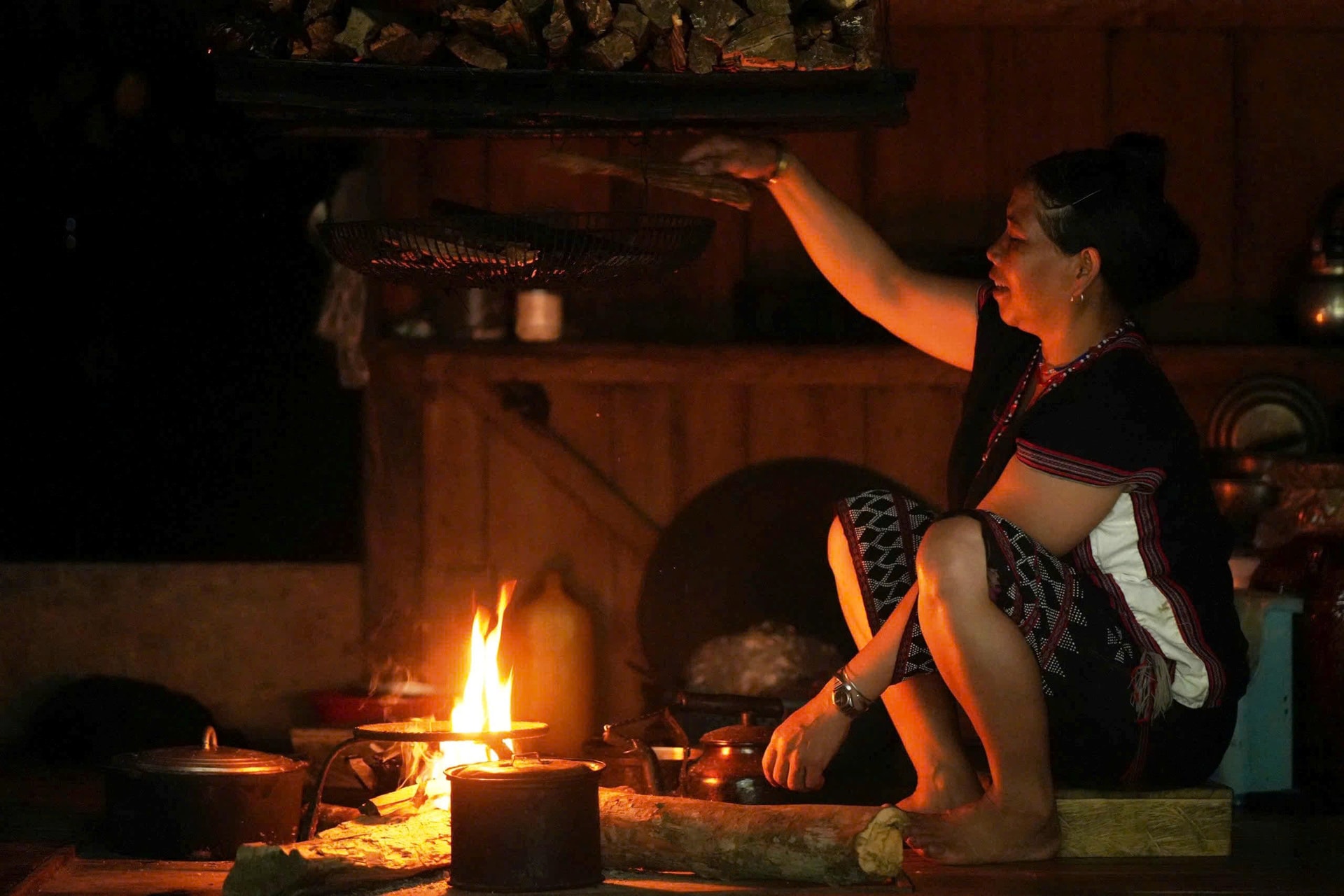
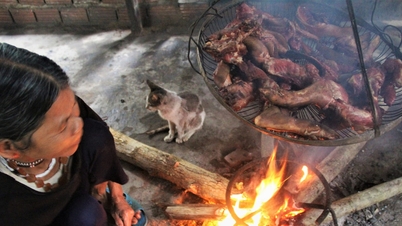
I arrived at a small village nestled on the mountainside of A Vuong commune at noon. On the porch, the village elder, Alăng Chrôt (Arec village), was sitting by the stove. His aged hands, though frail, were still nimble as he turned each steaming tube of sticky rice. The firelight illuminated his deeply wrinkled face, highlighting his warm yet pensive eyes.
“The hearth is the soul of the home. When the children and grandchildren return from the fields, everyone gathers around it. The food is not just for satisfying hunger, but also to remember the forest and the land,” old Chrot said slowly, his voice blending with the crackling of the fire.
This seemingly simple statement reveals an entire world that once existed here. A place where every meal was the result of a cycle intimately connected with nature.
In the memories of old Chrot and his generation, the livelihood of the Co Tu people in the past was closely tied to a life of absolute self-sufficiency. Each family had its own field. They grew upland rice, corn, cassava, etc. They relied on Mother Nature to gather bamboo shoots, hunt animals, and catch fish in the streams. Each meal was the result of a cycle intimately connected to the biological rhythm of the old forest. However, the whirlwind of "modern lifestyles" and "market economy " has changed everything.
“Now, the slash-and-burn agriculture is dwindling. People are planting acacia trees, trees to sell to traders. This is faster, and they get money immediately. But because of that, their diet changes according to their budget,” old Chrot looked out at the hillside in front of him, where only rows of straight acacia trees remained, and sighed.
The price of the "instant wealth" that old Chrot mentioned is the gradual disappearance of the ingredients that once defined the culinary identity of the highlands. Fewer people have the patience to venture deep into the forest to gather bamboo shoots, pick wild vegetables, or wade through streams to find fish to grill in bamboo tubes. When no longer completely dependent on the forest and fields, the ingredients that once formed the soul of the local cuisine are gradually disappearing.
Now, instead, trucks from the lowlands carrying white rice, instant noodles, canned goods, frozen meat, etc., are becoming increasingly common, flooding even the most remote village grocery stores. The convenience of the market has infiltrated every kitchen.
While washing a bunch of cabbage bought from the market, Ms. Alang Thi Ty reminisced wistfully: "Before, if you wanted to cook a bowl of soup, you just needed to go to the garden or the edge of the forest. Now, if you want to eat something, you have to go to a restaurant. Buying it is quick, but it no longer has that earthy, forest-scented smell like before."
The "flavor" she was referring to wasn't just the taste of the food, but also the flavor of a lifestyle, where people are intimately connected to their surrounding natural environment.
Forest depletion, coupled with land-use change, has led to the scarcity of many traditional ingredients. Leaves and roots that once gave dishes their distinctive flavors are gradually disappearing from everyday meals. The disappearance of ingredients leads to the disappearance of dishes. And when a dish is no longer present in daily life, the memory of it gradually fades.
The symbol remains, but its meaning has changed.
In the evening, the stilt houses are now brightly lit with electric lights, and the traditional hearth seems like a cold, dark corner. A group of young people gather to watch TikTok and YouTube videos about trendy city fast food, which they find fascinating. But when asked about their ethnic group's traditional dishes, many shake their heads. "I've eaten them, but I don't know how to cook them. Those dishes are difficult and time-consuming," one young girl said innocently.
Despite many changes, the hearth remains present in every home. But its role has changed. Many families have switched to gas or electric stoves. The traditional hearth is only lit on special occasions: festivals, religious ceremonies, or when guests arrive.
This change is not just about cooking methods, but also about how people connect with each other. The hearth is no longer a place where people gather every day, sharing stories and passing on life experiences. The physical fire remains, but the flame of connection is gradually weakening.
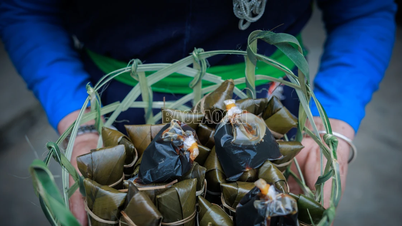
However, not everything is disappearing. In the village, there are still people quietly preserving old values. Some women have opened traditional cooking classes for young children. They patiently teach each step: how to choose leaves, how to wrap, how to bake. These classes are not just about cooking, but also about telling stories about the forest, about ancestors, about the old days when people lived in harmony with nature.
Some families have also begun to recognize the value of traditional cuisine in developing community tourism. They are reviving old dishes and inviting tourists to experience them. Thanks to this, a part of the memory is awakened, not only in the hearts of the locals but also in the eyes of visitors from other places. “As long as there are people who remember and people who do it, there is hope. The important thing is to teach the children to understand that it's not just about eating to satisfy hunger, but also about preserving our roots,” shared village elder Alăng Lấp.
As evening fell, smoke rose again from the rooftops. Though thinner and fainter, it remained as a sign that the fire hadn't gone out. I sat beside old Alăng Lấp, watching the small fire burning. He slowly added more firewood, as if trying to keep it from dying out.
"Change is the way of the world; we cannot avoid it. But we must know how to preserve what is ours. The hearth is not just for cooking. It is where the soul resides," the old man's words seemed to fade into the hazy space of the kitchen smoke.
In the flickering firelight, I suddenly understood that the story here wasn't just about food. It was a story about identity, about memory, about the continuity between generations. When the kitchen faces change, the important thing isn't to resist the change, but to find a way to prevent core values from being swept away.
And that hope begins with the smallest things: from a family meal with a traditional wild leaf soup, from a story told by the fireplace. As long as there are people diligently "keeping the flame alive," the soul of the vast forest will still have the opportunity to be passed down for generations to come...
Source: https://baodanang.vn/khi-bep-lua-doi-mat-voi-doi-thay-3333160.html
![[Photo] Secretary of the National Assembly Party Committee, Chairman of the National Assembly presides over the meeting of the Standing Committee and Executive Committee of the National Assembly Party Committee.](https://vphoto.vietnam.vn/thumb/1200x675/vietnam/resource/IMAGE/2026/06/03/1780480353201_ndo_br_bnd-2585-jpg.webp)
![[Photo] General Secretary and President To Lam presides over a meeting with the Central Organizing Committee.](https://vphoto.vietnam.vn/thumb/1200x675/vietnam/resource/IMAGE/2026/06/03/1780482764658_a1-bnd-4741-3342-jpg.webp)

![[Photo] First session of the 14th Congress of the Vietnam Trade Union](https://vphoto.vietnam.vn/thumb/1200x675/vietnam/resource/IMAGE/2026/06/03/1780465947883_ndo_br_img-3852-jpg.webp)









![[Infographic] Over 1.2 million candidates registered for the 2026 High School Graduation Exam](https://vphoto.vietnam.vn/thumb/402x226/vietnam/resource/IMAGE/2026/06/03/1780496872518_w_20260603205412.jpeg)








































![[Video] Sunset at Lap An Lagoon – Where the sun sets over the fishing nets](https://vphoto.vietnam.vn/thumb/1200x675/vietnam/resource/IMAGE/2026/05/31/1780192137701_beach-landscape-sea-water-nature-grass-745871-pxhere-com.jpeg)
































Comment (0)