


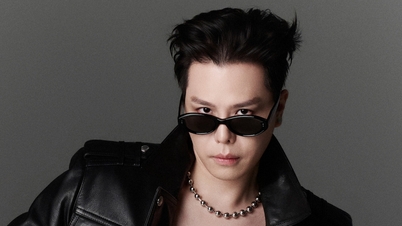
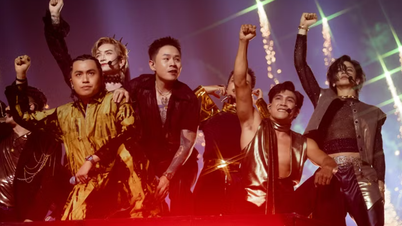
The Watermelon group returns with one member but still retains its appeal - Photo: Provided by the artist.
There are old songs, there are new songs, and one of them is "The Heart That Never Sleeps" - a classic from the 1990s. After 28 years of not being able to reunite, their hearts still seem restless.
People born in the 80s and 90s also "follow their idols".
It's often said that the music market is fickle, with new waves replacing the old. One familiar journalistic formula is: "After so many years since their disbandment, what are the members of group A doing now?"
Looking back at the members of the music groups from the late 1990s and early 2000s, around the same time as Quả Dưa Hấu (Watermelon) such as 1088, HAT, Mây Trắng, Mắt Ngọc, and MTV, too many are no longer actively performing, or if they are, they are no longer as famous as they once were.
However, not being a big star doesn't mean being forgotten. The musical journey has many stages, and not every stage requires a lot of public attention.
Bang Kieu once sang "Late Summer" from "My Brother Overcame a Thousand Thorns" with his clear, high tenor voice, so typical of Hanoi. He caused a sensation back then. But "Late Summer" is perhaps only complete with the addition of his friends Tuan Hung and Anh Tu from the band Qua Dua Hau (Watermelon).
Watching these men, in their prime and most mature years, reminisce about their youth with composure and elegance in the music video for this song, 80s-born viewers have the opportunity to recall a period of their youth that was also very "wild" and "crazy".
Who says only Gen Z knows how to "follow idols"? Those born in the 80s and 90s also followed idols back when that term didn't even exist.
Ung Hoang Phuc - one of the first young stars of V-pop, who at the peak of his career sold hundreds of thousands of records - is a fashion role model for many young people and still regularly releases new products.
Most recently, just last year, "Drawing Flowers, Drawing Leaves" - a ballad with a 2000s musical style - might not appeal to younger audiences, and might even be considered cheesy, but for those who have always liked Ung Hoang Phuc, they hope he remains just as cheesy.
Even though many new "pop princes" have emerged since then, setting new records, Ung Hoang Phuc still deserves to be called the "idol of idols".
The old hit songs he performed at May Lang Thang in Da Lat three years ago, when uploaded to YouTube, are still a phenomenon with millions of views.
From time to time, audiences still leave comments about their memories associated with songs like "Because Someone Is Gone Forever," "I Don't Believe," and "Each Person in a Different Place." They've experienced their school years, their youth, their first loves, their first breakups, all through the shared experiences of those songs.
Music video: Thank you for the music by Watermelon
Music is never forgotten.
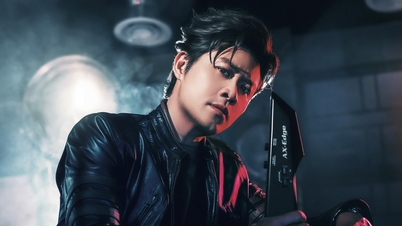
Another "prince" of V-pop in his innocent days was Quang Vinh, who also sang slowly but persistently.
Every year, Quang Vinh releases a music series on his YouTube channel: sometimes he sings cover versions of foreign love songs during his travels through Brunei, Taiwan, Austria, and Thailand; other times he goes into nature and sings duets with friends. He remains as youthful as ever, his voice still as lyrical and undiminished by time.
The performance of "The House of Roses" at a music venue in Hanoi last year, this time a duet with Bao Anh instead of Bao Thy, brought back nostalgic memories for many viewers of the days when they would sit in internet cafes playing video games while listening to Quang Vinh's music.
Let's revisit "The Heart That Doesn't Sleep" for a moment. This time, the song has been remixed by Quả Dưa Hấu (Watermelon) with the participation of Binz - one of the most prominent representatives of V-pop today.
This song was originally composed by Thanh Tung. He was a musician who brought a fresh breeze to Vietnamese music in the 1990s with countless timeless love songs, while the title was suggested by Trinh Cong Son, after he was bothered by Thanh Tung's phone call one night.
Just one song, yet its story unfolds through so many characters and across so many time periods.
That's what music is like, a silent stream flowing from one generation to the next. That's how music is never forgotten.
Source: https://tuoitre.vn/nhung-trai-tim-khong-ngu-yen-20260322094057138.htm
























































































Comment (0)