

BHG - Bat Dai Son is a particularly disadvantaged border commune located nearly 30 km from the center of Quan Ba district. Known as a barren land, this border area frequently suffers from droughts lasting for months, along with a shortage of water for daily life and irrigation. This greatly affects farming, production, and the lives of the ethnic minority people here.
It seemed as though this land would forever remain barren and desolate due to the harsh weather, climate, and terrain. However, thanks to decisive leadership and guidance, the determination of the local Party committee and government, and the bold efforts of the local people, many suitable solutions for restructuring agricultural crops have been implemented here.
With its sloping terrain and arid climate, Bat Dai Son commune has successfully encouraged its residents to convert nearly 140 hectares of low-yield corn fields to bamboo cultivation in the villages of Mo Lung, San Tro, and Na Quang. Giang Mi Su, from San Tro village, who converted his land to bamboo cultivation, shared: “After seeing some households in the commune cultivating bamboo and earning a stable income, at the end of November 2024, my family converted our upland corn fields to planting 3,000 bamboo trees for their leaves. To date, I find that bamboo requires less care than other crops and is well-suited to the arid climate and lack of irrigation water in the area.”
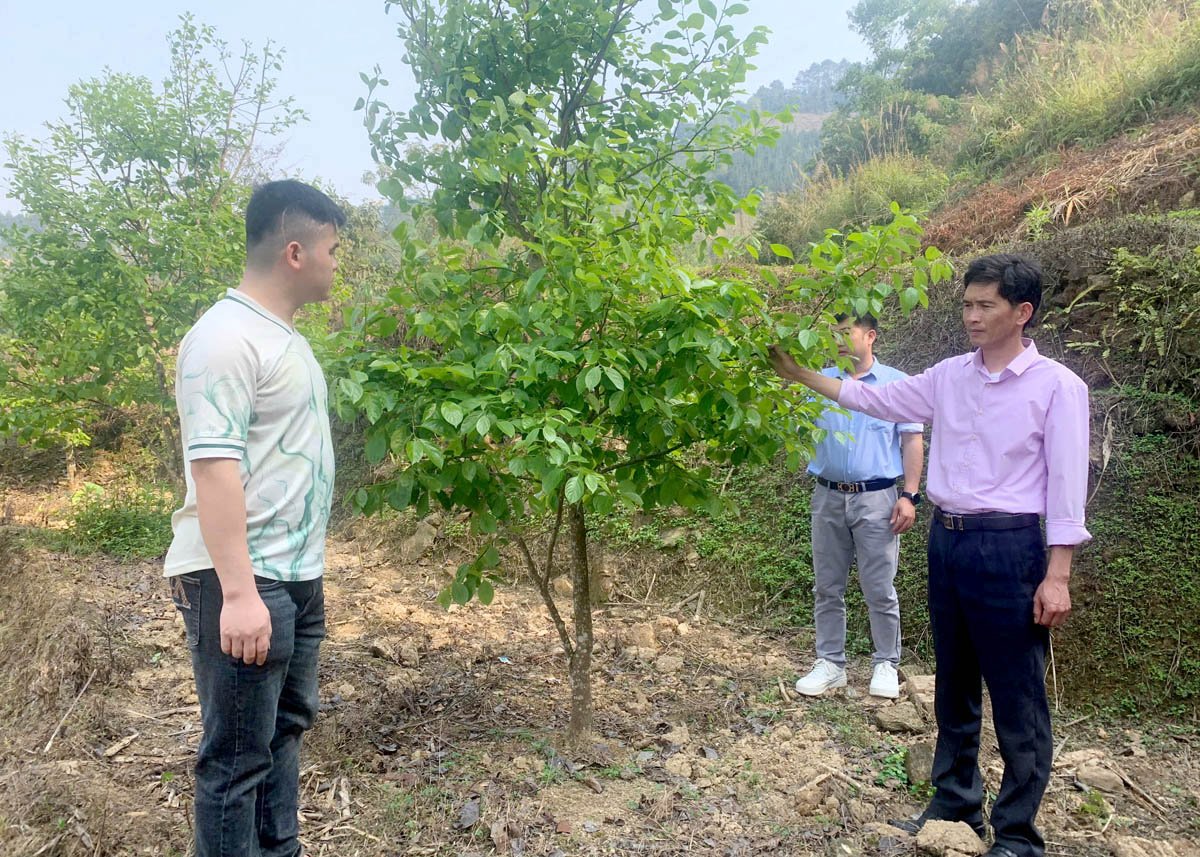 |
| Commune leaders inspect the area of seedless persimmons in Na Quang village. |
Currently, some areas of bamboo plantations in the commune are ready for harvest. Based on practical calculations, bamboo provides leaves year-round, with an average weight of 100 leaves at 1 kg, selling for 22,000 VND/kg to traders. All the harvested bamboo leaves will be sold to the lowland market for export to Taiwan. Furthermore, with diligence and perseverance in overcoming drought and sun, the people of Bat Dai Son commune have converted over 183 hectares of low-yield corn fields to cultivate medicinal plants, 66 hectares of temperate fruit trees such as seedless persimmons and plums, over 10 hectares of cinnamon trees, and several other citrus fruit trees.
Comrade Vien Ngoc Than, Vice Chairman of the People's Committee of Bat Dai Son commune, shared: “The biggest difficulty in the border area of Bat Dai Son is the dry climate, with the dry season lasting 6-7 months a year. This greatly affects farming and agricultural production in the area, as well as the yield and quality of crops; this is a major challenge in socio-economic development and sustainable poverty reduction efforts in the locality. Especially in the three highland villages of the commune, namely Pai, Xa Phin, and Thao Chu Phin, not only is there a shortage of water for daily life and production, but the percentage of cultivated land interspersed with rocks is almost 100%. In transforming the crop structure to suit the dry climate of the area, the locality focuses on researching crops suitable for red basalt soil such as bamboo, temperate fruit trees, citrus fruits, and some forestry trees such as cinnamon, nutmeg, star anise, combined with planting taro and short-term ginger underneath... Currently, we are planting "We're testing the Ngoc Linh ginseng plant to see if it's suitable for the soil type."
Furthermore, the impetus from the National Target Program for Socio-Economic Development in Ethnic Minority Areas for the period 2021-2025 has created conditions for local people to have resources in implementing crop restructuring through projects such as "Sustainable agricultural and forestry production development, leveraging the potential and strengths of regions to produce goods along the value chain" with 3 sub-projects, supporting people in converting nearly 263 hectares of crops.
The encouraging signs have charted new directions for Bat Dai Son, but the difficulties and challenges facing this region are still immense. To bring prosperity and happiness to the ethnic minority communities here, the local authorities need to continue proposing concrete solutions in proactively managing crop yields and responding effectively to droughts, transforming "difficulties and challenges" into opportunities for economic development and sustainable poverty reduction in this border area.
Text and photos: Hoang Chinh (Quan Ba)
Source: https://baohagiang.vn/kinh-te/202504/no-luc-phu-xanh-vung-dat-can-bat-dai-son-10a34dc/































































Comment (0)