|
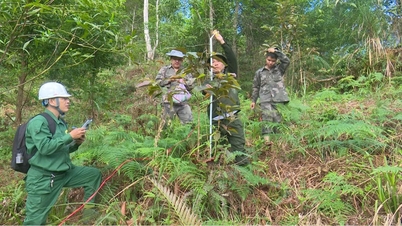
| Measuring and monitoring forest growth. |
Each model is built on different ecological conditions and management methods, contributing to providing a practical basis for future natural forest restoration efforts.
Three models, three approaches
At Khe Liem in the Phong Dien Nature Reserve, a forest restoration model is being implemented on an area of 20.28 hectares with 17 native tree species. This area was previously planted with acacia trees and has undergone clear-cutting. The goal of the model is to gradually transform these single-species planted forest areas back into native forest, restoring the inherent ecological functions of the natural forest ecosystem.
The model is designed to mimic the natural flora of the area. "I believe this is a very promising direction to enhance biodiversity as the forest develops in the future," commented Dr. Ho Thanh Ha, Deputy Head of the Forestry Faculty, Hue University of Agriculture and Forestry.
"Native tree species typically grow slowly in the initial stages and require shade to mitigate the adverse effects of external conditions. Planting at a density of 1,333 trees/ha helps the forest canopy close quickly, creating a favorable environment for tree growth. Monitoring over the next 5-7 years will provide a scientific basis for determining the optimal density for native forest restoration," said Mr. Le Van Huong, Director of Phong Dien Nature Reserve.


From the initial results, the model at Khe Liem shows that selecting the right tree species, planting at an appropriate density, and maintaining a long-term monitoring regime are decisive factors in determining the quality of the forest in the future.
While Khe Liem focuses on forest restoration on land after clear-cutting, a different approach is being applied in Hong Tien, under the management of the Song Huong Protective Forest Management Board. On an area of nearly 30 hectares, 15 native tree species are being planted under the canopy of trees such as black ebony, Dipterocarpus alatus, and acacia that have been thinned.
This method utilizes the existing canopy cover of planted forests to reduce the impact of heat and create favorable conditions for native trees to develop in the initial stages. Simultaneously, it gradually transforms single-layer, monospecies planted forests into multi-layer, multi-species forest ecosystems with better resilience to climate change.
In A Luoi 1 commune, forest restoration is taking place under much more difficult conditions. The complex terrain, scattered land, the lingering remnants of war, and the pressure of livestock grazing are major obstacles to reforestation efforts. However, this area clearly demonstrates the role of the local community in restoring the ecosystem.
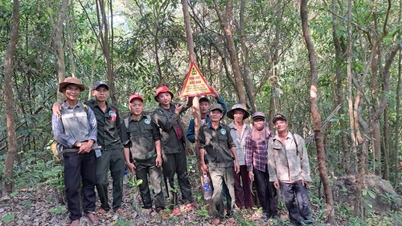
On an area of 25.71 hectares, residents of Ta Ay and Dut villages directly participated in planting more than 45,800 trees, including 22,382 native trees and the rest being supplementary acacia trees. Survey results from early 2026 showed that many areas still maintain a density of 800 to 1,500 trees/ha. The growth rate of the trees is high, and the prospects for forest formation are very promising.
A new direction
Evaluating the effectiveness of the models, Mr. Tran Vu Ngoc Hung, Head of the Forest Utilization and Development Department of the Hue City Forest Protection Sub-Department, said that the solutions implemented by the volunteers have many new aspects, especially in seed production and the application of silvicultural techniques. The models are implemented flexibly but still ensure full compliance with State regulations, aiming to create forests with structures and functions close to natural forests, contributing to biodiversity conservation and improving forest quality.



Initial results from Khe Liem, Hong Tien, and A Luoi 1 commune show that the restoration of native forests in the city is entirely feasible if there is a combination of scientific basis, appropriate technical solutions, and the participation of the local community. This is also an important basis for replicating the model in Hue city in particular and the Central region in general.
The city of Hue aims to restore approximately 500 hectares of natural forest by 2030 through regeneration and supplementary planting of native tree species. However, alongside positive signs, the restoration of native forests raises many issues that require further research, such as: What planting density is suitable for slow-growing tree species? How long should the care period be to ensure forest formation? Does the current investment mechanism meet the requirements for remote areas with scattered land? These are issues that need to be further researched by relevant agencies and units to find feasible solutions when organizing forest restoration in the coming period.
Source: https://huengaynay.vn/kinh-te/no-luc-phuc-hoi-rung-ban-dia-167117.html


![[Photo] "Hanoi Lotus Festival" honors the lotus flower that has been associated with Vietnam for thousands of years.](https://vphoto.vietnam.vn/thumb/1200x675/vietnam/resource/IMAGE/2026/06/27/1782516943048_sen-ha-noi-2026-minh-duy-1-jpg.webp)
![[Photo] A phone-free summer afternoon at the village library](https://vphoto.vietnam.vn/thumb/1200x675/vietnam/resource/IMAGE/2026/06/27/1782551770949_anh-1-jpg.webp)