

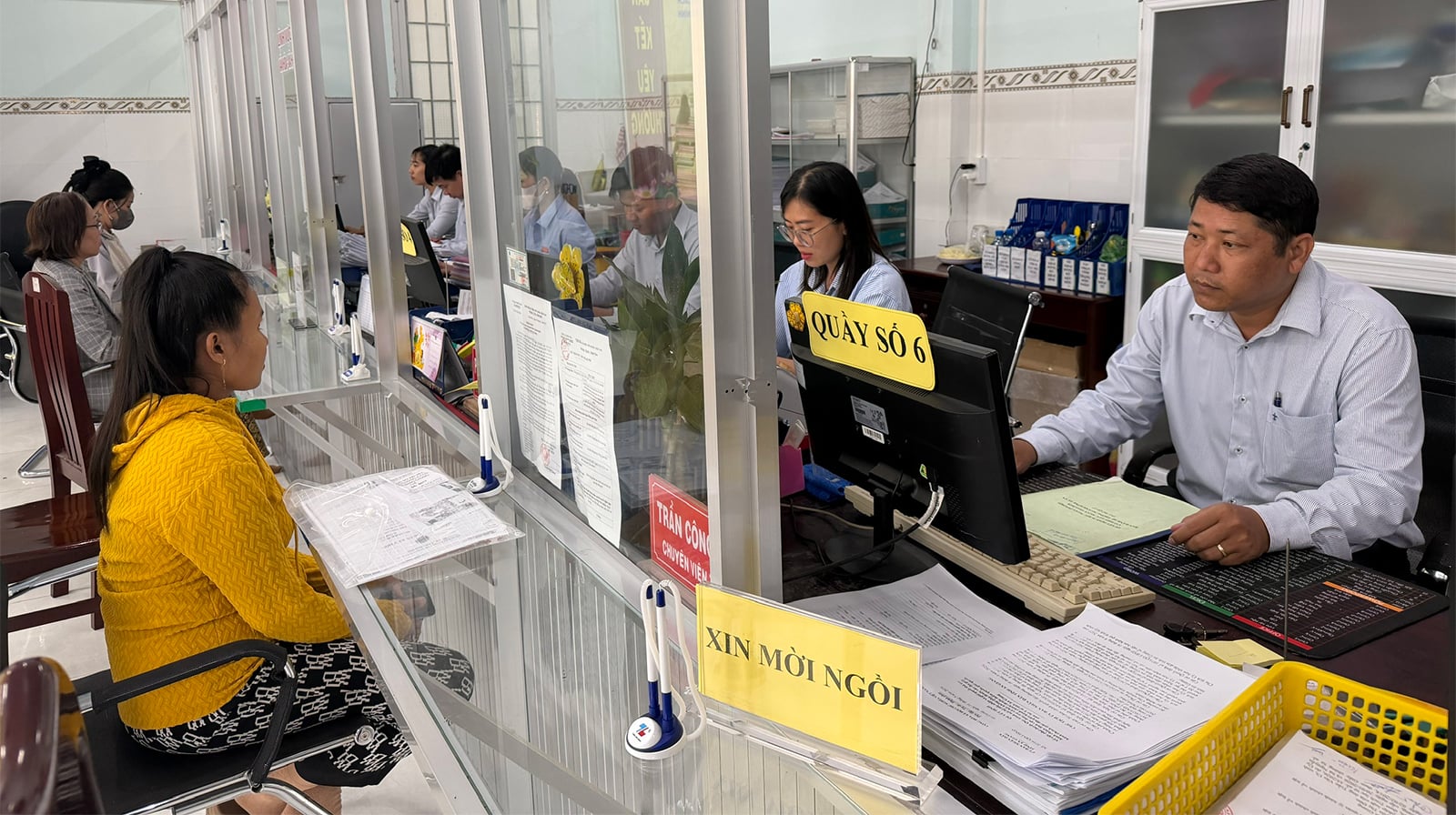
People come to the Dinh Hoa Commune Public Administrative Service Center to carry out administrative procedures related to land matters. Photo: CAM TU
Land management is a field with a large volume of complex and constantly changing data. It is one of the areas with a large number of records generated, directly related to many administrative procedures. Therefore, in the process of building a digital government and implementing Project 06, An Giang province has identified "enriching and cleaning" the land database as a key task, requiring decisive, systematic, and synchronized implementation from the provincial level to the grassroots. When data is synchronized, functional agencies will significantly reduce the time spent checking and cross-referencing records, minimize errors, reduce pressure on the one-stop service center, and create an important foundation for the province to promote data-driven management and administration.
Immediately after the Provincial People's Committee issued the plan related to maintaining, updating, and exploiting the land database, departments and agencies promptly reviewed the current data status, classifying each group of missing, inaccurate, or inconsistent information to develop a suitable handling roadmap. Specific tasks were assigned from the provincial level down to the commune, ward, and special zone levels, with accountability linked to progress and results.
To accelerate the digitization of land data, the province is focusing on reviewing and classifying land data into three groups: standardized data, data requiring supplementation and revision, and data requiring new data creation; collecting and digitizing land use right certificates and house ownership certificates that have not yet been updated in the database. It is also cross-checking and verifying land user information with the national population database to ensure accurate and complete data. Furthermore, it is creating digital data and fully updating information from certificates into the system.
In addition, the province is connecting and synchronizing its land database with the national database, ensuring interoperability with the national public service system and the tax system. Administrative procedures related to land are being restructured to reduce paperwork, utilize available data, and serve citizens quickly and conveniently.
According to the Director of the Department of Agriculture and Environment, Le Huu Toan, digitizing land data is not just a purely technical task, but also a breakthrough step in the modernization of land management, aiming towards a transparent, accurate, and more effective digital administration serving the people. In recent times, the Department of Agriculture and Environment has focused on building a land database; the total number of land parcels in the province currently stands at 2,437,076. By the end of May 2026, 1,527,312 land parcels had been updated in the land database, accounting for 62.67%; of which 621,896 land parcels had been reviewed to ensure they were "correct, complete, clean, and valid," reaching 40.72%.
Currently, there are 909,764 land parcels not yet included in the land database, and 905,416 land parcels whose data has not yet been reviewed and cleaned. These figures show that the workload remains enormous, but the initial results reflect the efforts and close coordination between the agriculture and environment sector, the police, the judiciary, and local authorities in implementing the digitization and cleaning of land data, contributing to resolving many difficulties in verifying and cross-checking information.
Despite the achievements, many difficulties remain in the digital transformation process of the land sector. The quality of original data, formed over different periods from paper records and old survey maps to digitized data, still contains many discrepancies and inconsistencies; the implementation progress varies among localities. Information technology infrastructure in some localities does not meet the requirements for processing large volumes of data; there is a shortage of personnel for digitization and data updating, while the workload is very large and the deadlines are very tight. Currently, only 27 out of 102 communes, wards, and special zones in the province have assigned dedicated information technology and digital transformation officers.
Speaking at the conference reviewing the results of the first five months of 2026 of the Steering Committee on Science , Technology, Innovation, Digital Transformation and Project 06 of An Giang province, Central Committee member, Deputy Secretary of the Provincial Party Committee, and Chairman of the Provincial People's Committee Ho Van Mung requested heads of departments, agencies, and localities to focus on directing the development of science, technology, innovation, digital transformation and Project 06; strive to complete tasks as directed and assigned by the Central and Provincial Steering Committees, overcome limitations; and link implementation with the evaluation of officials. Mr. Ho Van Mung requested that departments and agencies complete data digitization within the stipulated time, especially land data digitization, to be completed in the third quarter of 2026.
With strong political determination, a systematic and scientific approach, and the synchronized involvement of the entire political system, An Giang is gradually realizing its goal of building a unified digital data platform that is "accurate, complete, clean, and active," effectively serving state management and socio-economic development, and contributing to accelerating the national digital transformation process.

Source: https://baoangiang.com.vn/no-luc-so-hoa-du-lieu-dat-dai-a487760.html













































![[Video] Sunset at Lap An Lagoon – Where the sun sets over the fishing nets](https://vphoto.vietnam.vn/thumb/1200x675/vietnam/resource/IMAGE/2026/05/31/1780192137701_beach-landscape-sea-water-nature-grass-745871-pxhere-com.jpeg)































Comment (0)