

My village is a coastal village in Thach Kim commune (Loc Ha district, Ha Tinh province ) that has had a long-standing tradition of making fish sauce, but mostly on a small scale. Each household ferments a few jars of fish sauce, and mothers pass the trade down to their daughters, much like the secret recipe for making Van village's rice wine.

Thach Kim fishing village (Loc Ha district) in the early morning. Photo by Tien Dung.
A few years ago, a fairly large-scale fish sauce production facility was established, with nearly 100 earthenware jars, each capable of holding 200 kg of fish. The owner of this facility was a slender but agile and resourceful woman. She is Phan Thi Mai, the Chairwoman of the Women's Union of Thach Kim commune (Loc Ha district).
I met her on a rainy Sunday, when the sea was rough and I had some free time. Looking at the rows of carefully sealed earthenware jars, each marked with a rubber spout for drawing out the fish sauce concentrate, I asked Mai: "Why is your fish sauce called 'Sanh'?" Mai smiled: "At first, I intended to name it 'Ngoc Tich' fish sauce to commemorate my hometown, because our fishing village used to be called Ngoc Tich. But then I thought that name was too elegant and didn't make a strong impression, so I chose 'Sanh,' which is short and sparks curiosity in consumers. 'Sanh' means fish sauce stored in earthenware jars; 'Sanh' also means inviting connoisseurs to enjoy this 'magical' sauce to savor the taste of the sea. This is the nectar of the sea, extracted from the sun, the wind, and the skillful hands of the women."

Ms. Phan Thi Mai's (second from the left) Sành fish sauce production facility is rushing to complete the procedures to be recognized as meeting OCOP standards.
Yes, "a knack for it," I felt thrilled to hear Mai speak of the women of the fishing village with such natural, proud, and kind-hearted respect. "A knack for it" doesn't just refer to someone resourceful and capable, but also encompasses skill, meticulousness, thoughtfulness, and especially long-standing folk experience. Mai explained that her family has a tradition of making fish sauce, passed down from her grandparents to her parents and now to her grandchildren. Her grandfather used to make wooden barrels from bời lời wood to sell to fish sauce makers. Her mother was a famous fish sauce maker in the area, but in small quantities, mainly for personal use. Only in Mai's generation did they dare to invest, first in storage facilities, and then mobilize other women to work together.
The first element in making delicious fish sauce is the container used. In the past, our ancestors used wooden barrels, but as wood became scarce, they had to use earthenware jars or cement containers. After researching, Mai chose earthenware jars ordered from Ninh Binh . The main material of the jars is fired clay, each costing nearly 2 million dong. Unglazed earthenware jars ensure no water leakage, allowing for excellent fermentation, preserving the characteristic flavor, and offering high durability. Mai explained that after thoroughly cleaning the jars, she lines the bottom with a layer of pebbles to filter the water for clarity, then places a bamboo lid on top and adds the fish mixed with salt. She then uses another bamboo lid to secure the lid, places heavy stones on top, and finally seals the jar with a cloth to prevent flies and mosquitoes. Mai also mentioned that, despite her careful selection, some jars she buys sometimes crack, requiring her to transfer the fish sauce to another jar and use that jar to store salt.
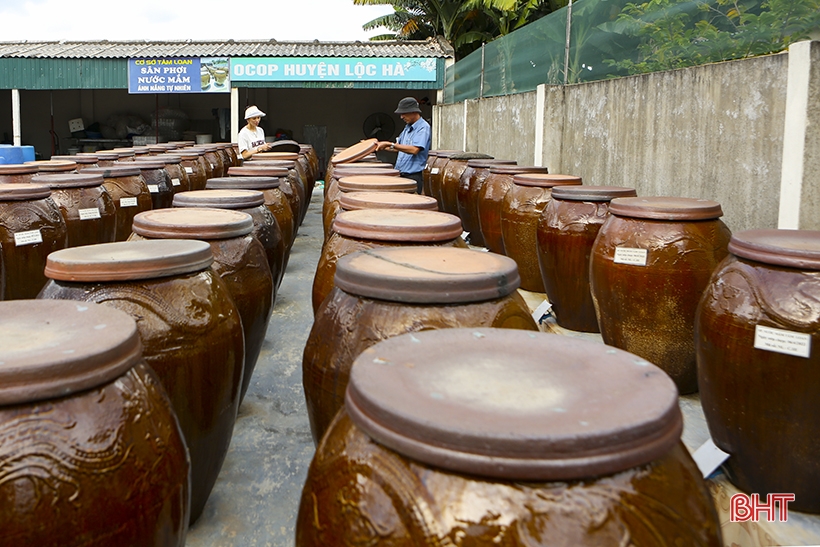
Fish sauce is salted in earthenware jars by the people of Loc Ha coastal village.
Salt – that's a crucial ingredient after fish. For good fish sauce, the salt must be pure and aged in a warehouse for at least a year to ensure it's dry before use. The longer the salt is aged, the more "mature" it becomes, resulting in the most perfect, fragrant, sweet, and smooth fish sauce. Mai orders her salt from Ho Do, a place with a long tradition of salt production. Good salt is characterized by large, white grains that are less bitter after being aged for many years. To ensure the fish sauce has a delicious aroma and isn't bitter or harsh, the salt used for marinating the fish must undergo a drying process. This process removes the "stickiness" and makes the salt "dry and rough," as it completely removes moisture and metal residues. If the salt isn't "mature," the color and flavor of the fish sauce will change immediately. This salt is called pure salt, distilled from the sun, wind, land, and the salty sweat of salt farmers who have "toiled under the sun and rain," choosing the hottest days to sunbathe in the salt fields to produce salt crystals that sparkle like diamonds.
I picked up a handful of salt and saw its shimmering, radiant sea-like flavor. The salt seemed to permeate my skin, a warm, rich, and concentrated taste of the ocean. Even the bamboo mats used to hold the fish in the jars were meticulously sourced by Mai, who went all the way to Thach My, where there are clumps of old bamboo. The flexible bamboo slices were carefully soaked and sun-dried, then skillfully crafted to produce durable bamboo mats that could withstand the pressure of the stones and the salty taste of the fish. The bamboo mats didn't break or erode; instead, they became tighter, more flexible, and stronger.
The story of Sành fish sauce became richer and more flavorful as I asked Mai about the most important ingredient: the fish. Actually, there are many types of fish used to make fish sauce, but for a long time, fishermen have chosen anchovies. There are usually two anchovy fishing seasons each year: the first from January to February (lunar calendar), and the second from July to August (lunar calendar). There are many different types of anchovies, such as striped anchovies, black anchovies, red anchovies, and small anchovies... But the best are the black anchovies with a black stripe down the middle of their bodies. Mai said: "I usually buy the whole boat as soon as it docks and mobilize my sisters to bring the fish back for fermentation in time. Especially, the fish must be thoroughly washed with seawater, and the fish skin should still have a shimmering phosphorescent sheen."
The process of salting fish sauce is truly elaborate. Mai shared: "This is a unique experience of each place, fermenting salt and fish in a specific ratio depending on the fishing grounds and season. The most common method for making good fish sauce is the stirring process. Each jar has a tap to drain the water. When the water from the fish flows out, the jar lid must be opened in the morning to let sunlight in, and at the same time, the water in the jar must be drained into a stainless steel basin to dry until evening, then poured back in – this is called the fermentation process. If the weather is sunny and hot, stirring only needs to be done for 2 months; if the weather is unfavorable, it must be extended. When salting the fish, the fish is divided into small pieces and placed in a stainless steel pan, then directly stirred by hand thoroughly with salt, ensuring absolute hygiene." I asked Mai: "How can you recognize good fish sauce?" Mai said: "It has a characteristic, mild, sweet aroma, not strong; when tasted, it has a sweet flavor; and in terms of color: a golden amber color, and when poured into a glass bottle, the fish sauce will have small bubbles rising to the surface."
In my coastal village, there's a simple way to test the quality of fish sauce using leftover cooked rice: Just drop a grain of cooked rice into the fish sauce. If the rice sinks to the bottom, it's not good. If it floats, it's a good bottle of fish sauce, free from chemicals. Interestingly, according to folk tradition, divers often drink fish sauce, especially the concentrated liquid, before going underwater. This is because fish sauce contains many substances that provide energy, keep the body warm, help prevent blood clotting, increase heart rate and blood pressure, and counteract water pressure.
One thing that surprised and baffled me was that when a funeral procession passed by, the locals would often take a handful of earth and cover the lid of the jar with it, and use lime to mark the outside of the jar to prevent the fish sauce from "changing"—changing color and smelling unpleasant. Through learning about the fish sauce making process, Mai also shared some tips on using fish sauce in cooking. These included: not adding fish sauce to the dish just before turning off the heat; not marinating meat with fish sauce as it will make the meat tough; and for soups, meat dishes, and stir-fries, only adding fish sauce last, about a minute before removing from the heat, to retain its nutrients and sweetness.

Ms. Phan Thi Mai (far left) receives an encouragement award at the 2022 Women's Entrepreneurship Ideas Competition . Photo: Thien Vy.
As evening fell, Mai walked along the rows of fish sauce jars. She gently stroked each jar, treating them like her own children, caring for and watching over them every day. This was her joy, and the joy of the women who had built the Sành fish sauce brand from my hometown. It is known that she received an encouragement award from the Ha Tinh Women's Union at the "Women's Entrepreneurship Ideas" competition in 2022.
Ha Tinh, November 2023
Nguyen Ngoc Phu
Nguyen Ngoc Phu
Source
![[Video] Sunset at Lap An Lagoon – Where the sun sets over the fishing nets](https://vphoto.vietnam.vn/thumb/1200x675/vietnam/resource/IMAGE/2026/05/31/1780192137701_beach-landscape-sea-water-nature-grass-745871-pxhere-com.jpeg)


















![[Video] Sunset at Lap An Lagoon – Where the sun sets over the fishing nets](https://vphoto.vietnam.vn/thumb/800x450/vietnam/resource/IMAGE/2026/05/31/1780192137701_beach-landscape-sea-water-nature-grass-745871-pxhere-com.jpeg)


















































![[Video] Sunset at Lap An Lagoon – Where the sun sets over the fishing nets](https://vphoto.vietnam.vn/thumb/402x226/vietnam/resource/IMAGE/2026/05/31/1780192137701_beach-landscape-sea-water-nature-grass-745871-pxhere-com.jpeg)































Comment (0)