

Having just struggled to overcome the COVID-19 pandemic, new economic shocks and global geopolitical instability have struck. Along with this, changes in business conditions and new legal regulations are causing businesses of all sizes to be caught in a whirlwind of difficulties.
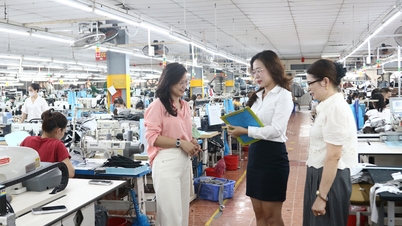
 The garment industry is one of the sectors most affected by the "storm" of declining aggregate demand. Photo: Minh Hang
When "the rich also cry"
Hoa Loi Group is the second largest footwear company in the world, with a production capacity of 220 million products per year. In Thanh Hoa, after 10 years of investment, the group has 20 factories in operation, creating jobs for 120,000 workers. However, economic inflation, along with a wave of order cuts from the second half of 2022 that continued into 2023, has inevitably caused this giant in the footwear industry to struggle. Mr. Tseng Jung Huei, Deputy General Director of Hoa Loi Group, said: “We have seen a reduction of approximately 40% in orders this year. With 10 factories under investment in Thach Thanh, Ba Thuoc, Cam Thuy, Thuong Xuan, Thieu Hoa, and Hau Loc districts, the investment and construction procedures are also taking longer due to new legal regulations. In this situation, we are not aiming for profit but are focusing on adjusting orders with the motto of avoiding job cuts.”
According to Mr. Trinh Xuan Lam, Chairman of the Thanh Hoa Provincial Textile and Garment Association, economic inflation is causing consumer demand in major markets such as the US and Europe to remain tight; while these are the markets that account for a large share of domestic and provincial garment and footwear businesses. Continuing the decline in consumption from the end of 2022, in 2023, many businesses saw orders in the European market cut by 30%, even 50%. To "salvage" the situation, businesses of all sizes in the industry have accepted many small, low-priced orders, taking on additional orders that are not advantageous given their current labor skills and facilities, in order to provide work for their employees, resulting in almost zero profit.
Many economic experts have stated that the current period is the most difficult for businesses in the past 30 years. In 2023, the total revenue of businesses in the Nghi Son Economic Zone and industrial parks decreased by more than 5%, and export turnover decreased by 23.4%. Coupled with the Nghi Son Refinery and Petrochemical Plant undergoing a 48-day maintenance period, difficulties in the consumer market and increased raw material costs resulted in the province's industrial production index (IIP) growth reaching only 4.87%, failing to meet the plan. The total value of goods exported from the province also only reached 92% of the plan; whereas previously, the province's exports had continuously increased progressively for many years. |
Unlike most businesses, Thanh Hoa Seafood Import-Export Joint Stock Company has a multi-sector ecosystem, ranging from seafood and wood exports to the production and trading of clean food. According to the company's representative, all of its production areas are deeply and broadly integrated; therefore, factors related to international political and economic developments have a direct and immediate impact on its production and business activities. In particular, the company's main export markets are developed countries such as the US, EU, Japan, South Korea, and China... and these are also the economies most strongly affected by the "shocks" that have occurred and are occurring. Consequently, the company's main export markets have been severely impacted. It is estimated that the company's sales volume has decreased by 35-40% depending on the market segment, with clam sales down 35% and surimi fish paste down 30%. In the wood industry specifically, due to the US anti-dumping investigation into plywood products, the market was at one point almost completely shut down.
According to Nguyen Cong Hung, Sales Director of Thanh Hoa Seafood Import-Export Joint Stock Company: “When overall market demand declines, maintaining production and sales volume poses many challenges for businesses. In markets consuming clams and surimi fish cakes, consumers drastically cut back on spending, making retail distribution pressure fierce, and importers demand significant price reductions for most orders. Input costs increase, and the price war to win orders intensifies, eroding most of the profits of businesses trying to sell goods to maintain market share.”
Besides the bleak picture of the consumer goods manufacturing market, major players in the real estate and construction sectors are also feeling uneasy as the housing market is almost "frozen." This is evidenced by figures provided by the Provincial Tax Department, which show that the tax revenue from land use rights this year has decreased by nearly 50%.
Along with tightened public investment, declining market demand both domestically and for exports has led to difficulties for many construction material manufacturing sectors such as cement, bricks, tiles, and packaging. Normally, this period should be the "final push" for production and consumption of these goods; however, many industrial plants inside and outside industrial zones are currently reducing capacity and operating at a reduced rate.
The Dai Duong Packaging Factory in the Nghi Son Economic Zone (NZE) has been operating steadily since 2018. The factory supplies its products to The Vissai Cement Group, other major cement plants, and exports approximately 5%. However, when the real estate and construction sectors were affected, the factory's packaging supply also suffered, with orders decreasing by up to 30%. The factory had to cut back and redistribute orders across its workshops to maintain stable income for its workers. Mr. Nguyen Ba Phuong, Workshop Manager of Workshop 5, stated: “Currently, all production workshops are operating at a reduced capacity. In Workshop 5, we have had to accept inventory storage at times to keep our workers employed.” According to the company representative, revenue in 2023 decreased by approximately 20% compared to the previous year.
According to statistics from the Management Board of the Southern Economic Zone and Industrial Parks, in 2023, businesses were forced to lay off more than 3,761 workers. In particular, some businesses were forced to temporarily suspend operations, such as Cong Thanh Cement Joint Stock Company and Innov Green Company in the Southern Economic Zone. Many businesses had to reduce working hours, implement rotational leave, and eliminate overtime, notably 12 businesses in the Bim Son Industrial Park. Difficulties in production and business have led to prolonged insurance debt with large amounts still unresolved, such as Cong Thanh Cement Joint Stock Company owing 5.7 billion VND, Beoyin Vina Co., Ltd. owing over 4 billion VND, Thanh Hoa Shipbuilding Industry Co., Ltd., and Song Chu Mechanical and Construction Joint Stock Company...
Across the province, many key and traditional industries continued to decline, such as sugar (down approximately 50%), cassava starch (down 21.7%), beer (down approximately 20%), and bricks (down 12.2%). Not only did production decline, but input costs also increased, while selling prices remained low, leaving businesses with almost no profit or very low profits.
The numbers speak for themselves.
Despite the challenging current situation, it is "surprising" that Thanh Hoa province still achieved "record" numbers in the establishment of new businesses. According to data from the Provincial Steering Committee for Business Development, as of March 31, 2023, the province had 3,611 newly registered businesses, ranking 6th nationwide and exceeding the plan by 20.4%, bringing the cumulative number of registered businesses in the province to over 27,000.
"Besides objective reasons like the global economic downturn, businesses are facing difficulties due to inherent shortcomings within the economy. First and foremost, the institutional framework and policies are still incomplete, if not contradictory. The line between 'right' and 'wrong' is very thin, leaving businesses operating in a state of anxiety. Furthermore, the stagnation of reforms means the business environment has not met expectations, and business conditions are now facing more insurmountable obstacles than before," said Do Dinh Hieu, Director of the Vietnam Federation of Commerce and Industry, Thanh Hoa - Ninh Binh Branch. |
However, behind this "impressive figure," in 2023, the province also recorded 1,245 businesses temporarily ceasing operations, equivalent to 34.5% of newly established businesses. In addition, 631 businesses were dissolved, an increase of 66.5% compared to the same period. The number of businesses resuming operations also decreased by 29.5% compared to the same period.
Furthermore, judging the vibrancy of the business environment solely based on the number of businesses entering the market seems inaccurate, because the "vitality" of businesses should be assessed using operational parameters, including revenue, profit, and tax contributions to the state budget. In reality, the percentage of businesses generating these indicators is very low compared to the total number of registered businesses.
The mountainous district of Cam Thuy has 189 registered businesses. However, only 107 businesses generated revenue. Of these, only 89 businesses paid taxes. Mr. Tao Ngoc Canh, Deputy Head of the Cam Thuy Tax Department, stated that in 2023, the revenue generated by businesses in the area was only slightly more than 78% compared to 2022. The total number of businesses operating in the district was only over 1,000, equivalent to 45.5% of last year, and even lower than in 2019 (before the COVID-19 pandemic). The reason is that garment businesses in the area lacked orders, leading to many workers being laid off. Ngoc Ninh Production and Trading Co., Ltd. alone ceased operations, resulting in 1,200 workers being laid off.
As an area with vibrant economic and trade activities, in 2023, the Thanh Hoa City - Dong Son area saw the establishment of 1,662 new businesses, exceeding the assigned target; however, during the year, 532 businesses were dissolved and 619 businesses temporarily suspended operations.
According to Cao Tien Doan, Chairman of the Provincial Business Association: “Businesses are facing a harsh environment, struggling daily with challenges. A very sad reality is unfolding as the number of businesses closing down or withdrawing from the market is increasing. In Thanh Hoa province, after more than two years of being severely affected by the COVID-19 pandemic, just as it was on the path to recovery, a series of businesses had to close down due to obstacles in fire safety regulations. Furthermore, the complex global economic and political situation, high inflation, scarcity of input materials, soaring market prices, and declining orders due to weak global and domestic demand; tightened credit causing a stagnation of capital for production and business are all factors having a “double” impact on the already ailing health of businesses.”
Minh Hang
Lesson 2: The "Policy Pie" is Hard to Grab.
Source


































































































Comment (0)