

- The traditional house of the Hong Dan District Party Committee: A "red address" for educating the younger generation.
- A significant historical site in the homeland of the heroic Tran Phan.
- Let's work together to build a "historical landmark" to honor those who have made sacrifices.
One trip, two trips, then many trips... Before we knew it, the age gap seemed to disappear, and his world and the younger generation quickly blended, becoming open, close, and like a family. Following him, we went to My Thanh, Ma Ca (Phu Thuan), Dat Chay, Ray Moi, Cong Dien (formerly Phong Lac), Vinh Dua (Hung My), Tan Hoa (Tan Thuan), Cay Tho, Bu Mac (Dat Moi), Chin Bo, Dien Chu Ngai, and dozens of other places scattered across Cai Nuoc, Phu Tan, Nam Can, Tran Van Thoi, and Dam Doi. With him around, we were welcomed like family wherever we went. Some months he made four trips in a row, sometimes traveling across two districts in a single day—Nam Can in the morning, Tran Van Thoi in the afternoon—by road and by river. When we asked if he was tired, he always replied, "It's alright!" So we continued our journey, and of course, we had to help him up and down bridges and onto house steps, and take care of his simple meals.
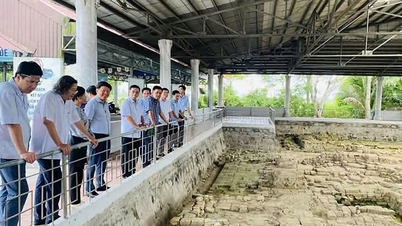
 The Ca Mau Provincial Museum delegation, along with historical witnesses, visited the "red addresses" in Nam Can.
Listening to his story, we found him to possess a great deal of romanticism. He had been away from his family for 18 years, spending 18 Tet holidays away; in 1955, his name wasn't on the family register of the Diem government; in 1959, he was lost in the Cai Nhay (Hiep Tung) area for an entire day; in 1974, he fell into a deep well in Lo Go ( Tay Ninh ). The day he arrived in Saigon on April 30, 1975, alone is a legend. During those April days, filled with the fervent spirit of the offensive, he was studying journalism at R, only in the philosophy section. On April 20th, the school closed; students from nearby provinces had to find their own way home, while those further away had to wait for further orders.
As a cadre of the Southwestern Regional Youth Union, he went to the Central Youth Union headquarters in the South to request a position in the assault team. With a hammock, two sets of nylon uniforms, a sack of rice, and a K54 pistol, he spent 20 days hiding and 20 nights marching, even using ropes to cross rivers, with the bright lights of Saigon ahead. On the morning of April 30th, he arrived at the Quang Trung Training School (Go Vap), and by 5 pm he was at the District 3 Administrative Building; on the morning of May 1st, he appeared before thousands of students at 4 Duy Tan Street, who looked at him – a flesh-and-blood revolutionary soldier – as an idol.
As a military administrator in District 3, directly in charge of Yen Do ward, he had very composed conversations with hundreds of former South Vietnamese soldiers. Recalling that trip, in his poem "A Glimpse of April," he wrote, "If I die, any land will make my grave / My loved ones will not know where I lie!" He explained that, as a soldier fighting for independence and national reunification, who wouldn't dream of being present in the enemy's stronghold on the day of complete victory? It was a once-in-a-lifetime opportunity. What was also unusual about him was that, having survived countless bombs, bullets, and chemical weapons, he wasn't even scratched by enemy shrapnel, and Agent Orange was no match for him.
While sitting in the car, we prompted him to talk about stories from his time fighting in the war, and sometimes he would spontaneously say something very distant, very down-to-earth. He talked a lot about reading, how reading makes people feel comfortable, virtuous, and live more slowly. He said that if it weren't for reading, he would have probably gone blind again after graduating from the First Grade in 1952. Pointing out books we could use as references for his work, he also bluntly stated: anyone, even with a PhD or Master's degree, who doesn't read regularly will easily become lost from the flow of culture and indifferent to doing good deeds.
When he joined the provincial history team, he considered himself an outsider, but thanks to over a decade of working in the Party committee office, and then immersing himself in mass movements, paying attention to events and even small details, he remembered quite a lot and was quite certain about the events that took place during the 20 years of the war against America. Sometimes he even "argued" with details already printed in books, verifying that events had occurred. During his trips back to the old base areas, he remembered every house and every person's name (even though the adults had passed away).
At the 6th Congress of the Ca Mau Provincial Association of Literature and Arts in 2015, he presented a paper titled "A Debt to History." Later, at the scientific conference "The Struggle Movement of Women in Ca Mau Province during the Resistance War against the US for National Salvation," he also presented a paper titled "The Direct Struggle at Dam Doi and Its Significance," and further detailed articles about the Provincial Party Committee Base in Xeo Duoc. He made significant contributions to nearly a dozen seminars and field trips. He was happy that many families were present at the Tet celebration with the Provincial Party Committee in Xeo Duoc, a place he had guided, and felt relieved of his debt of gratitude to the local people.
 Mr. Nguyen Thai Thuan (Ut Tran, leading the way) and the Ca Mau Provincial Museum delegation visited the "red addresses" in Phu My commune. (Photo taken in September 2023).
With enthusiasm and a sense of responsibility, he donated to the provincial museum various artifacts—shoes, sickles, planting stakes, stone mortars, etc.—which, though small, all embodied the spirit of the countryside. Sometimes, when we asked him something, he would answer immediately if he knew the answer; if he wasn't sure, he would ask older people who knew the story. He paid close attention to our image captions and explanations, and kindly and gently reminded us to be mindful of certain details while working.
Out of affection for him, we've become accustomed to calling him "Grandpa." He always radiated a compassionate and loving gaze towards his grandchildren, patiently guiding us in everything from the most important matters to the smallest details of daily life. During long journeys, the image of him standing beside his walking stick reminded us of his faith and love for his profession. He didn't just teach with empty words; he lived as a true friend, a role model, so that the younger generation felt listened to and trusted.
At 87, he is still writing diligently. Two volumes of poetry and a collection of essays have brought him joy in retirement, and he hopes to publish another collection next year, mostly on the theme of the revolutionary war. According to him, today's generation still owes a great debt to their fathers and ancestors. Every village, every canal, every river, every heart dedicated to the Fatherland is a reservoir of history yet to be fully explored.
Towards the end of his life, he summarized it simply in three words: recklessness, romanticism, and patriotism.
November 2025.
Huynh Thu Thao
Source: https://baocamau.vn/ong-va-nhung-chuyen-di-a127333.html
























































Comment (0)