

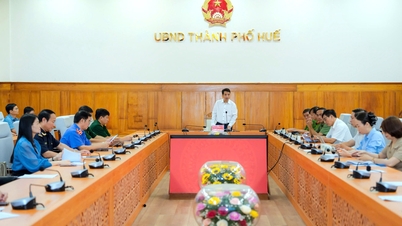
On March 24, Deputy Prime Minister Tran Hong Ha chaired a meeting to hear reports and give opinions on the draft Decree amending and supplementing a number of articles of Government Decree No. 6 regulating the reduction of greenhouse gas emissions and protection of the ozone layer.
The draft Decree is being developed to provide detailed regulations for the Law on Environmental Protection, in line with the implementation of international agreements on climate change.
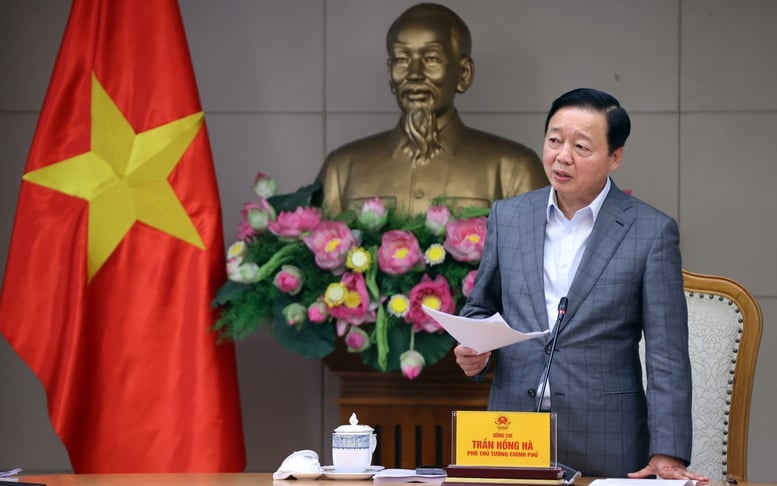
Deputy Prime Minister Tran Hong Ha assessed that the draft Decree has gradually updated the international situation, practical experience, and existing knowledge - Photo: VGP/Minh Khoi
Accordingly, the draft Decree specifies the roadmap for allocating greenhouse gas emission quotas in three phases: 2025-2026, 2027-2028, and 2029-2030. In the first phase, quotas will be allocated to facilities with high emission levels in three sectors: thermal power, iron and steel production, and cement production.
It is expected that 150 facilities will be allocated quotas in the initial phase, accounting for approximately 40% of the nation's total greenhouse gas emissions.
The revised regulations on the carbon market aim to clarify and update the criteria for trading emission quotas and carbon credits.
The draft decree also adds content on the National Registration System for Emission Quotas and Carbon Credits to serve management purposes; it specifies the activities of trading emission quotas and carbon credits on the exchange as well as the implementation of the mechanism for trading and clearing carbon credits domestically.
Specifically, the relevant ministries are responsible for approving and recognizing processes and technical standards for generating carbon credits, registering projects, changing project participants, canceling project registrations, and issuing carbon credits for projects within their respective areas of management.
Concluding the working session, Deputy Prime Minister Tran Hong Ha assessed that the draft Decree is technical in nature and subject to many changes and fluctuations. Therefore, the Ministry of Agriculture and Environment must thoroughly understand the specialized legal system and international agreements, while also providing controlled framework guidelines and principles with a "sandbox" mindset to continue updating technical issues that may still change.
"This is a new field, requiring new administrative procedures to perform state management functions, but they must be as simple and streamlined as possible. Careful research and calculation are needed on the decentralization plan, primarily by assigning management responsibilities to ministries and agencies," the Deputy Prime Minister said, noting that the content, concepts, terminology, and drafting techniques of the draft Decree must be scientific , clear, and easy to understand so that businesses and citizens can grasp and implement them.
The Deputy Prime Minister emphasized that regulations on standards, methods, and policies must be compatible with international practices, while also adhering to the standards of each market, each business and production sector, and each type of enterprise.
"We don't apply a uniform approach, but rather a flexible and diverse one tailored to each market, ranging from the highest and strictest standards to the most lenient," he said.
In addition, the Decree must decentralize and assign to ministries and agencies the responsibility of developing and promulgating technical regulations and standards related to carbon quotas and credits; the conditions for the formation and operating mechanisms of independent consulting organizations and experts to carry out measurement, statistics, assessment, recognition, and reporting of data related to greenhouse gas emissions and carbon credits that are mutually recognized and acknowledged by international organizations and partners.
Source: https://www.baogiaothong.vn/phan-cap-xay-dung-ban-hanh-quy-chuan-tieu-chuan-ve-tin-chi-carbon-19225032415214829.htm
![[Photo] General Secretary and President To Lam and the President of the Philippines hold talks.](https://vphoto.vietnam.vn/thumb/1200x675/vietnam/resource/IMAGE/2026/06/01/1780286997787_anh-man-hinh-2026-06-01-luc-11-09-43.png)










































































Comment (0)