

Keeping pace with labor market trends, vocational education institutions in Ha Tinh are strongly innovating their training programs, increasing linkages with businesses, expanding job opportunities, and helping students shape their future early on.
Option 2 opportunity
No longer viewing university as the only path to a successful career, an increasing number of students in Ha Tinh are choosing vocational training immediately after junior or senior high school. For many students, vocational training is no longer a "second option," but a shorter path to entering the labor market, earning income sooner, and taking control of their future.
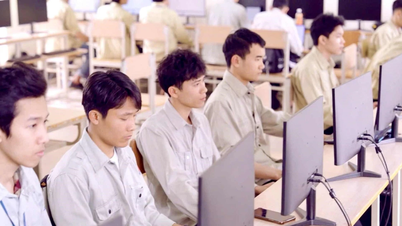
Nguyen Tuan Vu, a student in class 12A5, majoring in Information Technology at the Vietnam-Germany Technical College, is one of the students who chose this path. According to Vu, what changed his mind about vocational training was the opportunity to gain practical work experience early on.
During the summer break after graduating from 11th grade, Vu, along with many other students, participated in an internship at the VSIP Nghe An Industrial Park for over 2.5 months. Not only did he get acquainted with the production environment, but he also had the opportunity to hone his professional skills and work ethic, and earned over 20 million VND after the internship.
"I used to think that vocational training was only for those who didn't go to university. But after working directly at a company, I realized how important vocational skills are. If you have good skills, job opportunities and income are still very wide open," Vu shared.
Like Vu, Hoang Trong Son chose to continue his studies at a college level after completing his vocational program in Automotive Technology. According to Son, his research into job market needs revealed that many businesses currently require skilled technical workers, especially in the fields of automotive technology and mechanics.
"Businesses now need people who can do the job immediately. So I want to continue studying to improve my skills and have more opportunities for better jobs," Son said.

Businesses collaborate with schools.
The Vietnam-Germany Technical College is currently training over 2,600 students in 13 different fields. This includes nearly 380 students at the college level and approximately 2,300 students at the vocational level.
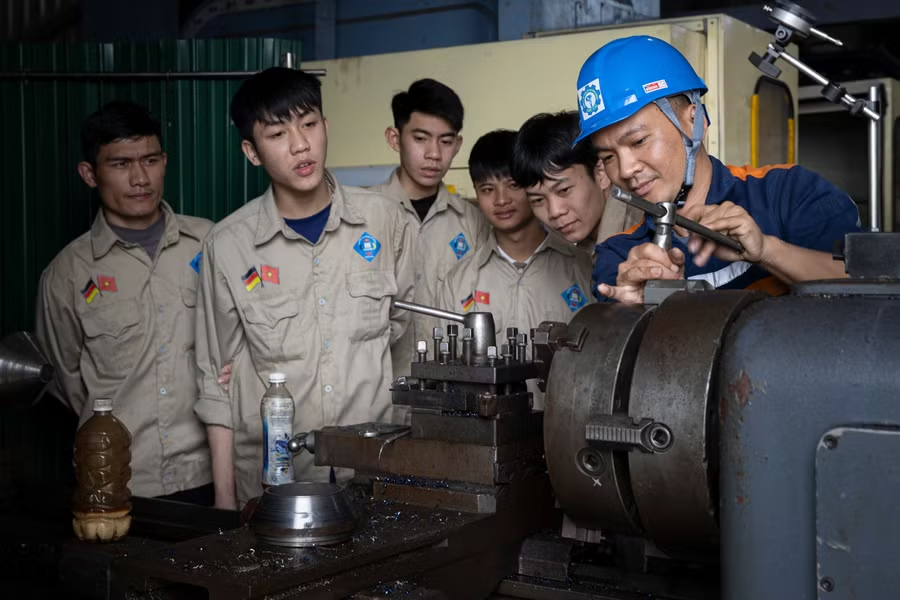
The school focuses on investing in practical training systems, updating new technologies, and strengthening links with businesses to integrate a production environment into the training process. According to Mr. Tran Thanh Dong, Deputy Head of the Training Management and Quality Assurance Department of the school, allowing students to interact with businesses during their studies is a very important factor.
“Through these collaborative programs, students hone their vocational skills, develop a professional work ethic, and become adaptable to real-world work environments. Currently, over 90% of graduates find employment relevant to their field of study, earning between 8 and 15 million VND per month,” Mr. Dong stated.
In addition to training in traditional technical trades, many vocational education institutions are proactively adjusting their programs to meet the evolving needs of the labor market.
At Ha Tinh College of Technology, enrollment currently focuses on highly applied fields such as industrial electricity, mechatronics, automotive technology, welding, mechanical engineering, automation, refrigeration and air conditioning technology, culinary arts, fashion design, and beauty care…
Notably, many businesses are directly involved in the training process. They not only accept students for internships but also collaborate on curriculum development, provide equipment support, and recruit graduates.
The school currently collaborates with many businesses, and this involvement helps make the training process more practical. Students gain access to production lines, new technologies, and the working environment right from their vocational training.
Mr. Nguyen Ba Dong – Chairman of the Management Board of Minh Duc Fund, Formosa Ha Tinh Hung Nghiep Steel Company Limited, commented: “Workers are trained in the right direction, so they meet job requirements quite well and adapt quickly to the industrial production environment. In the future, the company will continue to expand cooperation with training institutions.”
At Ha Tinh College of Technology, the school has currently signed cooperation agreements with more than 40 businesses inside and outside the province to organize practical experience and graduation internships for students.
Mr. Nguyen Trong Tan, the school principal, stated: “Each year, approximately 700 students participate in internships at businesses. This process helps them improve their practical skills, develop a professional work ethic, and increase their chances of being hired immediately after graduation. Businesses today are very interested in vocational skills and practical work abilities. Therefore, exposing students to the production environment from an early age is a mandatory requirement if we want to improve the quality of training.”
Avoid having too many teachers and too few skilled workers.
In addition to reforming training, career guidance and student placement after lower and upper secondary education in Ha Tinh are gradually becoming more in-depth.
According to data from the Ha Tinh Department of Education and Training, the province currently has 21 vocational training institutions offering 109 different occupations, with a total enrollment capacity of nearly 25,000 people per year. Of these, 1,750 are at the college level, 7,275 at the intermediate level, and approximately 15,900 at the basic level.
The vocational training network is becoming increasingly diverse, creating opportunities for many groups to access vocational training, from junior and senior high school graduates to rural workers and those seeking career changes. Notably, the effectiveness of career guidance is becoming more evident as more students proactively choose vocational training instead of continuing to chase after academic degrees.
For many years, numerous families viewed a university education as the only path to success. However, the reality of the labor market shows that many businesses are facing a severe shortage of skilled workers, while many graduates struggle to find suitable jobs.
In fields such as automotive technology, industrial electrical engineering, mechatronics, welding, metal cutting, and refrigeration and air conditioning engineering, the demand for mid-level and college-level skilled workers remains very high. Many businesses are willing to pay decent salaries to retain skilled workers.
According to statistics, over 80% of students graduating from vocational education institutions in Ha Tinh province find employment or create their own jobs after training. This figure clearly reflects the effectiveness of vocational education in the context of a labor market facing a shortage of skilled technical personnel.
The People's Committee of Ha Tinh province has recently issued a plan for career guidance and student streaming for the period 2026-2030, aiming to improve the quality of career guidance in high schools and meet the province's human resource needs in the new era.
According to the plan, Ha Tinh aims to achieve a 50% rate of post-high school education for the age group, and a 24% rate of workers with college or university degrees or higher by 2030. Simultaneously, 100% of junior and senior high schools will develop vocational education plans, assign staff and teachers to be responsible for career guidance and student placement; with a minimum of 90% in particularly disadvantaged areas.
Source: https://giaoducthoidai.vn/phan-luong-dung-huong-mo-loi-lap-nghiep-post778426.html






































































































Comment (0)