

NDO - Technology is currently playing a crucial role in many aspects of life. So how can we develop technology to not only boost the economy but also create sustainable value for the community?
These were the topics discussed by scientists and experts from Vietnam and abroad at the workshop "From Technology for Growth to Technology for the Community: Ready to Effectively Participate in the Digital Economy," organized by the Institute for Sustainable Development Studies (IRSD), under the Vietnam Academy of Social Sciences (VASS), and the Technology for Community Institute (TFGI), Singapore.
The workshop provides an opportunity for domestic and international experts, several regulatory agencies, and businesses to share trends in technology and the digital economy, and to exchange views on challenges and proposals to not only promote economic growth but also create sustainable and inclusive values for communities in the region, including Vietnam.
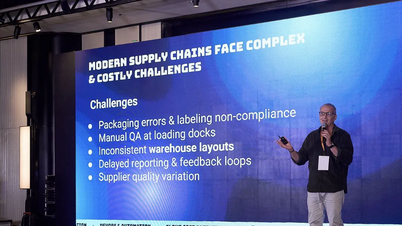
In his presentation "From Technology for Growth to Technology for the Community," Keith Detroit, Program Manager at TFGI Institute, noted that digital technology and technology-based business models are expected to be tools to drive growth in Southeast Asia, with the digital economy accounting for over 10% of the total GDP in four out of six Southeast Asian countries: Indonesia, Malaysia, Philippines, Thailand, and Vietnam.
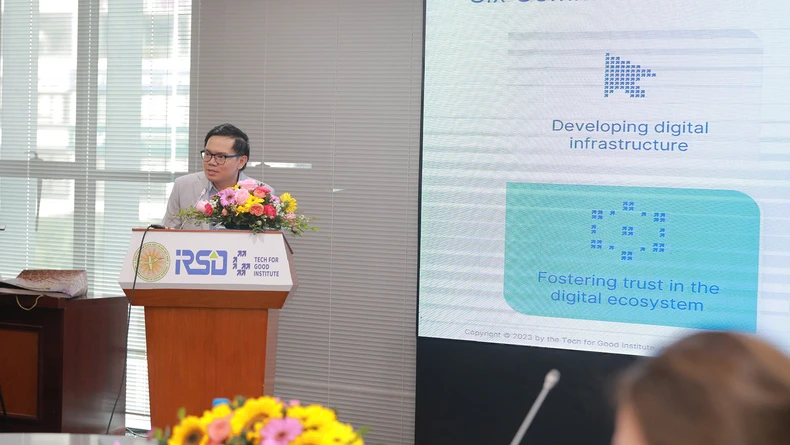 |
Keith Detroit, Program Manager at the TFGI Institute, shared his insights at the workshop. |
According to Keith Detroit, Vietnam's digital economy contributes 14.26% to its total GDP, the highest among the six countries surveyed. However, the rapid development of the digital economy comes with challenges related to inequality, cybersecurity risks, employment trends, and the environment. The report indicates that 54% of businesses operating in Vietnam's digital economy surveyed expressed a desire to address issues related to sustainable development, but the level of implementation and actual action remains low, at 31% and 4% respectively.
For the digital economy to be a driving force for sustainable, inclusive, and equitable growth, close coordination and collaboration among the government, businesses, and stakeholders in the digital economy are essential in areas such as technological innovation, business models, and policies, as well as building a strong digital society with digital infrastructure, digital skills, and a high-quality digital workforce. Therefore, policies need to be developed promptly and consistently, avoiding overlaps, to continue creating an environment that encourages startups and participation in the digital economy, aiming to develop a digital business community and address the new challenges of the digital economy.
Meanwhile, the report "The Gig Economy and the Case of Ride-Hailing in Vietnam" by the Institute for Regional Sustainable Development Studies (IRSD) raises the question, "Is the world experiencing a revolution in employment?".
According to World Bank calculations, in 2023, an estimated 435 million people participated in the gig economy (also known as the contract/freelance economy), accounting for 12% of the global labor market. In Vietnam, this figure was 14% and is projected to continue increasing in the future. The gig economy encompasses various types of jobs at different skill levels, such as cleaning, office work, IT programming, arts, and consulting.
In Vietnam, ride-hailing driving is one of the most popular jobs in the gig economy. According to a survey by the IRSD Institute, there are three factors that influence a person's decision to become a ride-hailing driver or driver partner for ride-hailing platforms like Grab, Be, and GoJek. These three factors are income, time flexibility, and sustainable development.
Accordingly, over 80% of ride-hailing drivers surveyed found that factors such as income, quality of life, mental well-being, and time for family all increased, and agreed that the job gives them more control over their time, allowing them to allocate more time for their families.
Regarding sustainable development, over 80% of drivers surveyed agreed that ride-hailing services help utilize idle personal assets for sharing, saving resources, and reducing emissions by using GPS to pick up and drop off passengers at the right locations. The majority of drivers participating in the study identified ride-hailing as their primary occupation and wished to pursue it long-term. This raises issues for promoting sustainable digital economic development, harmonizing the responsibilities and interests of businesses and individuals participating in the digital economy.
Along with reports from both institutes, the open discussion provided multifaceted perspectives from policymakers, domestic and international experts, and technology companies on employment trends stemming from the development of the digital economy, as well as ways to effectively leverage technological and digital economic development to bring sustainable benefits to the community.
Dr. Trinh Thu Nga from the Institute of Labor and Social Sciences believes that in the coming period, digital transformation and the development of the digital economy are considered "vital" choices for breakthroughs in Vietnam's socio-economic development. The national human resource development strategy in general, and that of each locality in particular, over the next 10 years must focus on addressing the issue of proactive human resources capable of adapting to and accessing the achievements of new science and technology and overcoming its challenges.
Accordingly, it is necessary to focus on the following measures: Firstly, developing and improving the national digital competency framework, as well as having a strategy to enhance this capacity for the general population and the workforce in particular (through the development and implementation of a project to popularize basic digital skills for the people; as well as training programs to equip workers with digital skills – with the active participation of the public and private sectors, especially technology companies).
Secondly, special attention needs to be paid to developing specific training mechanisms and policies for informal workers (especially those who are untrained or have low skills) so that they can be equipped with appropriate knowledge and skills, including digital skills, with the goal of supporting their transition to the formal sector and adapting to the transformation and application of new technologies in the future.
From a business perspective, Ms. Dang Thuy Trang, Director of External Relations at Grab, shared that one of the challenges for technology companies is awareness and openness to embracing new trends. The government has implemented numerous policies and efforts to promote the digital economy, but there needs to be synchronization across sectors and industries so that technology companies can continue to contribute to the digital economy and encourage micro, small, and medium-sized enterprises (MSMEs) to participate in it.
Sharing his perspective on this issue, Associate Professor Bui Quang Tuan emphasized that the institutional and policy framework for the new economic model also needs to be adaptable to create a favorable environment for the development of the digital economy. With improvements in institutional and policy frameworks, as well as changes in awareness among the workforce and the general public, technology will contribute to the stronger development of the digital economy and create sustainable, inclusive values for communities in the region, including Vietnam.
Source: https://nhandan.vn/phat-develop-technology-for-the-community-post845907.html
![[Photo] The General Secretary, President and his wife meet with Vietnamese-Chinese friendship leaders.](https://vphoto.vietnam.vn/thumb/1200x675/vietnam/resource/IMAGE/2026/04/15/1776264829725_vna-potal-tong-bi-thu-chu-tich-nuoc-to-lam-gap-mat-nhan-sy-huu-nghi-viet-nam-trung-quoc-8703641-3130-jpg.webp)
![[Photo] National Assembly Chairman Tran Thanh Man attends the opening session of IPU-152](https://vphoto.vietnam.vn/thumb/1200x675/vietnam/resource/IMAGE/2026/04/16/1776277863731_ctqh5-jpg.webp)
![[Photo] Mrs. Ngo Phuong Ly meets and exchanges views with Mrs. Peng Li Yuan](https://vphoto.vietnam.vn/thumb/1200x675/vietnam/resource/IMAGE/2026/04/16/1776277858080_phu-nhan-1-jpg.webp)
![[Photo] My Son at night: A thousand-year-old heritage site amidst the Milky Way](https://vphoto.vietnam.vn/thumb/1200x675/vietnam/resource/IMAGE/2026/04/15/1776261039184_ndo_br_chon6-jpg.webp)

![[Photo] National Assembly Chairman Tran Thanh Man arrives in Türkiye to attend IPU-152](https://vphoto.vietnam.vn/thumb/1200x675/vietnam/resource/IMAGE/2026/04/15/1776261003665_tnk10-jpg.webp)





































































![[Infographic Series] Red Addresses of Dong Nai: Location of the establishment of the Binh Phuoc - Tan Trieu Party Branch and the provisional Bien Hoa Provincial Party Committee, the site of the victory at Doc 31, the place where the 302nd Division was established.](https://vphoto.vietnam.vn/thumb/402x226/vietnam/resource/IMAGE/2025/9/26/1331532306fb4ad18e4a849e5c64202a)
















Comment (0)