

 |
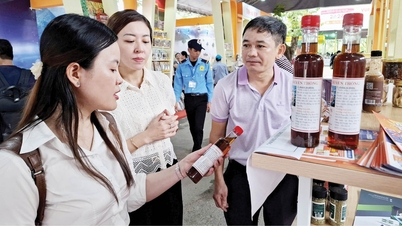
| A booth at the Hue International Food Festival 2025 |
It's not just about honoring.
Amidst the bustling atmosphere of the Hue International Food Festival 2025, held from December 18-21, we encountered a foreign female tourist walking past various stalls. She stopped to observe a few before leaving, buying only a bag of Hue-style pressed rice cakes. Through the tour guide's translation, the female tourist expressed her regret: "I wanted to find the distinctive flavors of Hue cuisine, but it seems that street food is more prevalent here."
That statement is not just empty words, but something worth pondering, because just a few days earlier (December 6th), TasteAtlas ranked Hue 36th among the 100 cities with the best food in the world . Prior to that, in 2024, Hue also ranked 35th, surpassing many locations in "culinary powerhouses" like Mexico and Brazil. These accolades and rankings only fuel the paradox: Hue's cuisine is recognized globally, but the culinary experience for tourists there is still not truly commensurate.
In fact, some travel companies have recently incorporated culinary elements into Hue tours. However, most have only done so at an integration level, viewing cuisine as a supplementary part of the trip to meet the basic eating needs of tourists. Some customized tours introduce traditional dishes and allow guests to experience cooking, but these are still only for "trying out" purposes.
According to businesses, the lack of clear recognition of cuisine as an independent tourism sector has led to fragmented investment. Infrastructure for culinary experiences is not standardized, lacking sufficient space to accommodate large groups. Cooking instructors lack professionalism in both skills and language proficiency. Meanwhile, the restaurant and eatery system in the area is disjointed, lacking planned specialized culinary zones; staff lack storytelling skills; and facilities are insufficient to organize regular, well-structured activities. Therefore, cuisine is often perceived as an "accompanying element" of tourism, rather than a product that can create added value. Consequently, how to leverage cuisine to become a tourism product, despite much discussion, remains without a complete solution.
In fact, many tourists have reported that when visiting Hue, they want to learn more about the origins and cultural value of the dishes they are interested in, but don't know where to start. Meanwhile, the tourism staff lacks sufficient knowledge to explain, guide, and promote the depth of Hue's culinary culture.
In recent years, Hue has focused on organizing many culinary events, most recently the "Hue - Culinary Capital" program (April 29 - May 2, 2025) and the Hue International Food Festival 2025 (December 18 - 21). However, according to many experts, these events have not yet created a strong enough impact to form a long-term tourism product. The Vice President of the Vietnam Tourism Association and President of the Hue City Tourism Association, Dinh Manh Thang, expressed his concern: "The scale and appeal of culinary events are still not as expected, and the ripple effect and ability to attract tourists remain limited."
From the name to the attractive product.
In discussions with travel businesses, the brand "Hue - Culinary Capital" and its frequent international rankings are often mentioned. They believe that this designation is very valuable and serves as an important catalyst for tourism promotion. However, the challenge lies in how to transform these designations into concrete products, encouraging tourists to spend money and return.
Mr. Do Ngoc Co, Chairman of the Hue City Tourism Association, believes that Hue lacks services and experiences attractive enough to retain tourists. Developing unique products, including culinary tourism, would increase spending and extend the length of stay for visitors.
From a culinary culture perspective, Mr. Le Tan, Vice President of the Vietnam Culinary Culture Association, believes that Hue needs clear policies, mechanisms, and investment directions for the culinary sector linked to tourism, viewing it as a factor to promote economic development. A systematic approach to communication is needed to activate the development of suitable products. The tourism industry could organize tourism survey programs, allowing tourists to experience Dong Ba Market or traditional food spaces not only for shopping but also to hear the stories behind each dish. In addition, the development of themed culinary tours needs to be done professionally.
Clearly, for Hue's culinary reputation to go beyond mere recognition, a comprehensive strategy is needed. First and foremost, cuisine must be viewed as an independent form of tourism, with products designed with a script and a narrative, not just a simple eating activity. Simultaneously, investing in human resources is crucial. Artisans, chefs, and tour guides not only need to be skilled professionals but also become "storytellers," helping tourists understand and appreciate the essence of Hue's cuisine. Furthermore, communication efforts need to be in-depth, focusing on core values, linking cuisine with the history, cultural traditions, and lifestyle of the ancient capital.
Source: https://huengaynay.vn/du-lich/phat-trien-san-pham-du-lich-cho-am-thuc-hue-161496.html


![[Photo] General Secretary and President To Lam meets with National Assembly delegates from ethnic minorities.](https://vphoto.vietnam.vn/thumb/1200x675/vietnam/resource/IMAGE/2026/04/20/1776696701056_a1-bnd-8331-3342-jpg.webp)
![[Image] National Assembly discusses the implementation of the socio-economic development plan.](https://vphoto.vietnam.vn/thumb/1200x675/vietnam/resource/IMAGE/2026/04/20/1776696707422_ndo_br_img-20260420-185419-jpg.webp)


![[PHOTO] The most beautiful sidewalks in Saigon that captivate people, captured with smartphones.](https://vphoto.vietnam.vn/thumb/402x226/vietnam/resource/IMAGE/2026/04/21/1776707735189_anh14_rlcz.jpeg)
































































Comment (0)