

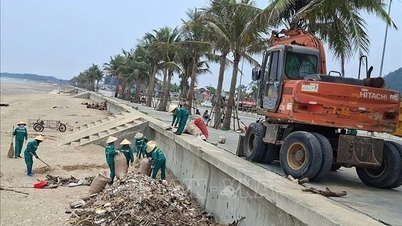
This leads to situations where, when garbage, foul odors, or inappropriate collection points arise, the response is often slow and the handling process is prolonged due to a lack of authority. To overcome these shortcomings, from December 1st, Hanoi will transfer the responsibility for maintaining environmental sanitation to 126 communes and wards.
This is an unprecedented step in terms of decentralization aimed at not only changing "who does it," but more fundamentally, revolutionizing the thinking "how" to keep the environment cleaner and more civilized.
This decentralization process restructures the responsibilities. Communes and wards are the investors, and are also responsible for and supervise environmental sanitation work. From monitoring volume, quality control, and progress checks to receiving feedback from residents, all activities are concentrated at the grassroots level – the closest to the people, understanding the local area, and directly evaluated by the community. The city is not only transferring tasks but also trust, while simultaneously demanding decentralization without any disruption to services; increasing responsibility without creating loopholes; and delegating authority without loosening management. This is the spirit of governance innovation, decentralization, and delegation of authority so that communes and wards can truly work, take real responsibility, and transparently inform residents of the results.
Practical implementation shows that the pressure placed on communes and wards is immense, from directly managing environmental sanitation maintenance contracts to preparing legal documents, controlling volume, payment, and acceptance. All are complex tasks requiring accuracy and professional expertise. Furthermore, the pressure of deadlines, with 2026 approaching, means that by December 2025, localities must prepare cost estimates, develop bidding documents, and organize the selection of waste collection units for the 2026-2030 period. Especially when communes and wards are the project owners, all public concerns are addressed directly, eliminating the mechanism of "passing the buck" and requiring immediate action.
According to environmental experts, these pressures also create motivation. Only when empowered can communes and wards reorganize their waste collection and environmental sanitation systems to be more practical, such as increasing the frequency of waste transportation, adjusting collection times, changing routes to avoid congestion, and arranging collection points more scientifically .
However, for the decentralization of environmental sanitation management to be not only "correct" but also "effective," solutions must be implemented synchronously, clearly, and with control. Specifically, communes and wards need to be given full authority in selecting waste collection units; adjusting collection frequency and routes; handling waste dumping violations; and conducting acceptance and payment processes. However, this must be accompanied by strong penalties; any area where waste remains for 24-48 hours must be held accountable to the City People's Committee.
City departments and agencies must ensure sufficient resources are available upon handover, such as: allocating sufficient funds according to the budget; supplementing equipment; and strengthening the environmental task force at the commune and ward levels. Simultaneously, the city requires localities to standardize the contractor selection process, absolutely preventing the emergence of vested interests. During the implementation of the contract, the volume, unit prices, and acceptance results must be publicly disclosed, and there must be cross-monitoring and inspection between the specialized departments of the Department of Agriculture and Environment. Another crucial solution is for communes and wards to intensify public awareness campaigns on proper waste disposal, eliminating illegal dumpsites and waste hotspots.
Decentralizing environmental sanitation responsibilities to communes and wards is not just about transferring technical tasks, but a major test of the governance capacity of the grassroots level. When rights, responsibilities, resources, and supervision are properly placed, the capital city will be cleaner and more civilized, starting from the smallest streets and alleys. This is a crucial step towards modern environmental management in Hanoi: Cleanliness from the source - standards from the grassroots - sustainability from the community.
Source: https://hanoimoi.vn/phep-thu-nang-luc-quan-tri-726112.html

![[Photo] General Secretary and President To Lam presides over a working session with the Central Policy and Strategy Committee on the development of the materials industry.](https://vphoto.vietnam.vn/thumb/1200x675/vietnam/resource/IMAGE/2026/05/21/1779359935432_a3-bnd-3129-1412-jpg.webp)


![[Photo] National Assembly Chairman Tran Thanh Man working with the Standing Committee of the Law and Justice Committee](https://vphoto.vietnam.vn/thumb/1200x675/vietnam/resource/IMAGE/2026/05/21/1779378929214_ndo_br_1-4610-jpg.webp)















































































Comment (0)