


Speaking at the scientific conference " The Unlimited Power and Unpredictable Challenges of Artificial Intelligence (AI) - Impacts and Policy Responses " held on the morning of September 15th, Minister of Science and Technology Nguyen Manh Hung emphasized that AI must become the country's intellectual infrastructure, helping Vietnam not only apply but also master the technology.
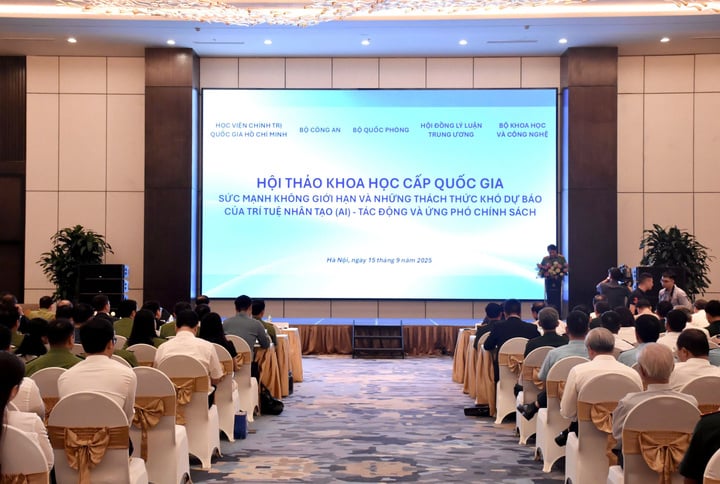
Overview of the scientific conference "The Unlimited Power and Unpredictable Challenges of Artificial Intelligence (AI) - Impacts and Policy Responses." (Photo: Thuy Linh)
Vietnam will build a national AI supercomputing center and a shared open AI data system, widely popularizing AI in society, following the "AI literacy for the masses" model. Every citizen will have their own digital assistant, helping to double social intelligence even without population growth.
AI – a driving force for asserting national dominance.
The scientific seminar "The Unlimited Power and Unpredictable Challenges of Artificial Intelligence (AI) - Impacts and Policy Responses" was organized by the Ho Chi Minh National Academy of Politics in collaboration with the Ministry of Public Security , the Ministry of National Defence, the Central Theoretical Council, and the Ministry of Science and Technology at the National Exhibition and Convention Center.
In his opening remarks, General Luong Tam Quang, Minister of Public Security, affirmed that in the fourth industrial revolution, AI is considered one of the key technologies, a factor that could lead to changes in the global order in the future.

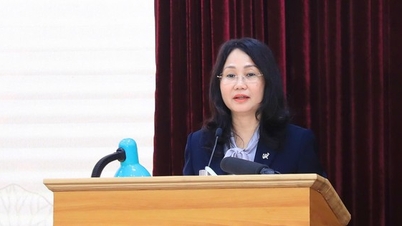
General Luong Tam Quang speaks at the seminar. (Photo: Thuy Linh)
With its potential to boost economic growth, optimize production, improve healthcare, innovate education, and enhance social governance, AI helps countries save costs, increase efficiency, expand knowledge, and serves as a resource, a driving force, and a means of asserting national position in the digital age.
"With strategic vision and keen thinking, our Party has issued and resolutely led the implementation of Resolution 57, identifying science, technology, innovation, and national digital transformation as a vital choice, the golden key to helping the country overcome the middle-income trap, push back the risk of economic backwardness, and achieve two strategic goals for the 100-year period: by the middle of the 21st century, our country will become a developed, high-income country; identifying the development of strategic technologies, including artificial intelligence technology, as a top priority breakthrough, the main driving force for the rapid development of modern productive forces, the innovation of national governance methods, and socio-economic development."
According to assessments, Vietnam's AI development potential is enormous, projected to contribute over $80 billion, equivalent to 12% of Vietnam's GDP by 2030 if widely applied ," General Luong Tam Quang emphasized.
Besides its potential, AI also poses unprecedented challenges regarding legal loopholes, ethical risks, the misuse of technology for cybercrime, information warfare, data privacy violations, and especially the potential impact on national defense and security.
According to Professor Nguyen Xuan Thang, Director of the Ho Chi Minh National Academy of Politics and Chairman of the Central Theoretical Council, the most worrying risk of AI is the potential for loss of control over self-learning and self-adaptive AI systems, especially when they develop in a direction beyond human understanding and supervision.
AI has been having negative impacts on the labor market, replacing many traditional professions and leading to increased unemployment, especially for unskilled or digitally unskilled workers. Furthermore, if training data is biased, AI can replicate and amplify social biases, leading to skewed and unfair decisions.

Professor Nguyen Xuan Thang giving a speech at the event. (Photo: Thuy Linh)
"The collection, analysis, and use of personal data by AI also poses a risk of privacy violations, as personal information can be exploited, tracked, or misused. AI can also be exploited for dangerous activities such as online fraud, spreading fake news, voice and image spoofing (deepfake), causing public panic and affecting social security and order."
Meanwhile, globally, even in the most developed countries, current legal systems and ethical regulations have not kept pace with the explosive growth of AI, making it very difficult to determine responsibility and exercise control,” Professor Nguyen Xuan Thang emphasized.
Referring to the draft revised National Strategy on Research, Development and Application of Artificial Intelligence until 2030, Professor Nguyen Xuan Thang stated that the new strategy has expanded its vision to 2045, aiming to make Vietnam a data-rich nation with the capacity to deploy AI solutions among the top 10 countries in the world, while also developing a large-scale Vietnamese language model, high-performance data and computing infrastructure.
Looking at the reality, Professor Nguyen Xuan Thang pointed out inherent shortcomings such as: a shortage of high-quality human resources, limited technical infrastructure, fragmented R&D investment, a fragmented AI ecosystem, and a lack of a legal framework. "In particular, Vietnam currently lacks a specialized law on AI, which makes risk control, data protection, and privacy assurance inconsistent and ineffective ," the professor said.
A national code of ethics for AI will be issued.
AI opens up great opportunities, but also raises many ethical, employment, and social trust issues. Therefore, according to Minister Nguyen Manh Hung, we must develop AI that is both fast, safe, and humane. AI should be for humanity, not replace humans, but serve humanity; AI should be a human assistant.
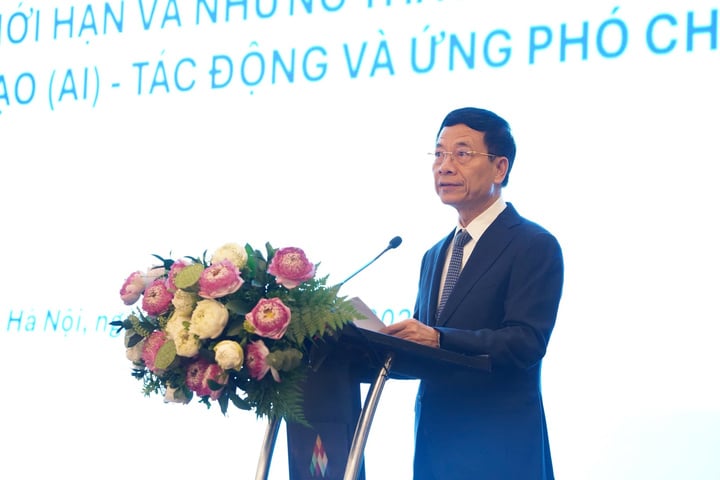
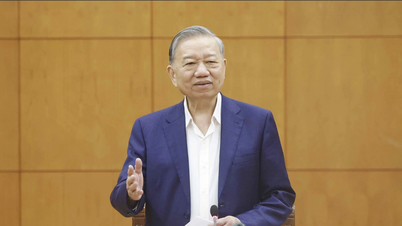
Minister of Science and Technology Nguyen Manh Hung speaks at the workshop. (Photo: Thuy Linh)
AI is a powerful tool, but humans are the ultimate decision-makers. "Let AI support, not replace, human thinking, values, and responsibilities," Minister Nguyen Manh Hung emphasized.
According to the Minister, Vietnam will also issue a national AI code of ethics, harmonized with international standards but designed to suit Vietnamese realities. Simultaneously, it will develop an AI law and an AI strategy based on six core principles, including:
First , manage based on risk level.
Secondly , transparency and accountability.
Third , put people at the center.
Fourth , encourage the development of domestic AI and achieve self-reliance in AI.
Fifth , leverage AI as a driver for rapid and sustainable growth.
Sixth , protecting digital sovereignty. In this context, data, infrastructure, and AI technology are the three strategic pillars of digital sovereignty.
Minister Nguyen Manh Hung also emphasized the need to balance global "big tech" technologies with the advantages of businesses and organizations that understand the local context, language, culture, and specialized data to develop specialized AI applications domestically.
"Vietnam's AI development path is defined by the word 'and': global and local, cooperation and autonomy, big tech and startups, open and controlled technology, open and protected data, platform AI and customized specialized AI. This is the key to developing AI quickly, sustainably, and humanely," the Minister of Science and Technology shared.
The manifesto for AI in Vietnam is: Humane - Safe - Self-reliant - Collaborative - Inclusive - Sustainable.
Finally, Minister Nguyen Manh Hung affirmed that AI is a powerful tool to free up human labor for more creative and higher-value tasks, but humans remain the ultimate decision-makers. AI is an assistant, not a replacement for human thinking, values, and responsibilities.
Minh Hoan
Source: https://vtcnews.vn/pho-cap-ai-theo-mo-hinh-binh-dan-hoc-vu-ar964268.html
![[Photo] Speaker of the National Assembly inspects election preparations in Dong Nai](https://vphoto.vietnam.vn/thumb/1200x675/vietnam/resource/IMAGE/2026/03/05/1772685006217_ndo_br_7-resize-6037-jpg.webp)




































































































Comment (0)