

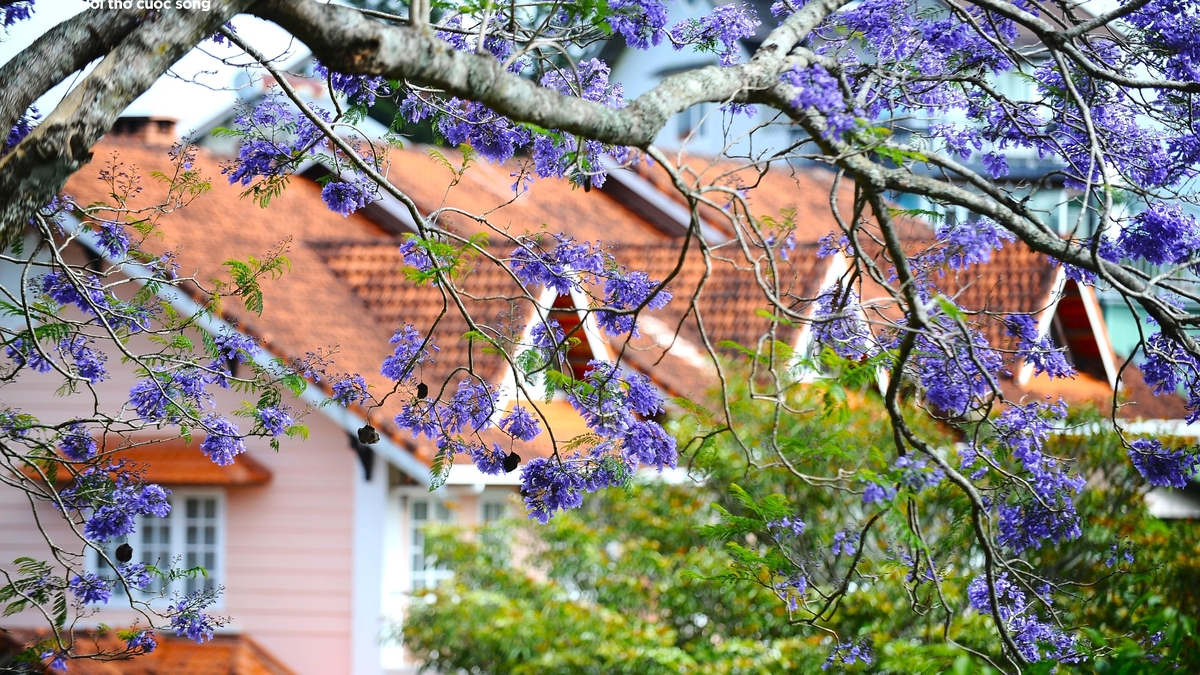
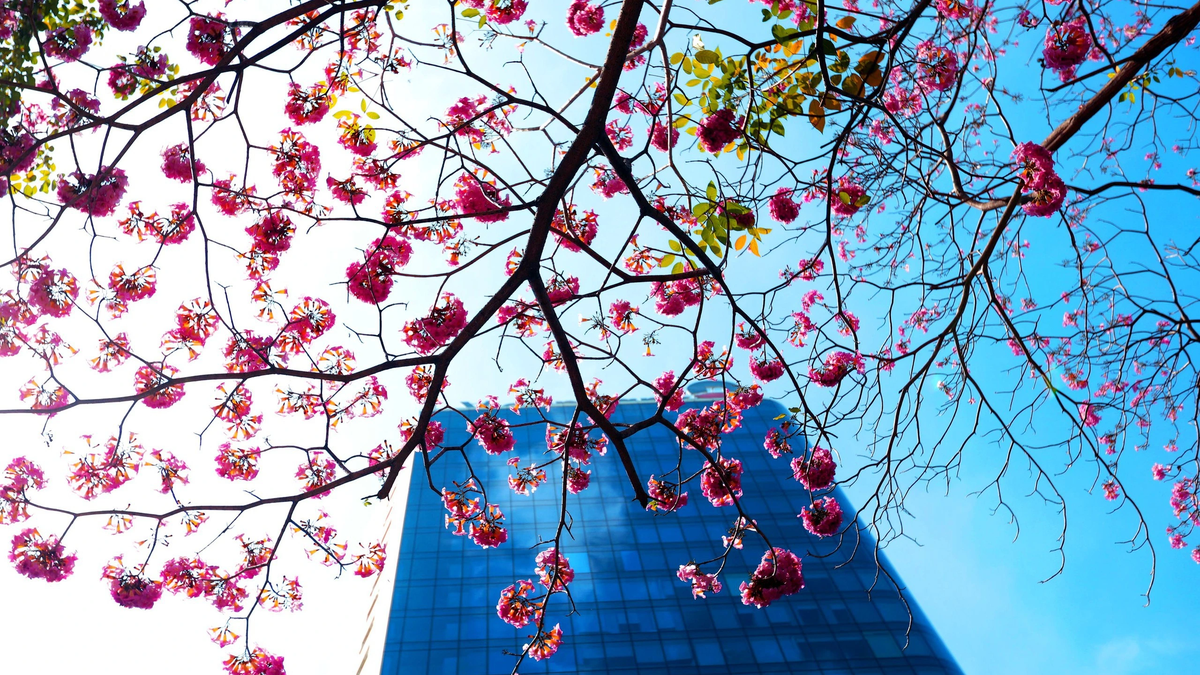
As part of my daily routine, I cycle through Cau Dat Street twice a day. On this short stretch, the wheels seem to slow down as I pass through this street. When April arrives, the crape myrtle trees on Cau Dat Street begin to display their gentle, poetic purple blossoms, leaving me utterly amazed and delighted. Clusters of flowers intertwine against the vast blue sky, captivating anyone who passes by with their delicate and enchanting beauty. It's hard to imagine that this street, blanketed in dreamy purple blossoms, was once the most famous commercial district in Hai Phong during the French colonial era.
Cau Dat Street is a central street in a strategically important location in Hai Phong city. The street has changed direction several times, and currently, it runs in the same direction starting from the Trai Linh intersection, where Lach Tray, Le Loi, and To Hieu streets meet, extending to the intersection of Cau Dat, Hoang Van Thu, and Tran Phu streets. Originally, Cau Dat Street belonged to the former Gia Vien and An Bien communes, and before the city's liberation (in 1955), it was part of the train station area. When it was first opened, the street was named after the Governor-General of Indochina, Paul Doumer (Avenue Paul Doumer). However, even then, the people of Hai Phong called it Cau Dat Street. In 1946, it was renamed Ho Chi Minh Boulevard. In 1954, it was renamed Tran Hung Dao. In 1963, it reverted to Cau Dat Street, a name it retains to this day.
According to the "Encyclopedia of Place Names of Hai Phong," the street was named Cau Dat (Earth Bridge) because, in the past, between the two villages of An Bien and Gia Vien, there was a small stream called Liem Khe, which was a tributary of the Tam Bac River flowing into the Cam River. This stream was the precursor to the Bonnal Canal, dug in 1885. Crossing the stream, in the area where the flower shop is now located, there was a small bamboo bridge with an earthen surface, so the locals called it Cau Dat (Earth Bridge). The street's name originated from there. Later, the French replaced the earthen bridge with an iron bridge, called Cau Doume. In 1925, when the Bonnal Canal was filled in, the iron bridge was dismantled.
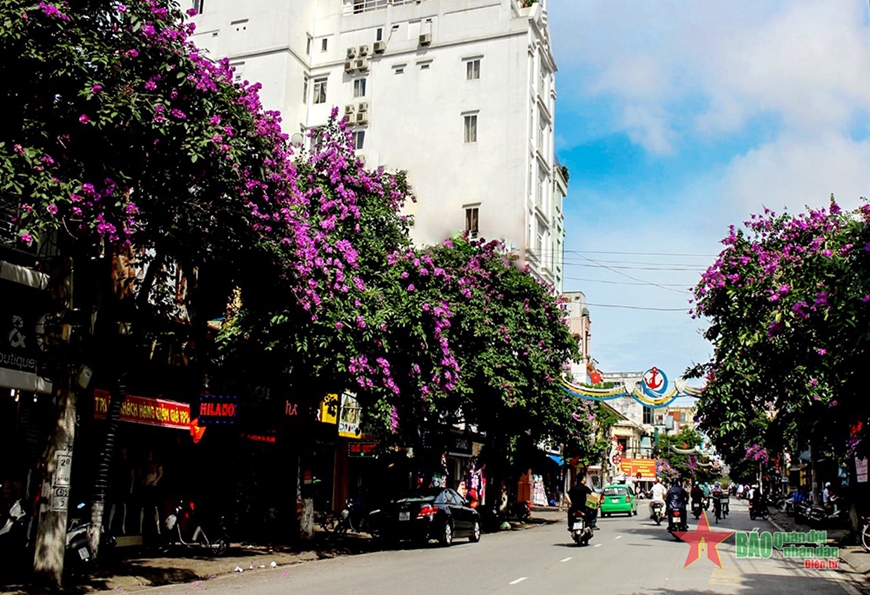 |
Cau Dat Street is notable for its two rows of purple crape myrtle trees. Photo: Vu Lam |
Although Cau Dat Street is only about 650 meters long, it is a very bustling street with a high population density and many famous goods; it's even called the street of imported goods. Many entrepreneurs who started their businesses in the gold, silver, and gemstone trade from this area have built their careers, names, and stature in the industry. Walking along the street, the rows of glittering gold shops reflect the characteristic wealth of the port city. The shop owners here are extremely enthusiastic when introducing the quality products and reputable brands they own. Ms. Nguyen Le Chan, a native of the area, said that when talking about the old Cau Dat Street, one cannot fail to mention Mai Linh Bookstore, a "golden cradle" for authors and their works, serving as both a bookstore and a publishing house, and also a revolutionary base. She couldn't hide her emotion when talking about the heroic past of Cau Dat, a land that suffered many bombing raids because it nurtured and protected patriots.
Spending time strolling leisurely along Cau Dat Street, I was captivated and amazed by the fascinating stories told by each shop, the origins of their respective brands. The residents of the neighborhood are always full of pride in their exquisite dishes, which have left a strong mark on their area. Not only Hai Phong residents but also tourists from all over come to enjoy and purchase them. My friends from Ho Chi Minh City, Hanoi, Quang Ninh, and other places often ask to be taken to Ba Cu's crab noodle soup when they visit the port city. I'm not surprised by these requests, as this is a favorite spot for travelers, recognized and spread by word of mouth. Ba Cu's crab noodle soup is one of the first crab noodle soup restaurants in Hai Phong, and it has been around for over 50 years. Upon entering the restaurant, one is immediately greeted by the rich aroma of the sea, captivating both sight and smell. After a moment of eager anticipation, when the waiter brings out the food, customers are instantly captivated by the vibrant colors of the crab noodle soup. Each characteristic brown noodle is chewy and delicious, blending perfectly with the rich, sweet and savory flavors of shrimp, crab, onions, and pork cracklings. Because it's a reputable restaurant , it's quite busy; during peak hours, there might not be any seats available.
Under the purple crape myrtle trees, I've become all too familiar with the sight of the women standing there, smiling and inviting passersby to buy fried donuts. When I first discovered Cau Dat Street, I stopped at a stall to buy donuts and curiously asked, "Why do both the stalls over there and this one say 'Ba Lang's Fried Donuts'?" The vendor smiled and replied, "Don't you know this is a famous street for sweets and pastries, including Ba Lang's fried donuts? Ba Lang's fried donuts have been a well-known brand for a long time. Most of the people selling here don't make them themselves, and Ba Lang herself doesn't make them anymore either; only her children and grandchildren do. And everyone else gets the donuts to sell there. Because in the old days, Cau Dat Street was full of children of wealthy officials and merchants, everything had to be delicious and unique, even snacks. If it wasn't delicious, how could it sell to those wealthy, discerning, and picky eaters?"
Mrs. Lang meticulously kneaded and prepared her fried donuts, creating a delicate, fragrant, crispy crust with a smooth filling. Her handmade donuts were easy to eat and not greasy. Back then, she wrapped them in leaves, but now people use plastic containers for convenience. In the past, buying fried donuts from Cau Dat Street as a gift was a luxury. Nowadays, with the economic development and the proliferation of restaurants and delicious food, visitors from all over still stop by to buy Mrs. Lang's fried donuts to enjoy during their trip to Hai Phong. Furthermore, when talking about the cakes of Cau Dat Street, one must mention mooncakes. Fried donuts are bought year-round, but mooncakes are especially popular during this festival. If you visit Cau Dat Street for the first time during the busy days when people come to buy and order mooncakes, you will surely be surprised by the unique appeal of the Dong Phuong bakery. I stood there, mesmerized, watching the long line of people stretching from the bakery to the end of the street. Dusty, noisy, busy, they patiently waited their turn just to buy a bag of Dong Phuong mooncakes. At peak times, they might have to wait for half the day. Yet, every year I see this crowded, bustling scene repeat itself.
Cau Dat Street holds many interesting and fascinating aspects for anyone who wants to explore and trace its development. The street's facade blends the glitz and glamour of the modern era with beautiful cultural values and precious traditional crafts. Over time, this small street has undergone countless changes; the rows of purple crape myrtle trees that have spread across the street are only a few years old. There is always a beginning, and then there is a continuation. Perhaps from now on, Cau Dat Street will have an even more special character, one that people will remember and want to call by a distinctive name. I would like to give Cau Dat Street the name "Purple Crape Myrtle Street." It seems that this deep purple canopy makes the street more complete and beautiful. In the city of red flamboyant flowers, instead of choosing flamboyant trees, they chose purple crape myrtle to plant uniformly in Cau Dat. In my personal opinion, this choice is perfectly fitting. The graceful purple color suits this street of many memories. A flower that is both intensely vibrant and delicate, graceful and profound, just like the street where it takes root and thrives each day. The violet-eyed flower evokes countless memories, stories, and journeys of development, self-improvement, and the creation of life's values...
Notes by TRAN NGOC MY
Source



![[Photo] Young people of the Dong Thap Border Guard actively participate in "March Border Month" activities.](https://vphoto.vietnam.vn/thumb/1200x675/vietnam/resource/IMAGE/2026/03/23/1774248483508_ndo_tl_dt3-jpg.webp)
![[Photo] The Prime Ministers of Vietnam and Russia witness the signing ceremony on cooperation in building a nuclear power plant.](https://vphoto.vietnam.vn/thumb/1200x675/vietnam/resource/IMAGE/2026/03/23/1774278492322_vna-potal-hai-thu-tuong-viet-nam-va-nga-chung-kien-le-ky-ket-hiep-dinh-ve-hop-tac-xay-dung-nha-may-dien-hat-nhan-8658380-jpg.webp)



















































































Comment (0)