

 |
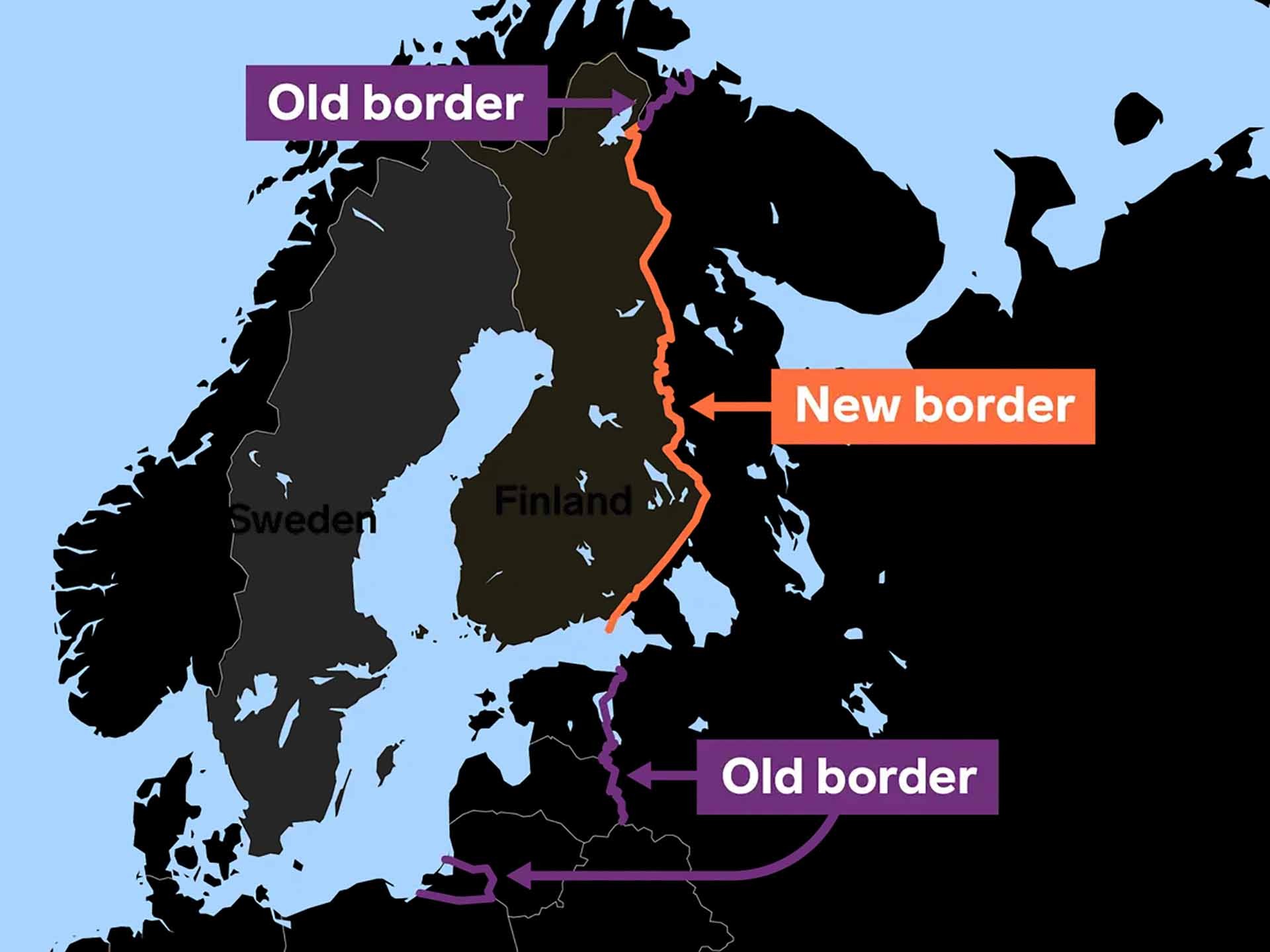
| The border between NATO and Russia has doubled in length since Finland joined NATO (Source: Business Insider). |
The North Atlantic Treaty Organization (NATO) was founded on April 4, 1949, with 12 founding members, including the United States, Canada, and 10 European countries: the United Kingdom, France, Belgium, Portugal, Denmark, the Netherlands, Iceland, Luxembourg, Norway, and Italy. NATO's purpose in its creation was to prevent the growing influence of the Soviet Union.
Following the formation of the Warsaw Pact in 1955, the rivalry and arms race between these two opposing military blocs was one of the main reasons that escalated the Cold War to a new level. When the Berlin Wall fell in 1989, the Warsaw Pact disintegrated, and NATO, no longer a counterweight, did not dissolve but continued to expand and participate in wars, such as in Yugoslavia…
Following the events of September 11, 2001, NATO shifted its focus to the fight against terrorism, notably through military interventions in Afghanistan, Iraq, and Libya.
Expansion process
NATO's "open door policy" stipulates that any European country capable of promoting the principles of the Treaty and contributing to the security of the North Atlantic region can join.
Since its inception, NATO has undergone nine expansions in 1952, 1955, 1982, 1999, 2004, 2009, 2017, 2020, and 2023. During the Cold War, NATO added Greece and Türkiye (1952), West Germany (1955), and Spain (1982).
Following the Cold War, the Czech Republic, Hungary, and Poland joined NATO in 1999. In 2004, Bulgaria, Estonia, Latvia, Lithuania, Romania, Slovakia, and Slovenia were added to the alliance. In April 2009, Albania and Croatia joined NATO. Montenegro joined in June 2017, North Macedonia in March 2020, and most recently, Finland (April 4, 2023).
In addition to the 31 full members, 22 other countries join NATO as relationship partners in the Peace Corps program, and 15 others participate in institutionalized dialogue programs.
Georgia, Ukraine, Bosnia-Herzegovina, and Sweden are currently continuing their NATO accession process. Sweden submitted its application along with Finland, but it has not yet been approved by Türkiye and Hungary. Ankara argues that Stockholm has not acted strongly enough against the Kurdish group considered terrorists, while Hungary used its veto power to demand concessions from the EU on other issues. Ukraine officially submitted its application to join NATO in September 2022, but since 2008, NATO members, particularly the US, have stated that they may admit Ukraine “at some point.” However, Kyiv’s NATO accession process has stalled due to concerns from countries like France and Germany that such a move would provoke Russia.
After the end of the Cold War, NATO launched three waves of "Eastward Expansion." In the first expansion alone, NATO's borders were extended eastward by 900 km, troop numbers increased by 13 divisions, and all weapons and equipment from new members and East Germany were received. This severely disrupted the balance of power between Russia and NATO.
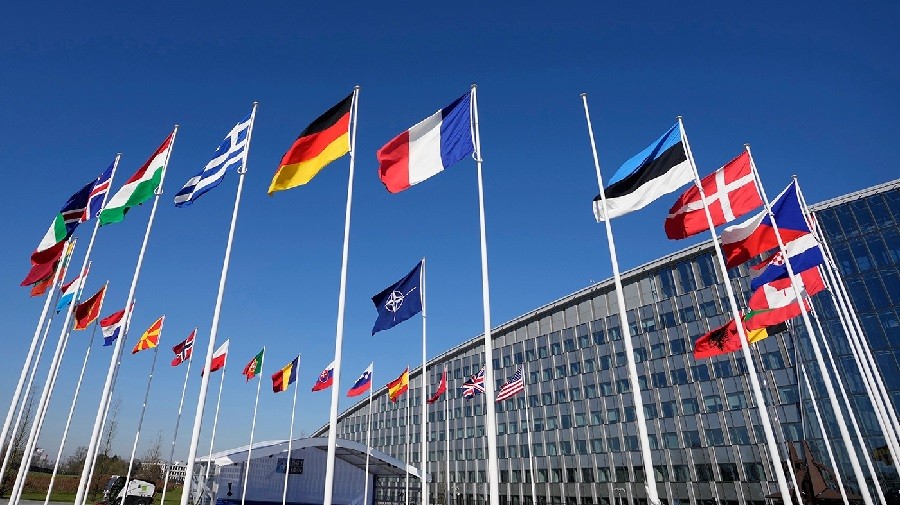 |
A flagpole outside NATO headquarters in Brussels has yet to raise its flag, awaiting Finland's official accession ceremony. (Source: The Hill) |
New member, old worries
Finland's official accession to NATO signifies the end of Helsinki's decades-long "Finnishization" policy. After World War II, Helsinki declared it would not join NATO to avoid Soviet attack. However, following the outbreak of conflict in Ukraine in early 2022, Helsinki changed its stance and accelerated its accession process, a goal that garnered strong domestic support.
Speaking at the induction ceremony on April 4th, the Finnish President joyfully declared: “Today, Finland has become a member of the NATO military alliance, ending the era of military non-alignment in Finnish history and beginning a new era. Every nation must ensure its own security to the fullest extent, and Finland is no exception. Becoming a NATO member strengthens Finland’s international standing and creates opportunities for action. As a partner, Finland has long been actively involved in NATO activities. In the future, Finland will contribute to NATO’s collective defense and deterrence capabilities.”
NATO believes that with the addition of Finland, "collective defense against Russia will be easier for the bloc thanks to access to Finnish territory and the military support capabilities of Helsinki." For many years, NATO's main concern in this region has been the Suwalki Corridor, a 65-kilometer strip of land connecting Kaliningrad, a Russian exclave nestled between the Baltic states of Estonia, Latvia, and Lithuania, with Belarus. If Moscow controls the Suwalki Corridor, it will cut off the connection between these three countries and Poland and other NATO member states. However, the addition of Finland also poses significant defense challenges for NATO because previously, only Estonia, Latvia, Lithuania, Norway, and Poland had direct borders with Russia, stretching approximately 1,300 kilometers. Now, with the addition of Finland's 1,340-kilometer border with Russia, extending from the Barents Sea in the north to the Gulf of Finland in the south, the border between NATO and Russia will double.
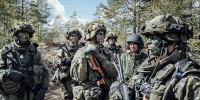
According to the Firepower Index, Finland's military strength is currently ranked 51st in the world . The annual defense budget is approximately $6 billion, with a standing armed force of around 23,000 personnel and 900,000 regularly trained reserves. If necessary, Finland can expand its military force to approximately 280,000 troops.
The Finnish army is considered to have combat experience, having served in the Western coalition in Afghanistan. Finland has 239 battle tanks, of which 179 are always ready for combat. Among these are 100 German-made Leopard 2A4 and Leopard 2A6 tanks. Of Finland's thousands of armored vehicles, there are over 100 CV-90 infantry fighting vehicles (IVFs), considered one of the most powerful IFVs in the world, manufactured in Sweden. Finland also has over 100 self-propelled artillery pieces, including 39 South Korean-made K9 Thunders, one of the most sought-after artillery systems on the market.
Finland also possesses 29 M270 towed multiple rocket launcher systems, along with the more mobile, wheeled HIMARS system. The Finnish military has a fleet of 55 US-made F/A-18 Hornet aircraft, equipped with advanced US weapons such as AIM-9 Sidewinder air-to-air missiles and AGM-158 JASSM air-to-ground cruise missiles. Finland's F/A-18s will begin being replaced by 64 US-made fifth-generation F-35 fighter jets starting in 2026, with completion expected by 2030.
Finland has the 12th largest navy in the world, with bases stretching along its 4,441 km coastline on the Baltic Sea. Latvian Foreign Minister Edgars Rinkevics stated that, upon Finland's membership in NATO, the Baltic Sea would be considered "NATO waters."
Stakeholder response
NATO Secretary General Stoltenberg affirmed that Finland's admission benefits NATO's security because the country has a large and modernly equipped military. US President Biden welcomed Finland's official accession to NATO, stating that it makes NATO stronger than ever. The Turkish President asserted that Helsinki has made "substantive progress" in dealing with groups Ankara considers "terrorists" and in changing its defense exports.
Meanwhile, Russian President Vladimir Putin's press secretary Dmitry Peskov stated: "Finland's accession to NATO will exacerbate the situation and is also an infringement on Russia's interests, forcing Russia to take countermeasures to ensure its security, both tactically and strategically." He explained that Finland's accession to NATO is different from Ukraine's, however, "it cannot fail to affect the nature of bilateral relations. NATO remains an unfriendly and hostile structure towards the Russian Federation."
Russian Defense Minister Sergei Shoigu announced the re-establishment of the Moscow and Leningrad military districts. He also ordered the creation of a new corps in the Republic of Karelia as part of the Ground Forces and two airborne assault divisions of the Airborne Forces. The Levashovo airfield near St. Petersburg, after reconstruction, will become a base for the Naval Aviation of the Russian Navy. From Levashovo, Russian Navy aircraft can control the entire Baltic region, and, if necessary, can be deployed to the Kola Peninsula.
According to the SIPRI (Special International Peace Research Institute), Russia could respond to NATO expansion at the cost of Finland in an asymmetrical way—deploying tactical nuclear weapons near its borders. These are Iskander missiles. In the event of NATO aggression against Russia, Helsinki and other major Finnish ports would become potential targets for Russian strategic nuclear missile attacks. However, experts also suggest that this is not Moscow's choice but a necessary solution.
 | NATO Secretary General visits Japan: Europe cannot ignore what is happening in East Asia. During his visit to Japan, NATO Secretary General Jens Stoltenberg held a meeting... |
 | Sweden 'gives the green light' to a request from Türkiye. On April 6, Sweden announced it would extradite a Turkish citizen wanted by Ankara but refused one request... |
 | A look back at the world in the first quarter of 2023. The first quarter of 2023 has just passed with many events, reflecting the trends of 2022 while also revealing quite a few events and developments... |
 | Finland joining NATO: A potential spark for tensions with Russia? Finland's accession to the North Atlantic Treaty Organization (NATO) is considered a historic turning point in the organization's structure... |
 | NATO suffered a severe cyberattack, paralyzing 40% of its infrastructure. On April 10th, the North Atlantic Treaty Organization (NATO) was subjected to a large-scale cyberattack, affecting 40% of its infrastructure... |
Source

































































Comment (0)