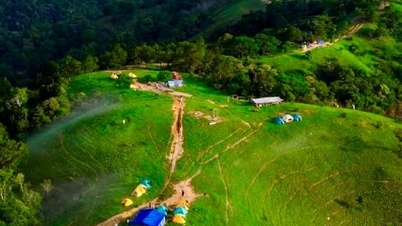
Quan Son commune has many favorable conditions for developing livestock farming, such as Khau Sao hill with an area of 144 hectares, which serves as a large grazing area providing abundant natural food sources; and the people have experience in livestock farming. This is the basis for the commune to gradually expand the scale of livestock farming.
As one of the pioneering households in horse breeding, Mr. Nong Van Chung from Co Huong village said: In 2014, his family invested in buying two white horses to raise. After caring for them for a while, they realized that the model brought high economic efficiency, so the family continued to expand the scale and increase the herd. Currently, the family maintains 15 white horses; on average, they sell 4 to 6 breeding and commercial horses each year, bringing in an income of over 200 million VND.
Meanwhile, the family of Mr. Lam Van Quy in Suoi Ma village focuses on developing goat farming. Mr. Quy said: "In 2015, my family started raising goats with a small number, only 5 to 7 animals. Through the process of raising them, we realized that goats have good resistance to disease and the investment and care costs are not high, so the family has proactively increased the herd each year. Currently, the family maintains a total herd of over 60 native goats. On average, each year, the family sells 45 to 50 commercial and breeding goats, bringing in an income of over 150 million VND."
Not only the two families mentioned above, but since 2014, many households in Quan Son commune have boldly invested in and developed livestock farming. Along with the proactive efforts of the people, the commune government has also paid attention to and implemented solutions to support them over the years. On average, each year, the commune People's Committee, in coordination with specialized agencies, organizes four training courses on livestock farming techniques, with approximately 180 participants.
In particular, from 2025 to the present, using funds from the National Target Program for Sustainable Poverty Reduction, the People's Committee of the commune has implemented 5 projects to support the development of breeding white horses, with 45 households participating. To date, the horses have grown and developed well, contributing to creating livelihoods for the people.
Besides providing people with knowledge, livestock farming techniques, and breeding stock, the commune government also facilitates people's access to preferential loan sources. Currently, the entire commune has a total outstanding loan balance at the Social Policy Bank of over 74 billion VND, with 994 borrowing households.
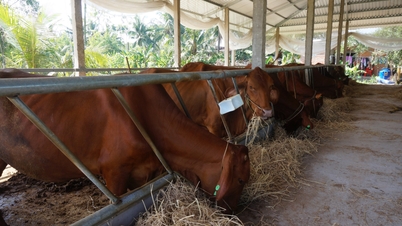
Thanks to the synchronized implementation of various solutions, livestock farming models in the commune have developed stably and yielded high economic efficiency. According to statistics, the commune currently has over 32,600 poultry and over 8,000 livestock. From livestock development, over 200 households in the commune now earn between 50 and 150 million VND per year, and nearly 20 households earn between 200 and 300 million VND per year.
With the support of the commune government and the proactive efforts of the people, livestock farming models have been providing a stable source of income for the people, contributing positively to poverty reduction in the commune. By the end of 2025, the poverty rate in the commune will be 11.83%, a decrease of 3.3% compared to 2024; average per capita income will reach over 32 million VND/person/year, an increase of 4 million VND/person/year compared to 2024.



Source: https://baolangson.vn/quan-son-phat-trien-kinh-te-tu-chan-nuoi-5095999.html




![[Photo] "Hanoi Lotus Festival" honors the lotus flower that has been associated with Vietnam for thousands of years.](https://vphoto.vietnam.vn/thumb/1200x675/vietnam/resource/IMAGE/2026/06/27/1782516943048_sen-ha-noi-2026-minh-duy-1-jpg.webp)