Opening the doors to destination promotion.
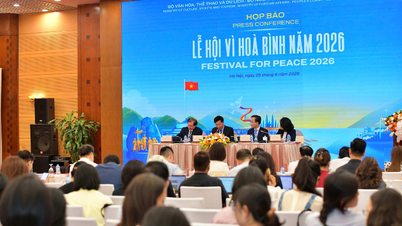
The Hanoi Tourism Promotion Center has just announced its tourism promotion and marketing plan for the remaining months of 2026 and its orientation for 2027, featuring many large-scale activities. A notable point is the combination of direct cultural and tourism events with digital media communication activities to create a widespread impact on the image of the capital city.
According to the plan, from now until the end of 2026, Hanoi will organize a series of events such as the Hanoi Lotus Festival, the Hanoi Beverage Festival, the Hanoi Autumn Festival, the Hanoi Ao Dai Tourism Festival, along with many promotional programs in key international markets. This is not only an opportunity to introduce unique tourism products but also contributes to the widespread promotion of the cultural, historical, traditional craft, and culinary values of the capital city.
In the context of increasingly changing travel behaviors, the digital environment is becoming the preferred gateway for tourists to learn about a destination. Recognizing this, Hanoi's tourism industry has determined that digital transformation is no longer a trend but a necessity.
One of the highlights of the new strategy is the launch of a tourism promotion website integrated with a smart virtual assistant, capable of helping tourists search for information, build itineraries, and access tourism services more conveniently. Alongside this, social media platforms, digital data systems, and multimedia communication channels continue to be utilized to increase interaction with domestic and international tourists.
Beyond simply promoting their image, boosting digital communication also enables travel, accommodation, and tourism service businesses to reach customers more effectively, contributing to stimulating demand and expanding the market.

According to Nguyen Anh Tuan, Director of the Institute of Tourism Economics, Hanoi possesses enormous potential to become a leading smart tourism center in the region thanks to its advantages in cultural heritage, large tourist market, and strong digital transformation momentum. Hanoi's smart tourism model needs to be firmly based on three pillars: technology, people, and institutions.
Creating a smart tourism ecosystem.
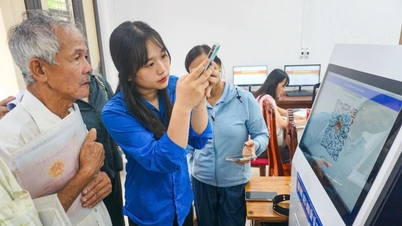
In addition to promotional activities, Hanoi is actively building a smart tourism ecosystem, considering it a crucial foundation for the sustainable development of the tourism industry in the future. Digital transformation is being implemented synchronously from state management to business operations, services, and visitor experiences. Many destinations, historical sites, and museums in the city have applied QR codes, electronic tickets, digital maps, and multilingual automated audio guides, contributing to improved service quality and convenience for visitors.
According to Nguyen Tran Quang, Deputy Director of the Hanoi Department of Tourism, in the context of the strong digital transformation taking place in all fields, the capital's tourism industry has identified the development of smart tourism as an important direction to improve the efficiency of state management, innovate methods of promotion and advertising, enhance service quality, and provide increasingly convenient and personalized experiences for tourists.
In recent times, Hanoi has been gradually applying new technologies such as artificial intelligence (AI), big data, virtual reality (VR), and augmented reality (AR) to its tourism activities.
In today's competitive tourism destination landscape, technology is playing an increasingly decisive role. Tourists not only want to find information quickly but also expect the entire journey, from booking services and making payments to enjoying the experience, to be conveniently conducted digitally. Therefore, localities that build a complete smart tourism ecosystem will have a significant advantage in attracting and retaining tourists.
Despite achieving positive results, Hanoi's tourism digitalization journey still faces numerous challenges. These include the fragmentation and lack of standardization of data, as well as the absence of mechanisms for data sharing among different entities. Small and medium-sized enterprises (SMEs) in the industry continue to struggle with budget constraints, digital human resources, and data exploitation capabilities. Furthermore, there are obstacles stemming from a lack of a unified legal framework and technical standards, and a shortage of highly skilled personnel with expertise in both tourism and technology.



Mr. Nguyen Tuan Anh suggested that Hanoi needs to establish a Hanoi Tourism Data Center to standardize data on destinations, events, businesses, customer behavior, and feedback. This would create a smart tourist journey, a seamless digital path from searching, booking services, payment, experience, to feedback. Simultaneously, AI should be applied to management and business through forecasting dashboards, multilingual chatbots, marketing automation, and customer care…
In the current context, simultaneously developing large-scale cultural events and promoting digital transformation shows that Hanoi is choosing a path that is both modern and based on its cultural identity. This is not only a solution to boost tourism growth in the short term but also a necessary step to help the capital affirm its position as a cultural, creative, and smart destination in the region in the coming years.
Source: https://bvhttdl.gov.vn/quang-ba-du-lich-tren-khong-gian-so.htm