

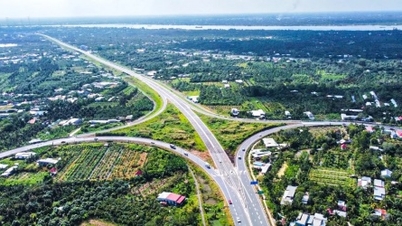
The Can Tho 2 Bridge and approach roads project – the final "piece" of the North-South Expressway in the eastern Mekong Delta region – has completed its pre-feasibility study and proposed a specific construction plan.
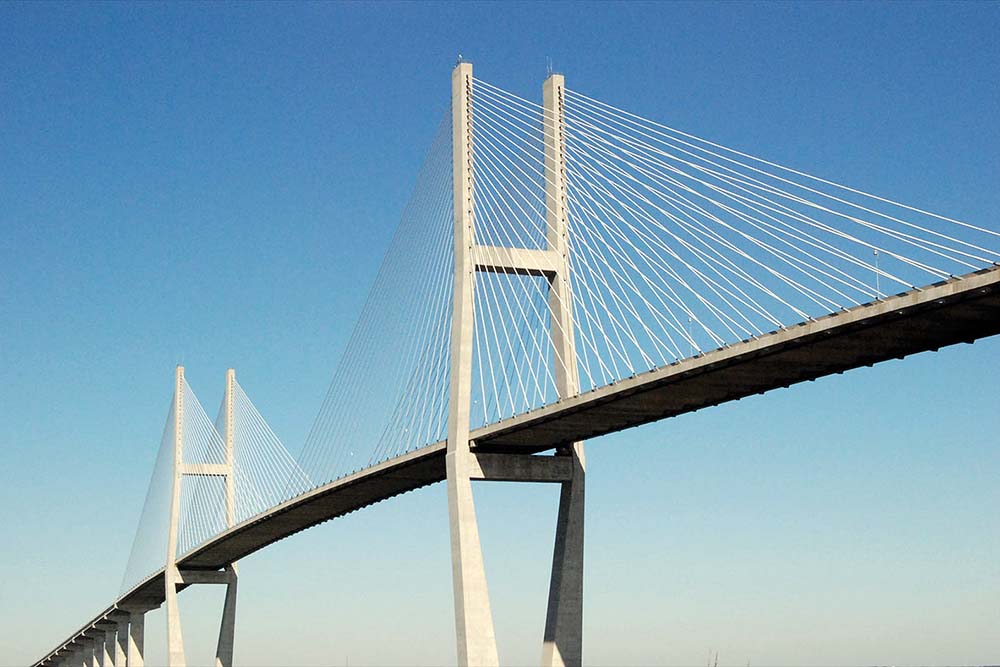 |
| The proposed design for the Can Tho 2 Bridge suggests constructing its main span using a cable-stayed bridge structure. |
Proposal for early implementation
After nearly a year in office, last weekend, the My Thuan Project Management Unit (PMU My Thuan) reported to the Ministry of Transport on the results of the pre-feasibility study for the Can Tho 2 Bridge and approach roads project.
Previously, in May 2023, the Minister of Transport signed a Decision assigning the My Thuan Project Management Unit (PMU) to prepare a Pre-feasibility Study Report for the Can Tho 2 Bridge and its approach roads, with the goal of gradually completing the Eastern North-South Expressway according to the plan, strengthening connectivity in the Mekong Delta region in general and Vinh Long province and Can Tho city in particular, and maximizing the effectiveness of state capital invested in the Eastern North-South Expressway.
The Can Tho 2 Bridge construction project, connecting Vinh Long and Can Tho City, is the final major piece of the Eastern North-South Expressway in the Mekong Delta region, connecting the My Thuan - Can Tho Expressway and the Can Tho - Hau Giang - Ca Mau Expressway. Furthermore, the project contributes to creating a synchronized and convenient connection with major seaports, large urban areas, industrial zones, inland ports, and logistics systems in the Mekong Delta region.
“Early research and implementation of investment in the construction of Can Tho Bridge 2 is crucial to synchronize with the Ho Chi Minh City - Trung Luong - My Thuan - Can Tho expressway, which opened at the end of 2023, and the Can Tho - Hau Giang - Ca Mau expressway component project, which is under construction and expected to be completed and put into operation from 2026,” emphasized Mr. Tran Van Thi, Director of the My Thuan Project Management Unit.
- Project name: Investment in the construction of Can Tho Bridge 2 and approach roads at both ends of the bridge.
- Authority that approves investment policies: National Assembly
- Investment decision-making authority: Prime Minister
- Competent authority: Ministry of Transport
- Project investor during the preparation phase: My Thuan Project Management Board
- Project implementation locations: Vinh Long province and Can Tho city.
- Total investment (proposed plan): 19,782 billion VND
- Implementation timeline: Expected to start construction in 2026 and be completed in 2029.
According to the Road Network Planning for the period 2021-2030, with a vision to 2050, the Eastern section of the North-South Expressway (CT.01) will cross the Hau River at Can Tho 2 Bridge, approximately 4.5 km downstream from the current Can Tho Bridge, with a planned scale of 4 lanes, and is scheduled for investment before 2030.
According to the proposal from the My Thuan Project Management Unit, the Can Tho 2 Bridge Construction Project will have its starting point connecting to the My Thuan - Can Tho Expressway at the Cha Va interchange on the Vinh Long province side; and its end point connecting to the Can Tho - Hau Giang - Ca Mau Expressway Project at the IC2 interchange. The total length is approximately 14.65 km, of which the approach roads on the Vinh Long side are 8.38 km long; the main bridge and approach spans are 2.75 km long; and the approach roads and bridge on the Can Tho side are 3.52 km long.
Based on approved plans, topographical conditions, and current traffic conditions, the consulting unit has carefully considered the options for the starting point of the Can Tho 2 Bridge Construction Investment Project.
Specifically, Option 1: basically maintains the approved plan. At the end point of the My Thuan - Can Tho Expressway Project, the route coincides with National Highway 1 for about 0.7 km, then turns left at the location of Can Tho 2 Bridge, runs parallel to the left of the Ho Chi Minh City - Can Tho railway bridge, and then intersects with the road connecting National Highway 91 - Nam Song Hau.
However, because Option 1 overlaps with National Highway 1, complicating traffic organization by consolidating multiple branches at the Chà Và interchange, the consultant is studying an additional option: shifting the starting point of the route approximately 1.6 km towards Vĩnh Long – Option 2. Accordingly, from the intersection with the Mỹ Thuận - Cần Thơ expressway, the route turns left and runs parallel to National Highway 1 for about 0.5 - 1 km, then merges into the route of Option 1.
Because Option 2 has more advantages than Option 1, such as a straight route, a reduction of approximately 500 m compared to Option 1, reduced land acquisition, and the creation of space for urban and industrial development, the My Thuan Project Management Unit recommends it as the preferred route option for the Can Tho 2 Bridge Project.
Cable-stayed bridge options
Similar to the existing Can Tho Bridge, the most important highlight of the Can Tho 2 Bridge Construction Investment Project is the scale of the approach bridges and the main bridge. The My Thuan Project Management Unit (PMU) proposed building the Can Tho 2 Bridge across the main channel of the Hau River with a navigable clearance of 300 m, including a main channel 160 m wide and 39 m high; side channels 30 m high; and a bridge deck width of 24.75 m to accommodate 4 lanes of motorized vehicles; the main span is expected to be a cable-stayed bridge structure, exclusively for the expressway.
At the same time, the My Thuan Project Management Unit is considering two options for constructing the main cable-stayed section of the Can Tho 2 bridge.
Option 1: The railway line runs separately from the road, with a main bridge span length of 550 m. The preliminary total investment for the project is VND 19,782 billion, including VND 12,874 billion for construction and equipment; VND 1,287 billion for project management, consulting, and other costs; VND 2,968 billion for contingency costs; and VND 2,653 billion for compensation, support, and resettlement costs.
Option 2: Railway shared with road, main bridge span length 550 m. The preliminary total investment for the Project is VND 27,494 billion, of which construction and equipment costs are VND 18,544 billion; project management, consulting and other costs are VND 1,853 billion; contingency costs are VND 4,276 billion; and compensation, support, and resettlement costs are VND 2,821 billion.
In a report submitted to the Ministry of Transport, the My Thuan Project Management Unit recommended selecting Option 1 for the implementation of the Can Tho 2 Bridge Construction Investment Project.
“These are preliminary research results. The results of the pre-feasibility study for the Can Tho 2 Bridge and approach roads project will be updated after receiving guidance from the Ministry of Transport, the leaders of Vinh Long province and Can Tho city,” a representative of the My Thuan Project Management Unit informed.
Source



![[Image] National Assembly discusses the implementation of the socio-economic development plan.](https://vphoto.vietnam.vn/thumb/1200x675/vietnam/resource/IMAGE/2026/04/20/1776696707422_ndo_br_img-20260420-185419-jpg.webp)
![[Photo] General Secretary and President To Lam meets with National Assembly delegates from ethnic minorities.](https://vphoto.vietnam.vn/thumb/1200x675/vietnam/resource/IMAGE/2026/04/20/1776696701056_a1-bnd-8331-3342-jpg.webp)















































































Comment (0)