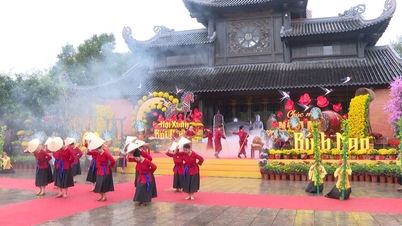
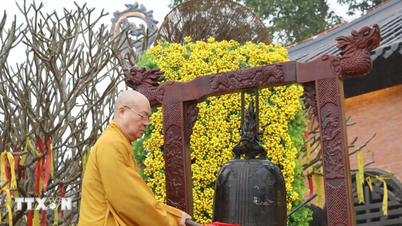
As is customary, every year on the 6th day of the first lunar month, Bai Dinh Pagoda welcomes thousands of monks, nuns, Buddhists, and tourists from all over to participate in the festival, worship, pray for a prosperous new year, national peace and security, and favorable weather.
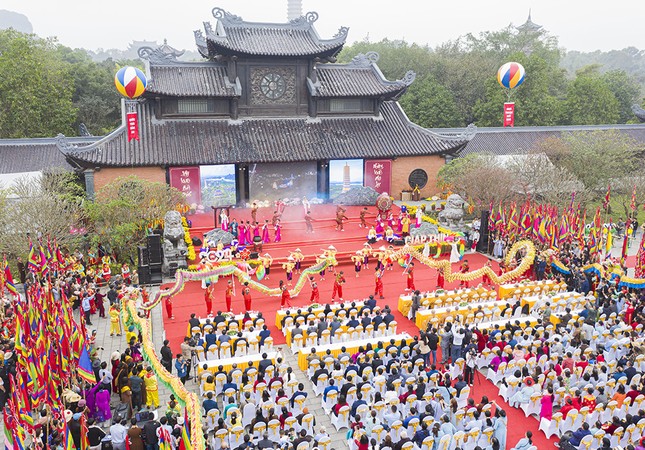
Thousands of monks, nuns, Buddhist followers, and local people attended the opening ceremony of the festival. Photo: Pham Nam
The Bai Dinh Pagoda Festival officially opens on the 6th day of the first lunar month and lasts until the end of the third lunar month every year. This is the 10th year that the Vietnam Buddhist Association of Ninh Binh province has organized the Bai Dinh Pagoda Festival since the Trang An Scenic Landscape Complex, where Bai Dinh Pagoda is located, was recognized by UNESCO as a World Cultural and Natural Heritage site.
The opening ceremony of the Bai Dinh Pagoda Festival - Spring of the Year of the Dragon 2024 is the inaugural event in a series of celebrations marking the 10th anniversary of the Trang An Scenic Landscape Complex, including Bai Dinh Pagoda, being recognized by UNESCO as the first mixed world heritage site in Southeast Asia, encompassing both cultural and natural criteria.
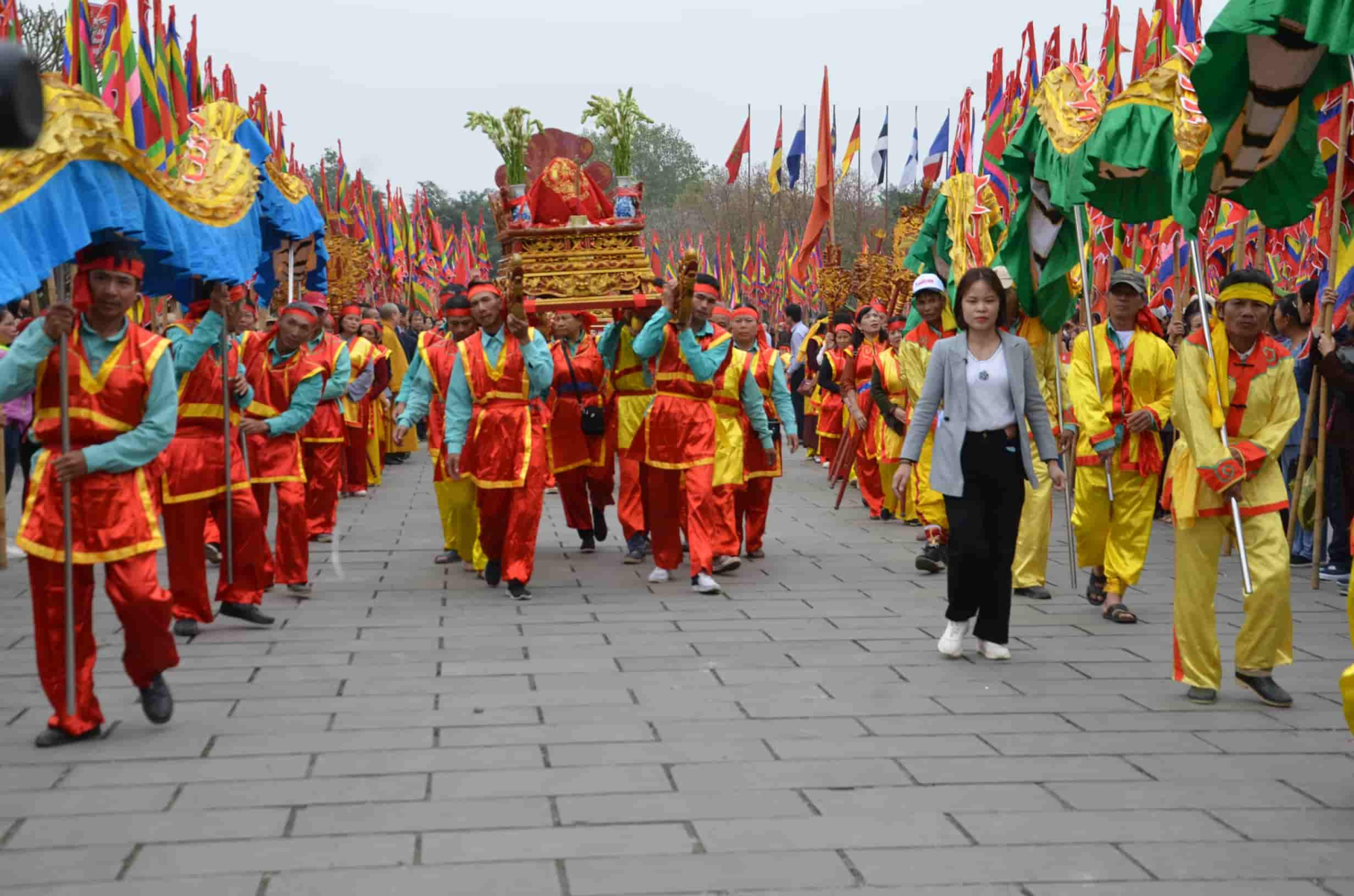
The procession of palanquins at the opening ceremony of Bai Dinh Pagoda. Photo: Nguyen Truong
The opening ceremony of the Bai Dinh Pagoda festival is a major event in Vietnamese spiritual culture. The festival at Bai Dinh Pagoda begins with a procession, in which monks carry the ancestral tablets of the deities Cao Son, Saint Nguyen, and the Goddess of the Mountains from the old pagoda area to the new pagoda area, followed by the main festivities.
This part of the festival will include folk games, sightseeing at temples, enjoying traditional Vietnamese opera (Cheo, Xam, Ca Tru), or participating in cave exploration activities.
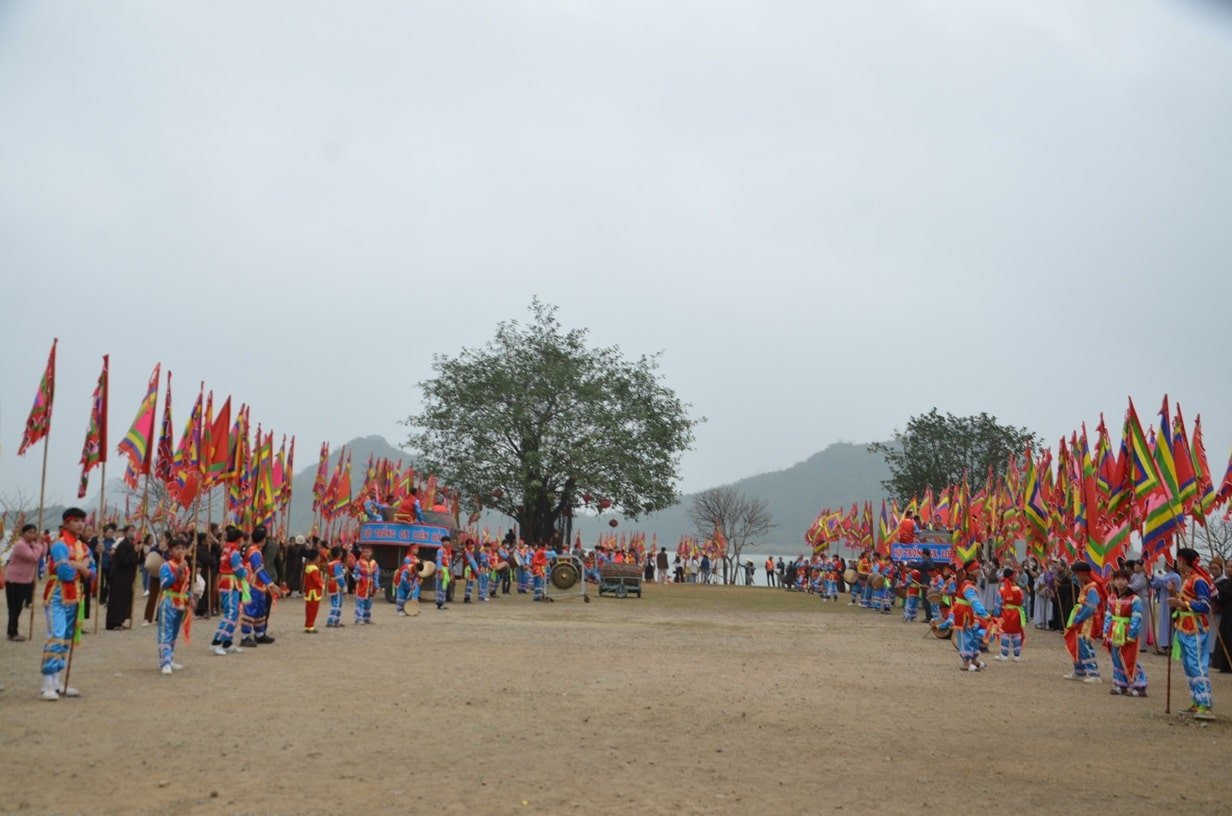
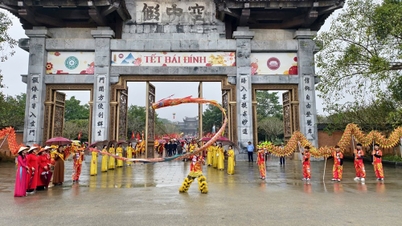
The Bai Dinh Pagoda Festival features many unique activities. Photo: Nguyen Truong
In particular, the stage performance by the Ninh Binh Cheo Theatre will recreate the flag-worshiping ceremony of King Quang Trung on Dinh Mountain before the battle and the ceremony of ascending the altar to the state of Dinh Tien Hoang.
Approximately 1,000 years ago, in the capital city of Hoa Lu, three successive dynasties of kings emerged: the Dinh, the Early Le, and the Ly dynasties. All three dynasties focused on Buddhism and considered it the national religion. Ninh Binh, with its many ancient temples, including Bai Dinh Pagoda on the Trang An mountain range, reflects this spirit. Besides religious activities, the opening ceremony of Bai Dinh Pagoda also provides opportunities for locals and tourists to participate in cultural, artistic, and entertainment activities.
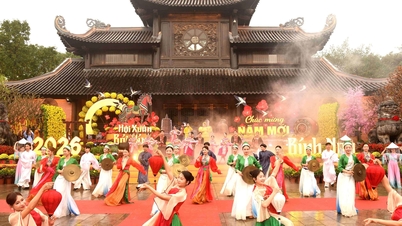
Traditional art events such as puppet shows, folk singing, and other folk art performances often take place in the area surrounding the temple.
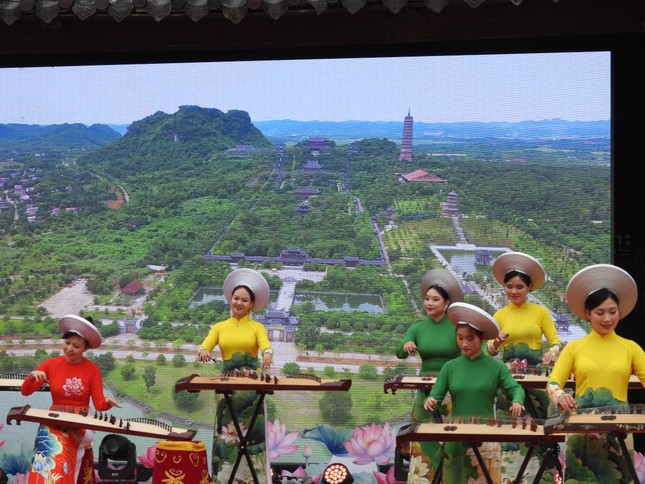
Many cultural performances were presented at the festival. Photo: Pham Nam
In addition, the opening ceremony of Bai Dinh Pagoda often includes social activities such as charity campaigns, fundraising to build the community and help those in need, or programs supporting education and healthcare.
Bai Dinh Pagoda is one of the largest and most important pagodas in the country, renowned for its unique architecture and sacred atmosphere.
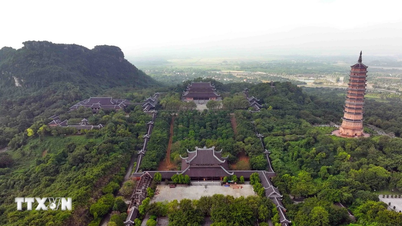
The current Bai Dinh Pagoda complex covers 1,700 hectares, including the ancient Bai Dinh Pagoda, the new Bai Dinh Pagoda, and other areas such as a cultural park and Buddhist academy, a reception area and landscaped park, roads and parking lots, Dam Thi Lake, and a lake for releasing fish, all constructed since 2003.
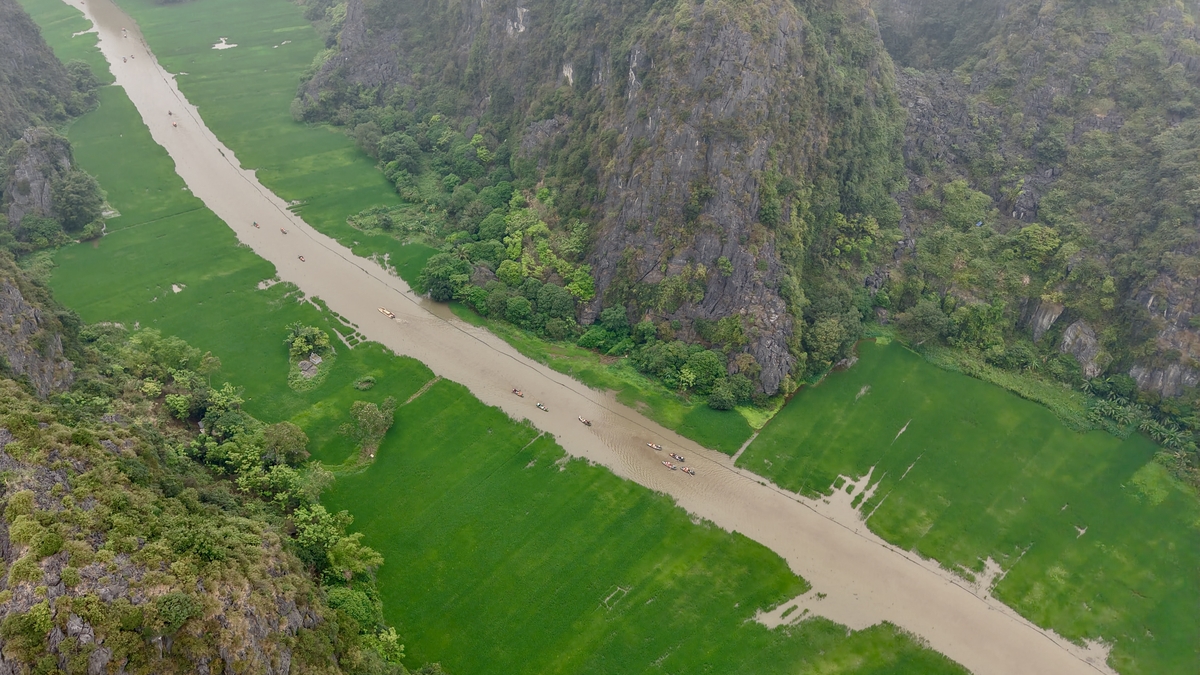
Located on a mountainside, nestled between a valley and rocky mountains, the pagoda serves as the western gateway to the ancient capital of Hoa Lu. The new pagoda's architecture is distinctly traditional, grand, and imposing. Therefore, it quickly became a popular spiritual tourist destination. The new Bai Dinh Pagoda complex is renowned as the largest pagoda complex in Southeast Asia.
The ancient Bai Dinh Pagoda, also known as Bai Dinh Ancient Temple, is located about 800 meters south of the Tam The Hall of the new pagoda complex.
This temple complex faces west, situated near the summit of a peaceful mountain forest, with a central main hall. To the right is a bright cave dedicated to Buddha, to the left is a shrine to Saint Nguyen, and finally, a dark cave dedicated to the Mother Goddess and fairies. This land is believed to possess all the elements of a land of exceptional people, according to Vietnamese folklore, the birthplace of Kings, Saints, and Deities.
In 1997, the pagoda was recognized as a national historical, cultural, and revolutionary relic. Although the pagoda's history dates back to the Dinh Dynasty with the Cao Son temple guarding the western part of Hoa Lu, the ancient Bai Dinh Pagoda possesses many architectural details and artifacts characteristic of the Ly Dynasty.
On February 28, 2012, Bai Dinh Pagoda set a record with 8 titles as the largest pagoda in Asia.
Source














































![[Photo] Hue: Admire the 2.4 trillion VND sea bridge, the longest in Central Vietnam.](https://vphoto.vietnam.vn/thumb/402x226/vietnam/resource/IMAGE/2026/05/24/1779614018347_anh-man-hinh-2026-05-24-luc-16-13-29.png)































Comment (0)