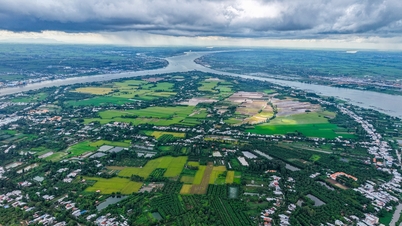
Implementing the plan for restructuring crop and livestock production on rice-growing land in Le Thuy commune in 2026, immediately after the winter-spring rice crop, people in the villages of Phan Xa, Tuy Loc, An Xa, and Tan Le have been urgently improving their fields, channeling water, and gradually adapting to the new production season. According to data from the People's Committee of Le Thuy commune, to date, the total area of land converted to new crops is 13.5 hectares, reaching 100% of the plan.
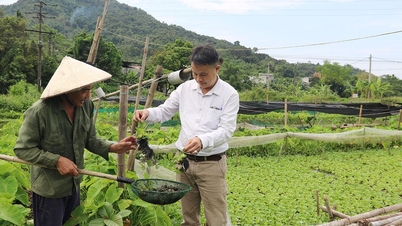
The entire converted area is being implemented according to the lotus cultivation model. Specifically, people in the Phan Xa area boldly converted 0.4 hectares at the beginning of 2026, abandoning rice production during the winter-spring season to cultivate lotus. The remaining villages will carry out the conversion immediately after harvesting the winter-spring rice crop in 2026; among them, Tuy Loc is the largest conversion area with 8 hectares, An Xa with over 1.6 hectares, and Tan Le with over 3.4 hectares. The conversion is being implemented in the correct location and area as approved, in accordance with the actual production conditions of the locality.
According to Le Van Tan, Vice Chairman of the People's Committee of Le Thuy commune: "We have identified crop restructuring as a crucial solution to increase production value per unit area. The choice of lotus cultivation is considered suitable because this plant adapts well to local natural conditions, has economic development potential, and meets market demands."
 |
| Lotus cultivation model on low-yield rice land in Le Thuy commune - Photo: HC |
According to Mr. Le Van Tan, the conversion process was implemented in the correct location and area as approved, closely adhering to the current state of the fields and farming conditions of each area. The commune government coordinated with the people to carefully review each plot of land, ensuring that the production boundaries were not disrupted and that the irrigation system and internal field transportation were not affected. Thanks to the strict implementation of these steps, the conversion model maintained stability in production organization while being suitable to local realities, creating favorable conditions for people in the process of cultivating and caring for lotus plants.

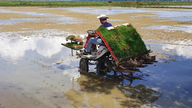

Leading us on a tour of the lotus cultivation model in the area, the Chairman of the Tuy Loc Agricultural Production and Service Cooperative, Dang Ngoc Thang, said: “The lotus cultivation model in Tuy Loc has been implemented and has proven effective thanks to the close attention and guidance of the Le Thuy Commune People's Committee in implementing the crop restructuring according to the local agricultural development orientation. In the Tuy Loc conversion area, the lotus plant has shown good adaptability and high economic efficiency, gradually helping people stabilize their income. And a highlight in the production process is that people have applied drones to fertilize the lotus plants, contributing to significantly reducing labor costs, improving production efficiency, and promoting the modernization of agriculture in the locality, in line with the current trend of smart agriculture development.”
Mr. Bui Huu Hue's family owns the largest area of land converted for lotus cultivation in Le Thuy commune, with over 8 hectares. According to Mr. Hue, lotus plants have a growth period of about 4-5 months before they begin to yield harvests. From the beginning of June, his family starts harvesting lotus from the early-planted areas; by mid-July, they enter the peak harvesting period across the entire area and this continues until the end of September.
Under favorable weather conditions, each hectare of lotus can yield an average of about 3 tons of seeds, bringing in an estimated economic value three times higher than rice cultivation. During production, Mr. Hue's family focuses on applying safe farming practices and proactively collaborates with purchasing units to ensure a stable market for their products. Not only lotus seeds, but other parts, such as lotus flowers and stems, are also popular in the market, contributing to increased value and the formation of a sustainable lotus product chain in the locality.
From previously unproductive rice fields, the lotus cultivation model in Le Thuy is gradually proving to be a suitable direction in the restructuring of crop production in the locality and the province. With the synchronized involvement of the local government and the proactive and flexible approach of the people in organizing production, the lotus cultivation model in the area will continue to be expanded, bringing sustainable economic value in the future.
However, observations at the grassroots level indicate that the production process still faces some difficulties. Some areas are at risk of flooding during prolonged heavy rains, affecting plant growth. A portion of the population lacks experience in caring for and controlling pests and diseases in lotus plants. The linkages between production and consumption are not yet stable, with output still heavily dependent on traders. Furthermore, the irrigation system in some areas is not yet synchronized, affecting the ability to proactively manage water supply and drainage, especially during extreme weather conditions.
According to Le Van Tan, Vice Chairman of the People's Committee of Le Thuy commune, in order for the lotus cultivation conversion model to be sustainably effective in the future, the locality hopes that all levels and sectors will continue to provide support in many aspects. This includes strengthening technical guidance for the people, building and replicating production linkage models associated with product consumption to enhance economic value. Investing in upgrading the irrigation system in the converted areas is also essential, contributing to minimizing risks from natural disasters and ensuring stable production.



Hien Chi
Source: https://baoquangtri.vn/kinh-te/202606/ruong-trung-hoi-sinh-3080e33/


![[Image] A look back at the capital's preparations for the century-long master plan.](https://vphoto.vietnam.vn/thumb/1200x675/vietnam/resource/IMAGE/2026/06/29/1782750453122_quy-hoach-100-nam-minh-duy-1-2118-jpg.webp)




















![[Photo] General Secretary and President To Lam works with the Party Committee of the Government on the work of preventing and combating storms, floods, extreme natural disasters and climate change.](https://vphoto.vietnam.vn/thumb/1200x675/vietnam/resource/IMAGE/2026/06/29/1782729441945_a1-bnd-0385-9454-jpg.webp)