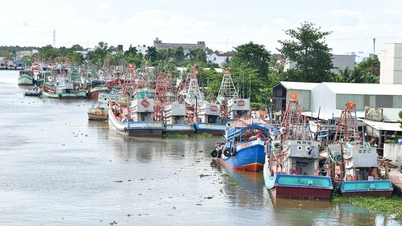
Fishing boats anchored on the Cai Be River. Photo: BAO TRAN
As dawn broke, the Xeo Ro canal echoed with the sounds of people calling out to each other. On the 23-meter-long trawler owned by Mr. Nguyen Van Tung, a resident of An Bien commune, 15 crew members busily prepared for a fishing trip lasting over a month. Ice blocks were being loaded into the fish hold. Over 1,000 liters of fuel were being added to the fuel tank. Two 1,000-liter freshwater tanks were quickly filled. Nearly 200 kg of rice, 5 blocks of sugar, 2 cans of cooking oil, along with dozens of other necessities and fishing gear, were carefully checked before departure. Standing on the deck, Mr. Tung calculated that the preparation alone had cost over 50 million dong. Fuel accounted for the majority of that. “Before, when fuel and supplies were cheaper, going to sea was less burdensome. Now, everything is increasing, and I have to consider everything very carefully before each trip,” Mr. Tung said in a low voice.
If the cost of a purse seine fishing boat is already high, the cost of a squid trawling boat owned by Mr. Vo Van Tan (59 years old), residing in Hamlet 6, Bien, Dong Thai Commune, is even higher. Each trip lasts about 40 days, consumes more than 4,000 liters of fuel, and the initial cost exceeds 100 million VND. Therefore, the boat is currently sitting idle at the dock. The paint on the hull has faded after 5 months of not going out to sea due to a lack of crew. Mr. Tan said that in the past, young people from coastal areas often followed their fathers onto boats to make a living from the sea. But now, young people often choose to work as factory workers, go to the city, or work abroad because the income is more stable and they don't have to sacrifice long days at sea.
To ensure he had enough crew for a fishing trip, Mr. Tan often had to advance over ten million dong to each person. However, not everyone who received the money kept their word; some would take the money and then run away or go on another boat. Sometimes, after less than a month at sea, the crew would go on strike, demanding to return to shore. “If things go well, after nearly 40 days at sea, we can harvest about 2-3 tons of squid, and each crew member gets over 20 million dong. But such trips are becoming increasingly rare. Some trips are profitable, some are unprofitable, and the losses outweigh the profits, so the crew is no longer enthusiastic. I invested over 2 billion dong in building the boat and buying fishing gear, and after 7 years, I still haven't recovered my capital,” Mr. Tan said with frustration.
To get a good catch, the boat has to go further out to sea and stay longer, which increases costs with each nautical mile. The weather is also becoming increasingly unpredictable, with more frequent storms forcing many trips to stay ashore waiting for calmer waters. After many unprofitable fishing trips, Mr. Truong Van Co (56 years old), residing in Hamlet 6 Bien, Dong Thai Commune, decided to sell his boat and engine, which he had used for decades. In his small house, he keeps a few old nets as mementos of his time at sea. “At sea, sometimes the vessel tracking device loses signal without me knowing, but I still continue fishing normally. It wasn't until more than a month after returning to shore that I received a notice of being fined for not maintaining the device connection. By then, much of the information was no longer sufficient to provide a clear explanation,” Mr. Co said.



The anxieties weren't limited to offshore waters. In coastal villages, each boat leaving the harbor carried not only men braving the waves but also women silently waiting for news of safety. Nearly 30 years have passed, but Mrs. Nguyen Thi Oanh, residing in Hamlet 2, An Bien Commune, still hasn't forgotten the last days of 1997, when Typhoon Linda swept through the southwestern sea region. At that time, she was in the final months of her pregnancy, while her husband was out at sea. The constant storm warnings plunged the entire fishing village into anxiety. “At that time, the whole village thought my husband was dead because he hadn't returned two days after the storm. Everyone at home was crying, preparing for his funeral. Unexpectedly, he returned on the third day. It turned out he had stayed behind to help rescue people and retrieve the bodies of his fellow fishermen. Back then, there were no telephones like there are now to send news. Even now, I'm still scared,” Mrs. Oanh recounted, her voice trembling.

Mr. Truong Van Co examines the old fishing nets. Photo: Bao Tran.
After his near-fatal escape, the man never returned to the sea but stayed home to help his wife with her business. Their son, born not long after, was named Nguyen Van Bao. For the family, the name means "storm," a way of remembering the life-or-death moment they had experienced. More than 20 years later, the boy chose the same path as his father. "The seafaring profession is dangerous because the weather is unpredictable, but I'm used to it. My fellow fishermen have been working here for many years, so we understand and care for each other. A good fishing trip brings in a decent income. Like the first trip of the year, we had a very successful one, each earning over 20 million dong. But the last trip was very rough, we were at sea for over a month, and each of us only earned about 10 million dong," Bao said.
After many days at sea, the ships gradually docked. While the sky was still hazy, the Tắc Cậu fishing port was already bustling with the sounds of unloading and people calling out to each other. Along the port, buyers had practically set up their stalls since early morning. Mr. Nguyễn Văn Sản, a resident of Bình An commune who has been buying seafood for over 10 years, said that his work is closely tied to each fishing trip. When the boats have a good catch, the buyers, transporters, loaders, and processing facilities all have work. But when the boats have a bad catch, the whole chain almost comes to a standstill. Recently, rough seas have reduced the number of boats going out to sea, and even when they do, the catch is not much. The amount of seafood arriving at the main port is significantly less, with many boat owners choosing to sell directly at points near the fishing grounds such as Hòn Nghệ, Hòn Sơn, and Bình An sluice gate… Therefore, although the port lights are still on, the atmosphere is no longer as lively as before.
The trading continues amidst the fading sounds of engines at the dock. The sea remains, not far away, yet unpredictable. Some still quietly make their living at sea, but young people are gradually leaving the profession. Who will continue these voyages in the future? The answer lies not only in those who cling to the sea but also in finding solutions for the sustainable development of the fishing industry, so that coastal regions can maintain the way of life that has existed for generations.



Source: https://baoangiang.com.vn/sau-chuyen-bien-a490967.html


![[Image] National conference summarizing one year of operation of the overall organizational model of the political system, the three-tiered government model.](https://vphoto.vietnam.vn/thumb/1200x675/vietnam/resource/IMAGE/2026/07/01/1782882811691_ndo_br_1-jpg.webp)