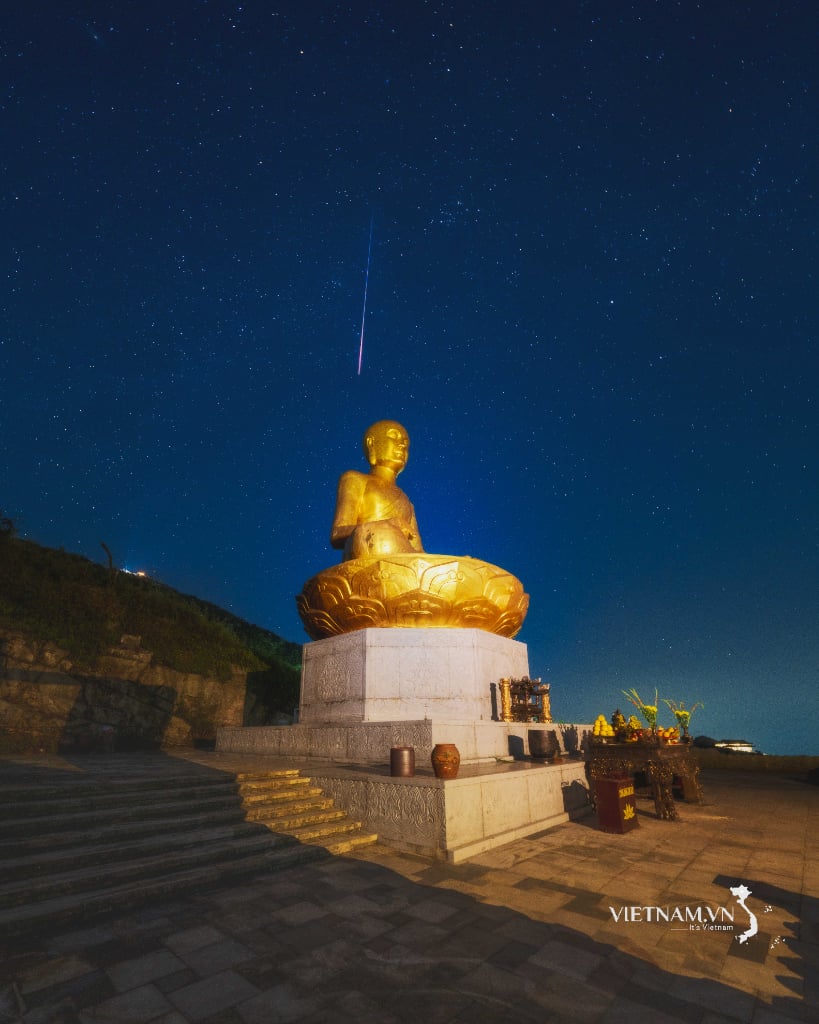
A view of Thien Phu Temple. Photo: Nguyen Hong Thuy.
Thien Phu is a new commune, established by merging the entire natural area and population of Thien Phu and Nam Dong communes (formerly part of Quan Hoa district), Thanh Hoa province.
The total natural area of Thien Phu is 147.48 km²; comprising 13 villages, with a population of 6,485 people in 1,362 households. The ethnic groups living in this area are Thai (65.8%), Muong (28.6%), Kinh (5.2%), and other ethnic groups (0.4%).
But what first impresses the traveler is not the administrative numbers or population structure, but the breathtaking green of the mountains and forests. In Thien Phu, nature is not just a landscape but also a living space, a place that preserves the memories of many generations of Thai and Muong people.
Land of lush forests and heritage
Legend has it that the first inhabitants arrived in this land in the 13th century. They relied on each other to withstand natural disasters and wild animals, built their lives, and preserved their customs and traditions to this day.
In Thai culture, there is a saying: "Tắng chắnh kin pá, phứa na kín kháu," which means "Block the water to eat fish, cultivate the fields to eat rice." This saying reflects the survival philosophy of the mountain dwellers: valuing water resources, valuing seeds, and knowing how to live in harmony with nature.
Upon arriving in Thien Phu, I realized that there are very few terraced rice fields here. For generations, the people have lived closely connected to the forest, with livestock farming and hunting. No other place in Thanh Hoa has as many bamboo groves as Thien Phu. Lush green bamboo forests stretch across the mountain slopes, creating a distinctive green color of this land.
According to the latest data published and applied in 2026 by the People's Committee of Thanh Hoa province, the total existing forest area of the province is 644,796.69 hectares, of which natural forest accounts for 391,842.63 hectares and planted forest accounts for 252,954.06 hectares. Forest protection in Thanh Hoa is quite good, and the province is one of the localities with the highest forest cover rate in the country.
Amidst the lush greenery, Thien Phu boasts numerous natural landscapes with rich potential for community-based tourism development. Thien Phu features the Water Cave with its cool, clear stream like a lullaby from the mountains; the tranquil Dry Cave, possessing an ancient beauty. The deepest is the Nang Mon Cave – where the space opens up like a magical palace with shimmering stalactites and falling water droplets resembling the tears of time. The cave's name is associated with a legend, a spiritual story passed down through generations by the local people.
Amidst the bamboo forests, streams, and caves steeped in legend, the people of Thien Phu have forged a rich spiritual life. Perhaps that is why, even at night, the sounds of flutes and songs still resonate, preserving the village's culture.

The girls in Tianfu are as beautiful as mountain flowers. Photo: Ngo Duc Hanh.
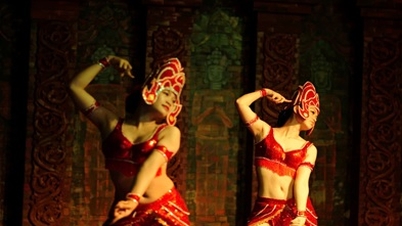
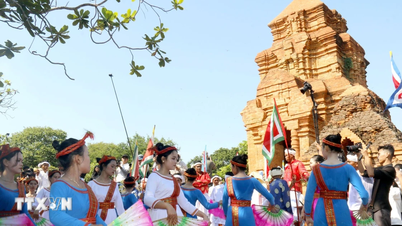
I was captivated by those days steeped in ethnic cultural identity. The sounds of gongs, drums, and threshing drums filled the air. Young Thai women in their traditional costumes enthusiastically sang songs like "The Sound of the Village Flute," "Come to the Northwest," and "The Beauty of the Village."
I was immersed in the singing, the colors, and the vibrant beauty of the Thai girls right here in the No. 1 flood-relief resettlement area of Lo village, feeling as if I were enjoying a performance by a professional art troupe.
After the cultural performance "to entertain the delegation" with a variety of dance, singing, and poetry recitations, I asked Ms. Pham Hong Ly, a teacher at Lot Doi Kindergarten, and learned that all 13 villages have their own performing arts groups. From the villages to the commune level, everyone pays close attention to the activities of these groups.
The people in general, and the Thai and Muong residents of Thien Phu in particular, are always conscious of preserving and passing on the beautiful tangible and intangible cultural features. Each person is a nucleus for spreading the art of bamboo pole dancing, folk singing, traditional drumming, reed pipe playing, and other musical instruments during festivals, holidays, and in daily life.
The Thai ethnic group is the majority here, with its own historical traditions, culture, and writing system. Many oral traditions are still preserved in community life, such as "Sắng chụ sống Sáo" (Farewell to a Lover), "Khún lu nang úa", "Quân quán húa mương"...


In the spiritual life of the local people, khặp is indispensable. Khap is a style of reciting or singing poetry. The Thai and Muong ethnic groups here have a rich collection of musical instruments made from readily available natural materials such as the khèn bè, sáo ôi, pí một, khươ luống...
“From beyond the high red mountains of my village/ In the misty morning, I follow my father up to the forest to set traps…”, the melodious voice of Ha Thi Kim Chi Na, an 11th-grade student from Sai village, echoed through the evening's cultural exchange. Teacher Pham Hong Ly explained that these were lyrics from the song “The Sound of the Village Flute”.
The Party Committee of Thien Phu commune has just issued Resolution No. 5-NQ/DU on preserving and promoting the fine traditional cultural identity of ethnic groups associated with the effective and sustainable development of community tourism in the period 2026-2027, with a vision to 2030.
Experience shows that economic growth and the expansion of opportunities are not enough to ensure sustainable development if they are not accompanied by a commensurate development of culture and human quality. Culture has been and continues to be an intrinsic strength, a spiritual foundation, and a regulator of sustainable development.
From identity to livelihood
Preserving cultural identity is not just about preserving community memories. For Thien Phu today, culture is also seen as a resource for development. Folk songs, brocade weaving, and traditional village spaces are gradually becoming the foundation for new livelihood models.
It would not be surprising if Resolution No. 5 preceded Resolution No. 4-NQ/DU on improving labor quality, diversifying livelihoods, creating jobs, and increasing people's income in the period 2026-2030.

According to Phan Van Dai, Chairman of the People's Committee of Phan Van Dai commune, the locality is focusing on leading and directing the development of distinctive livelihood models suitable to the actual conditions. The commune prioritizes support in terms of capital, livestock, materials, and technology transfer to build and maintain the effectiveness of 6 pilot models, including: green-necked duck farming in Sai village; brocade weaving in Lot Doi village; black pig farming in Bat village; Ri chicken farming in Chong village; cinnamon cultivation in Chieng village; and macadamia nut cultivation in Chong.
I visited the brocade weaving cooperative in Lot Doi village. The smiles, the eyes, and the shared stories of the cooperative members conveyed a simple message: preserving traditional crafts is also preserving livelihoods.
Thien Phu is encouraging people to participate in production linkages by establishing production groups in each sector; gradually consolidating and developing them into cooperatives and associations to improve production efficiency and increase the competitiveness of products.
The commune also links production with product consumption, focusing on building local brands and trademarks for distinctive products; promoting and connecting with markets, gradually forming a sustainable value chain.
Change happens in places blessed by heaven.
Starting with modest but practical economic models, Thien Phu is gradually creating significant changes. These changes are not only reflected in income but also in the appearance of each village.
During our two days in Thien Phu, we artists and writers had the opportunity to experience life as farmers, catching fish in the Cang stream, visiting Bau village, and participating in many meaningful experiential activities. Living, eating, and working together made us realize, and we were delighted, that after many years of implementing socio-economic development programs in particularly disadvantaged areas, especially the National Target Program, the rural landscape of Thien Phu has undergone significant changes. Social, technical, and economic infrastructure has contributed to transforming the appearance of all 13 villages.
New roads, modern resettlement areas, and increasingly完善 infrastructure are the most visible evidence of this. But to truly feel the changes, perhaps one must listen to the people who have lived their entire lives on this land.
I vividly remember my conversation with Mr. Luong Van Loi, 76, and his son, Luong Van Hoan, 42, under their spacious stilt house in the Lo village resettlement area. Mr. Loi said, "Without the care and attention of the Party and the State, the people here wouldn't have this kind of life."
Hoan took a puff of his pipe and continued, "I must say the local government is very close to the people. Now there's a two-tiered government system. When you go to do paperwork, the officials at the commune level receive the documents for you, and you just wait to collect the results."
Behind these changes is the constant support of local officials. In the stories of the people of Thien Phu, the image of the local government appears quite naturally, as an integral part of village life.
Speaking of the Chairman of the People's Committee of Phan Van Dai commune, Mr. Hoan expressed great affection: "Mr. Dai comes down to the village all the time."


Listening to Hoan's story, I recalled the words of Chairman Phan Van Dai: "To get things done, you have to be close to the people, and to be close to the people, you can't help but go down to the villages. Someone once asked me if I felt bored working here, and I honestly said, I don't have time to be bored." Not only Chairman Phan Van Dai, but all the officials in Thien Phu commune consider going down to the villages to check on the work and understand the thoughts and aspirations of the people as a regular task.
Leaving Thien Phu, what lingered in my mind was not just the green of the mountains and forests or the singing that echoed during the cultural exchange night. It was also the feeling of a land striving to develop using its inherent values.
Amidst the lush green forests and bamboo groves, the rhythmic sounds of weaving looms and the diligent weaving of threads each day fill the air, as the people here nurture their aspirations for an increasingly prosperous and sustainable life. Perhaps this is also the aspiration that the name Thien Phu has carried for generations: the hope for favorable weather, for heaven and earth to work together with humanity to build a better future.
For the Muong people, Thien Phu refers to a land within the ancient Muong Khang cultural space. In the Muong language, "Muong Khang" means a difficult land. However, some argue that the word "Phu" or "Phu House" is often used to refer to the center of governance, the residence of the Lang Dao (the head of the Muong village), or the common place of worship for the community. When combined, "Thien Phu," in the context of cultural exchange in the Muong region, means the house of the heavenly palace or a blessed, prosperous central land. It represents a vast, rich rice valley with a highly respected position within the system of large Muong communities.
According to the language and beliefs of the Thai people, this name originates from the desire for "Heaven's blessings." Since ancient times, the Thai people came to settle and cultivate this rugged mountainous region to establish villages. They named the land Thien Phu (Heavenly Abode) in order to pray for Heaven's protection, for favorable weather, and for abundant harvests.
Furthermore, in ancient Thai, the word "heaven" or "heavenly realm" was often associated with the concept of the place where earth and sky meet, carrying an extremely sacred meaning. The Thai-Vietnamese dictionary also records the equivalent concept of heaven/heavenly realm as "muong bon".

...
Source: https://nongnghiepmoitruong.vn/say-trong-coi-troi-thien-phu-d816657.html
![[Image] Schools organize meetings and introduce teaching models to students admitted to grade 10.](https://vphoto.vietnam.vn/thumb/1200x675/vietnam/resource/IMAGE/2026/06/25/1782368077271_ndo_br_z7970052192242-1ec8daeb77a6eed1a4e9f58c564ddd3e-jpg.webp)

![[Photo] General Secretary and President To Lam receives Palestinian Ambassador Saadi Salama](https://vphoto.vietnam.vn/thumb/1200x675/vietnam/resource/IMAGE/2026/06/25/1782365384740_a1-bnd-9423-8322-jpg.webp)
![[Image] Ho Chi Minh City: Ma Lang area, Chicken-Rice Market about to change its appearance](https://vphoto.vietnam.vn/thumb/1200x675/vietnam/resource/IMAGE/2026/06/25/1782377698627_ndo_br_m1-jpg.webp)