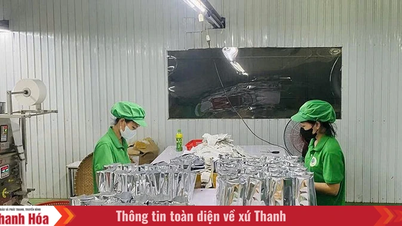
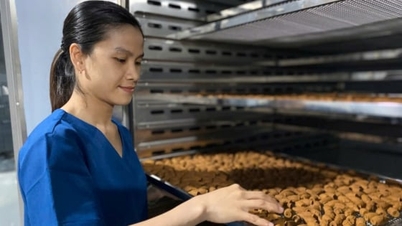
In early June, the atmosphere at the production area of the VANPA Cooperative in Lia commune was always bustling. Some were collecting raw materials, others were mixing compost, and still others were packaging products for delivery to customers. Among these busy members was Ms. Ho Thi Dem, a Van Kieu woman who had been with the Cooperative since its inception.
Ms. Đêm said that previously, her family's income mainly depended on farming and small-scale livestock raising, so life was quite difficult. Since joining the cooperative, she has received guidance on organic fertilizer production techniques and participated in all stages from collecting raw materials and fermenting microorganisms to packaging the product.
"Previously, cow and goat manure were usually left in the garden or thrown away. Now, those things have become raw materials for making marketable products. With more work and more income, all the women are excited," Ms. Dem shared.
 |
| Ms. Ho Thi Tuyen (on the left) introduces organic fertilizer products produced by the VANPA Cooperative to customers - Photo: LA |
According to Ms. Ho Thi Tuyen, Head of the VANPA Cooperative, Lia commune has a strong advantage in livestock farming with a large number of buffaloes, cows, and goats. However, for many years, the treatment of livestock waste has remained a difficult problem. In many places, livestock manure is dumped indiscriminately or washed into streams by rainwater, affecting the environment and drinking water sources. Recognizing that this raw material could be fully utilized for agricultural production, Ms. Tuyen and several local women boldly built a model for producing organic microbial fertilizer. In May 2025, the VANPA Cooperative was officially established with 12 members.
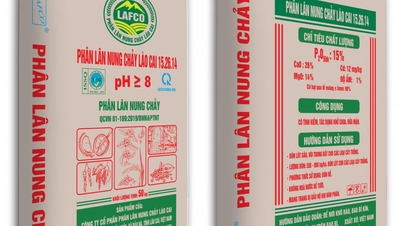
Through technical training courses, members gradually learned how to collect cow and goat manure, combine it with agricultural by-products and probiotics to compost it according to a specific process. After many trials, the first batches of organic fertilizer yielded positive results. To date, THT has developed many product lines such as composted cow manure, composted goat manure, whole-grain goat manure, and various probiotics for livestock farming and environmental treatment.

According to Ms. Tuyen, although the cooperative has only recently started operating, its products are gradually being accepted by local people. The organic fertilizers produced by the cooperative are used for many types of crops such as coffee, cassava, bananas, fruit trees, flowers, ornamental plants, etc., contributing to soil improvement, reducing input costs, and limiting the use of chemical fertilizers. To date, the cooperative has supplied more than 20 tons of organic fertilizer to the market. Customers are mainly farmers in Lia commune and the surrounding area.
Not only does VANPA create jobs for its members, but its products also contribute to changing the production habits of many farmers. On his 2.5-hectare plot of land planted with bananas and fruit trees in Thuan 4 village, Mr. Doan Trung Thanh is one of the households using organic fertilizers from the cooperative.
According to Mr. Thanh, his family previously used mainly chemical fertilizers for their orchards. However, the increasing investment costs, coupled with the soil becoming compacted, led to a gradual decrease in production efficiency. After being introduced to VANPA's products, he began using organic fertilizers for his orchards. Over time, he noticed that the soil became more porous, the plants grew steadily, and he was able to reduce some of his input costs. "What reassures me is that the product is made locally, with clearly sourced ingredients. Using organic fertilizers is both good for the plants and contributes to the long-term protection of the soil," Mr. Thanh said.
According to Ms. Nguyen Thi Phuong Thuy, from the Lia Commune General Service Center, the greatest benefit of the model lies not only in its economic value but also in its environmental and social significance. The regular collection and treatment of livestock waste has contributed to reducing rural environmental pollution, limiting odors, and mitigating the risk of contamination of drinking water sources. At the same time, the model has helped people access environmentally friendly agricultural production methods, reducing their dependence on chemical fertilizers. More importantly, the model has created opportunities for women in border areas to participate in local economic development. From being only familiar with housework, farming, and small-scale livestock raising, many women have boldly learned new techniques, participated in commodity production, and gradually increased their family income.
Chairman of the People's Committee of Lia Commune, Tran Dinh Dung, assessed that the VANPA Cooperative is a clear example of the effectiveness of leveraging local resources within the community. When people receive the right support and have the opportunity to develop their strengths, they can create suitable and sustainable livelihood models right in their hometown. According to Mr. Dung, the locality is aiming to support the cooperative's continued development, gradually improving production processes, enhancing product quality, building a brand, and expanding the market. Further, the goal is to form a more professional cooperative, creating stable jobs for many local workers.
Using livestock waste, Van Kieu and Pa Ko women in Lia commune have created useful products for agricultural production and increased their family income. This model demonstrates that when people are given opportunities and support in the right direction, community-based initiatives can become a driving force for sustainable development in border regions.
Le An
Source: https://baoquangtri.vn/xa-hoi/202606/sinh-ke-xanh-noi-bien-gioi-5d22fa3/



![[Photo] General Secretary and President To Lam receives Palestinian Ambassador Saadi Salama](https://vphoto.vietnam.vn/thumb/1200x675/vietnam/resource/IMAGE/2026/06/25/1782365384740_a1-bnd-9423-8322-jpg.webp)
![[Image] Schools organize meetings and introduce teaching models to students admitted to grade 10.](https://vphoto.vietnam.vn/thumb/1200x675/vietnam/resource/IMAGE/2026/06/25/1782368077271_ndo_br_z7970052192242-1ec8daeb77a6eed1a4e9f58c564ddd3e-jpg.webp)
![[Image] Ho Chi Minh City: Ma Lang area, Chicken-Rice Market about to change its appearance](https://vphoto.vietnam.vn/thumb/1200x675/vietnam/resource/IMAGE/2026/06/25/1782377698627_ndo_br_m1-jpg.webp)








![[Video] Weather forecast for tonight and tomorrow, June 26, 2026: Northern Vietnam to end heatwave from tomorrow, Central Vietnam to continue experiencing a heatwave.](https://vphoto.vietnam.vn/thumb/402x226/vietnam/resource/IMAGE/2026/06/25/1782392692278_thumb-dem-png.webp)