

Liver biopsy helps diagnose and evaluate lesions of unknown origin, classifying them as benign or malignant.
Dr. Vu Truong Khanh, Head of the Gastroenterology Department at Tam Anh General Hospital in Hanoi , said that liver biopsy is performed to diagnose liver problems whose exact cause cannot be determined or whose benign or malignant nature is unclear using blood tests, imaging diagnostics, etc.
Liver biopsy helps determine the severity of the disease (stage) and its rate of progression (classification), thereby developing a treatment plan based on the type, stage, and grade, and predicting the treatment outcome (prognosis). Patients may undergo a liver biopsy if a liver tumor is detected.
According to Dr. Khanh, non-invasive methods such as ultrasound and liver elastography have made significant progress, but biopsy remains the "gold standard" for diagnosing and differentiating many liver diseases such as fatty liver disease, chronic hepatitis, cirrhosis, and liver cancer.
This method helps doctors isolate specific causes or types of disease such as alcohol-related liver disease, autoimmune hepatitis, hepatocellular carcinoma, Hodgkin's lymphoma, primary cholangitis, toxic hepatitis, or viral hepatitis B or C.
There are many indications for liver biopsy, which can be divided into three main categories:
Diagnosis: Liver biopsy is important when diagnosis is difficult. For example, differentiating autoimmune hepatitis from non-alcoholic fatty liver disease in obese patients with abnormal liver function tests and positive autoimmune serology.
Liver biopsy is useful when there are overlapping syndromes such as autoimmune hepatitis with primary cholangitis. Liver biopsy is also used to evaluate abnormal liver function tests immediately after liver transplantation. In atypical cases to differentiate cholangiocarcinoma from hepatocellular carcinoma, liver biopsy may be performed.
Prognosis: Liver biopsy can be used as a prognostic tool for several conditions, including non-alcoholic fatty liver disease progressing to cirrhosis, hemochromatosis, and viral hepatitis.
Treatment: Liver biopsy plays an important role in people with autoimmune hepatitis who are being treated with steroids and immunomodulatory drugs.
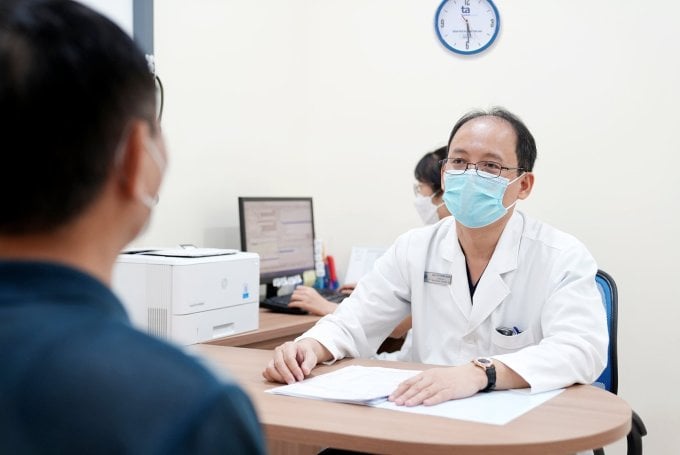
Dr. Vu Truong Khanh examines a patient. Photo: Provided by the hospital.
Currently, there are three commonly used types of liver biopsy: percutaneous ultrasound-guided biopsy . The biopsy process only takes a few tens of seconds because the needle moves quickly into and out of the liver.
Intravenous biopsy : The doctor applies a local anesthetic to one side of the patient's neck. A small incision is then made, and a flexible tube is inserted into a jugular vein and then into a vein in the liver. A biopsy needle is then passed through the tube to obtain one or more liver samples. This method can be performed safely even when the liver's clotting function is impaired.
During a laparoscopic biopsy , the patient is under general anesthesia. The doctor makes one or more small incisions in the patient's abdomen, inserting special instruments through these incisions to obtain tissue samples with the assistance of a small camera. The incisions are closed with sutures after the instruments and liver tissue sample are removed. This method is rarely performed alone; it is usually combined with a liver biopsy during laparoscopic surgery.
Dr. Khanh further shared that after the sample is taken, the liver tissue is evaluated by pathologists. Based on the size and shape of the liver cells and other factors, the biopsy can indicate the cause of the liver damage, whether it is benign or malignant.
Emerald
| Readers can ask questions about digestive diseases here for doctors to answer. |
Source link


![[Photo] Announcement Ceremony of the Art Program “Light Concert – Welcoming the New Year 2026”](/_next/image?url=https%3A%2F%2Fvphoto.vietnam.vn%2Fthumb%2F1200x675%2Fvietnam%2Fresource%2FIMAGE%2F2026%2F01%2F27%2F1769514762857_le-cong-bo-ct-hoa-nhac-anh-sang-1772-9042-jpg.webp&w=3840&q=75)


![[Photo] Commemorating the unwavering friendship between Vietnam and Laos](/_next/image?url=https%3A%2F%2Fvphoto.vietnam.vn%2Fthumb%2F1200x675%2Fvietnam%2Fresource%2FIMAGE%2F2026%2F01%2F27%2F1769518372051_ndo_br_1-jpg.webp&w=3840&q=75)


![[Video] Ministry of Health orders recall and cessation of sales of several batches of milk due to toxin contamination.](/_next/image?url=https%3A%2F%2Fvphoto.vietnam.vn%2Fthumb%2F402x226%2Fvietnam%2Fresource%2FIMAGE%2F2026%2F01%2F27%2F1769528268519_720-jpg.webp&w=3840&q=75)


![[Hightling] Conference on the Implementation of Tasks for 2026](/_next/image?url=https%3A%2F%2Fvphoto.vietnam.vn%2Fthumb%2F402x226%2Fvietnam%2Fresource%2FIMAGE%2F2026%2F01%2F27%2F1769477856197_dsc01637.jpeg&w=3840&q=75)


![OCOP during Tet season: [Part 2] Hoa Thanh incense village glows red.](/_next/image?url=https%3A%2F%2Fvphoto.vietnam.vn%2Fthumb%2F402x226%2Fvietnam%2Fresource%2FIMAGE%2F2026%2F01%2F27%2F1769480573807_505139049_683408031333867_2820052735775418136_n-180643_808-092229.jpeg&w=3840&q=75)
![OCOP during Tet season: [Part 1] Ba Den custard apples in their 'golden season'](/_next/image?url=https%3A%2F%2Fvphoto.vietnam.vn%2Fthumb%2F402x226%2Fvietnam%2Fresource%2FIMAGE%2F2026%2F01%2F26%2F1769417540049_03-174213_554-154843.jpeg&w=3840&q=75)





Comment (0)