Struggling to choose which skills to learn.
At the forum, student Nguyen Phuong Mai from the Faculty of International Studies - VNU Hanoi shared that, as a final-year university student preparing to graduate, she is still struggling to discover her true strengths and abilities.
Although I participate fully in all academic and extracurricular activities with the desire to maximize my soft skills and increase my job opportunities, I still haven't identified which area I'm most confident in and which weaknesses I need to learn more about.

Click to enlarge the image
Similarly, student Tran Cao Bang , from the International Faculty of Vietnam National University, Hanoi, also realized that classroom learning and textbooks only provided him with a very small portion of knowledge, leaving him still behind compared to his international classmates. He worried about which skills and knowledge he should focus on to easily find employment after graduation.
Ms. Nguyen Thi Viet Bang, Director of Professional Services at Edutas International Career Guidance Organization, commented that it's not just Phuong Mai and Cao Bang; most students today are in a similar state of disorientation. They are confused, questioning their own abilities and actively developing skills but unsure if they are suitable for them.
Ms. Nguyen Thi Viet Bang shared with the students about self-assessment of their abilities.
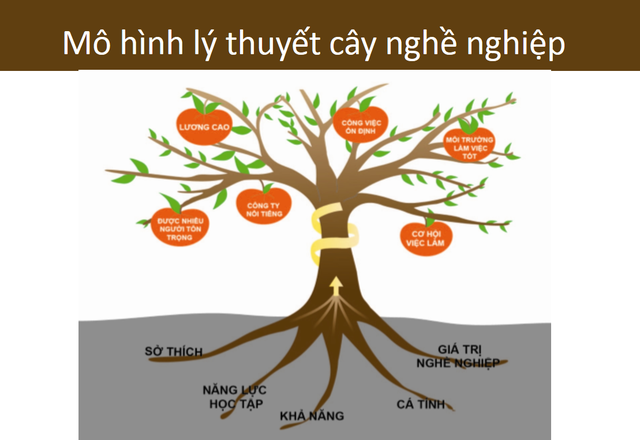
Therefore, Ms. Viet Bang proposed the career tree model, also known as a method to help students choose a job that matches their abilities after graduation. The model consists of five branches of the tree: jobs that match interests; academic ability; personal capabilities; personality; and the value the career brings to oneself and society.
Students need to develop these five key areas of competence as early as possible, ideally from their high school years through university. Understanding their own capabilities will help them find suitable jobs and achieve success more easily, rather than vaguely searching for jobs that don't match their skills, Ms. Bang advised.
Click to enlarge the image



Ms. Bang believes that when young people determine their career path, they should not place too much emphasis on job opportunities, salary, or work environment in their chosen field of study. These are unrealistic expectations that will not contribute to a better future, but will only lead to fatigue and disorientation later on.
Make your own decisions about employment.
Sharing more about the secrets to helping students seize job opportunities after graduation, Ms. Viet Bang said that previously, the formula for finding a job was usually qualifications + family connections + desired company; but now the formula has changed: soft skills + professional networking + societal recruitment needs.
Therefore, students shouldn't focus too much on qualifications; the most important thing is effort and determination to get the best job. At the moment you make a decision, there are no wrong decisions; always believe in your own choice and do your best to achieve the desired results. It may seem wrong or unsuitable today, but you will certainly need it and have the opportunity to use it in the future," Ms. Viet Bang said.

Click to enlarge the image
Mr. Le Dinh Hieu, Director of Admissions at Vinuni University, Vingroup, stated that we are living in a country with 96 million people, and after graduation, students will enter an extremely competitive and challenging job market. Our country is opening its doors to welcome human resources from Southeast Asia, so students will have to work much harder if they don't want to face unemployment in their own country.
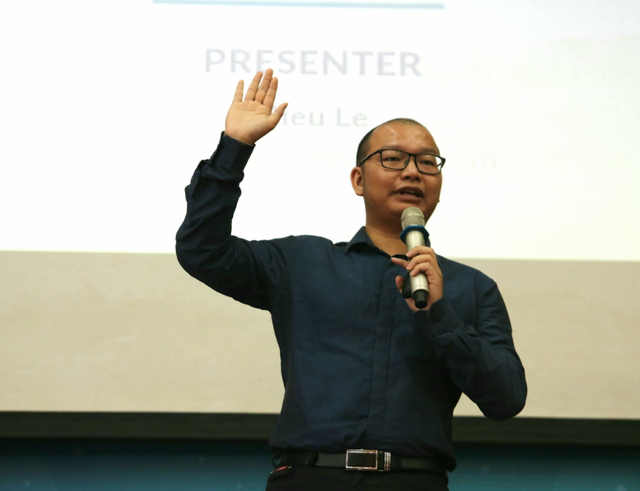
Click to enlarge the image
Mr. Le Dinh Hieu, Director of Admissions at Vinuni University, Vingroup Group, shared his job application tips with students.
Mr. Hieu gave an example: 100 years ago, students who memorized as much textbook knowledge as possible had a higher chance of passing the high school graduation exam and becoming officials for the king; then, 50 years ago, those who gained the most experience from the market and knew how to seize opportunities would succeed. But now things are different; success is not guaranteed simply by studying a lot and mastering all knowledge and skills.
Students, don't mistakenly think that simply memorizing everything your teachers teach makes you smart. We must learn what is worth learning and what is necessary. To do that, you need to clearly define your goals for studying, how you want to learn, and what methods you should use. Learning will then become much easier.



Based on his own experience, Mr. Hieu believes that students don't need to know everything; they should only choose one or two areas where they feel most confident and excel. He acknowledges that making this decision will be difficult, but without taking risks, success is impossible.
At the same time, young people should always ask themselves whether what they do creates value for society and is humane, bringing them happiness with their aspirations, their work, and themselves. If you confidently answer "yes," then pursue it to the end, even if it's a job unrelated to your field of study, as the success rate is still very high.
Mr. Hieu advised students that, regardless of their job or career choice, they should always ask themselves, "Are you happy with what you are doing?" This will help them have a clear purpose in life and avoid losing direction.
Ha Cuong
Source: http://laocai.edu.vn/chuyen-de-gddt/8984593bbd4da29ac5ab9929a8621555-461546