The father's successor
Mr. Nguyen Dac Thanh, Director of Thanh Hung Agricultural Production Cooperative, is a mechanic – a profession that involved wandering from place to place until he got married and returned to his hometown to farm, hoping for stability and closeness to his family. More than 10 years ago, at the same time that the project to plant red-fleshed dragon fruit in Lap Thach district (formerly Vinh Phuc province) was approved, the State supported households with a portion of seedlings, materials, and fertilizers.

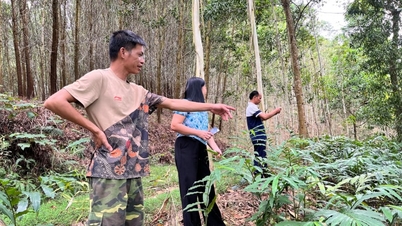
A corner of the hillside planted with dragon fruit by Thanh Hung Agricultural Production Cooperative. Photo: Duong Dinh Tuong.
Mr. Thanh eagerly rented 2 hectares of forest land from local residents for 10 years, at an annual cost of 15 million VND, to plant red-fleshed dragon fruit. Before the project, in 2005, his father, Mr. Nguyen Dinh Long, had bought red-fleshed dragon fruit seedlings to plant experimentally on 4,000 square meters in his garden. Unexpectedly, the rocky, hilly soil there was very suitable for this type of cactus. Two years later, when the dragon fruit plants began to bear fruit, Mr. Long discovered that the varieties were mixed; some plants produced fewer flowers, some produced more, some produced more fruit, and the yields varied significantly despite the same quality.
He marked the good plants for further propagation, while removing the bad ones. Dragon fruit quickly became a poverty-alleviating crop for the impoverished Lap Thach district. When the project's target of 100 hectares of dragon fruit was reached, the people independently developed an additional 200 hectares. Thanks to his reputation, Mr. Long was trusted by the people and elected as the Chairman of the Red-Fleshed Dragon Fruit Association of the district.
Applying his father's experience to production, Mr. Thanh also propagated red-fleshed dragon fruit seedlings himself, but when the area expanded significantly, he still had to buy seedlings from outside. After 2 years, the 0.5 hectares of dragon fruit planted with those unregulated seedlings had very poor flowering and fruiting, so he had to destroy them, accepting a loss of 300 million VND.
Initially, red-fleshed dragon fruit in Lap Thach sold for 60,000-70,000 VND/kg, equivalent to the price of 10kg of rice, yet many farmers still suffered losses. Meanwhile, red-fleshed dragon fruit in Binh Thuan province sold for 7,000 VND/kg, and farmers still made a profit. With this question in mind, Mr. Thanh took a bus to Binh Thuan to learn, but after only two days he had to return home because there was no transportation between the vast dragon fruit orchards there. The next time, he put his motorbike in the trunk of a bus and returned to Binh Thuan to continue learning. After dozens of such trips, he finally mastered the basic techniques for successfully growing dragon fruit.

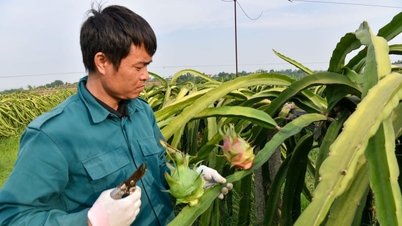
Mr. Nguyen Dac Thanh, Director of Thanh Hung Agricultural Production Cooperative, inspects his dragon fruit orchard. Photo: Duong Dinh Tuong.
Shifting production towards VietGAP standards.
In 2020, when his land lease from the villagers expired, Mr. Thanh bid for 10 hectares of 5% land from the commune for a period of 5 years. These were hills previously planted with eucalyptus trees, uneven in height, so he had to hire machinery to level and improve the ground. This time, he planted dragon fruit on trellises with an automatic irrigation system, instead of simply using concrete pillars and manual watering as before. In addition, he invested in a 1,000m2 warehouse to store materials and process products, and housing for workers.
The biggest changes in dragon fruit production aren't on the surface, but hidden deep underground. "Dragon fruit has no leaves, so it's less susceptible to pests and diseases, but we must pay special attention to fungal diseases. There are many types of harmful fungi with development cycles of 15-30 days depending on the variety and weather, so we need to understand their characteristics to prevent them. Fungal diseases are not only in the soil but also in the air, and they develop very quickly under hot, sunny conditions or heavy rain," Mr. Thanh shared.
When he was renting 2 hectares of land from the locals, he produced crops using conventional methods, applying 30% manure and 70% chemical fertilizers, and using only chemical pesticides. On average, he would spray 2-3 times a month to treat anthracnose, brown spot, crab-eye spot, gecko fungus, betel nut fungus, fruit flies, black caterpillars, stink bugs, branch beetles, etc. Dozens of people would carry sprayers, and it would take several days to finish.
Now, on over 10 hectares of land (5% of the commune's land) that he leased, he's shifted towards VietGAP standards. He mainly uses soluble fertilizers, which he buys and mixes himself before adding them to the automatic irrigation system. However, he still prioritizes applying manure once a year to create a foundation for microorganisms to thrive. Chemical pesticides are still needed, but only once every two months. Otherwise, he uses biological preparations like Trichoderma and Bacillus mixed with liquid fertilizer and added to the automatic irrigation system once a month to control harmful fungi. He manages weeds by cutting them with a machine instead of using herbicides.

Mr. Nguyen Dac Thanh, Director of Thanh Hung Agricultural Production Cooperative, prunes his dragon fruit garden. Photo: Duong Dinh Tuong.
In addition to closely coordinating with the Phu Tho Provincial Department of Crop Production and Plant Protection on technical matters, the Thanh Hung Agricultural Production Cooperative also hired an expert from the South to live on-site and supervise production. A weather monitoring and forecasting station with a 5km coverage radius was also installed by the province in the dragon fruit growing area to support the cooperative. By simply opening an app on his phone, Mr. Thanh can get information about the weather for 5-7 days in advance, as well as which areas will experience drought, allowing him to activate the automatic irrigation system to add water and nutrients to the plants and prevent fungal diseases.
As a result, the dragon fruit plants grow more evenly and are less susceptible to disease. He also invested in a specialized LED lighting system to stimulate off-season flowering and fruiting, thus avoiding the recurring problem of "bumper harvest, falling prices" and not having to compete on price with in-season produce.



The cooperative's dragon fruit trees have now been granted domestic and export planting area codes. The cooperative's dragon fruit has been exported for a year, and recently several companies have proposed cooperation to continue exporting, requiring a minimum production of 2 containers/month (equivalent to 50 tons), which the cooperative cannot meet.
Although there are approximately 300 hectares of red-fleshed dragon fruit, the farmers in Lap Thach commune do not follow the same technical procedures and lack coordination, so currently 100% of their produce is sold domestically.
Although not as productive as in the South, red-fleshed dragon fruit grown in the North boasts superior quality and delicious flavor. Dragon fruit plants flower twice a month; workers must remove one crop and leave the other. The dragon fruit offered to me that day was the first crop of the year, yielding only about 3 tons, but selling for 28,000 VND/kg. Of the cooperative's 10 hectares, 4 hectares are currently producing 100-120 tons annually, generating approximately 2 billion VND in revenue. After deducting expenses, the profit is 700-800 million VND. When the remaining 6 hectares are ready for harvest, the cooperative's revenue and profit will be significantly higher.
Source: https://nongnghiepmoitruong.vn/so-hoa-xanh-hoa-tren-doi-thanh-long-d815257.html